Shutter Windows Manufacturer China Factory Price Adjustable Blade Security Aluminum
1. System Overview — Three Functions in One Opening
The Shutter Windows Manufacturer China Factory Price Adjustable Blade Security Aluminum benchmark — Richocean’s shutter windows use adjustable horizontal aluminium blades set directly into the window frame, combining ventilation, visual privacy, sun shading and a physical barrier in one assembly. As a Foshan factory, Richocean extrudes and finishes shutter systems in 6063-T6 alloy with SS316 pivot hardware at factory-direct pricing, instead of relying on imported blade profiles.
The reason shutters remain a specification choice rather than a nostalgia item is that they solve four problems a fixed glazed window cannot: they ventilate with rain deflection, they block sightlines from outside during the day, they cut solar gain before it reaches the glass, and they present a physical barrier that a burglar must defeat before touching the glazing.
2. Core Material Science — 6063-T6 Extruded Blades
Each blade is a small cantilever loaded along its length, so stiffness per unit weight governs the profile design. Richocean specifies 6063-T6 aluminum aged to 170 MPa yield, with frame wall thickness of 1.8–2.5 mm, extruded hollow blade profiles that resist bending, and CNC-machined pivot brackets held to 0.1 mm accuracy. Blades are cut and punched on automated lines so pivot holes stay coaxial across the whole stack.
Coating matters as much as the alloy: shutters sit directly in weather, so a 60–80 μm powder coat over correct pre-treatment is the difference between a facade that still looks new after years of salt and rain and one that chalks.
3. Blade Geometry, Glazing & Shading
Blade geometry is where airflow, privacy and daylight are balanced, and it is calculated rather than guessed:
- Blade width: typically 90–150 mm; wider blades give more shading but add wind area
- Blade pitch: spacing determines the free area and the sightline angle when tilted
- Tilt range: blades commonly adjust from fully open to fully closed
- Glazed options: blades can carry glass where daylight with privacy is wanted
- Shading: exterior blades cut solar heat gain before it reaches the glazing, reducing cooling load
- Sightline control: closed or near-closed blades block inward views during daylight hours
Where security is the primary driver, blade pitch is tightened so a closed stack cannot be levered apart by hand, and blade ends are captured by a full-perimeter frame rather than being free-floating.
4. Hardware & Security Engineering — RC2 / RC3 Options
A shutter is a security product the moment it is closed, so hardware is specified to a recognised burglar-resistance standard:
- Pivots: SS316 shafts in nylon or bronze bearings for corrosion-free, low-friction cycling
- Linkage: concealed rod or gear linkage synchronising the full blade stack
- Locking: multi-point locking with tamper-resistant fixings, built to EN 1627 RC2 or RC3 where required
- Frame fixing: security-rated packers and anchors so the assembly resists forced removal
- Anti-lift detailing: blade ends engaged in the frame rebate to resist levering
- Reinforcement: steel inserts in the perimeter frame where fixing zones take attack loads
Note that security performance is a system property, not a hardware property: an RC3 hinge on a frame fixed with domestic screws is not an RC3 window. The anchorage into the wall is part of the specification and is reviewed on the shop drawing.
5. Weather, Privacy & Performance Engineering
Shutters are often selected in climates where weather itself is the design constraint:
- Rain deflection: outward-profiled blades shed water and break driving rain
- Drainage: sill channel and jamb chambers collect and discharge any tracked water
- Wind loading: engineered to project-specific design pressure, with heavier blade sections where pressure is high
- Cyclone-rated options: denser blade pitch, reinforced pivots and heavier frames for high-wind regions
- Corrosion: C5-M-grade coating and SS316 hardware specified for coastal projects
- Acoustics: a closed blade stack forms a secondary barrier that reduces noise reaching the glazing
- Thermal: shading reduces solar heat gain, cutting cooling demand in hot climates
Water and air performance is verified to ASTM E547 and E283, with structural performance engineered to ASTM E330 for the project design pressure.
6. Operation Options — Manual, Crank or Motorized
The same assembly can be driven three ways, and the choice is usually about height and accessibility:
- Manual lever: direct blade adjustment for reachable openings
- Crank handle: geared operation for taller or hard-to-reach shutter banks
- Motorized: 24 V DC actuator driving the linkage, with KNX, ZigBee or RS485 integration and BMS control
- Sensor logic: wind and rain sensors close the shutters automatically, protecting the assembly
- Zoning: grouped control so a facade responds as one zone rather than window by window
Motorized shutters on high or exposed elevations are normally paired with a wind lock, because a shutter left open in a storm presents far more sail area than a glazed sash.
7. Performance Specification Table
| Parameter | Standard / Basis | Typical Value |
|---|---|---|
| Alloy | 6063-T6 | 170 MPa yield |
| Frame wall thickness | Manufacturer spec | 1.8–2.5 mm |
| Blade width | Manufacturer spec | 90–150 mm |
| Burglar resistance | EN 1627 | RC2 / RC3 option |
| Structural | ASTM E330 | engineered to design pressure |
| Water Resistance | ASTM E547 | tested per project spec |
| Air Leakage | ASTM E283 | tested per project spec |
| Corrosion class | ISO 12944 class | C5-M option for coastal |
8. System Comparison — Shutter vs Standard Glazed Window
| Criterion | Standard Window | Shutter Window |
|---|---|---|
| Ventilation with rain deflection | limited when open | continuous via blade pitch |
| Daytime privacy | needs film or blinds | inherent from blade angle |
| Solar shading | depends on coating only | exterior shading before glazing |
| Physical barrier | glass and lock only | blade stack plus RC-class lock |
| Daylight admission | maximum | adjustable by blade angle |
9. Technical FAQ
Q: Can shutter windows be used as the only window, or are they a secondary layer?
A: They can be the primary opening where the design brief accepts blade-based ventilation and controlled daylight, which is common in tropical and coastal architecture. Where maximum daylight or a sealed thermal envelope is required, shutters are specified as an external layer over a glazed window so each element does its own job.
Q: How is burglary resistance rated?
A: The assembly is specified to EN 1627, commonly RC2 or RC3. Because the rating depends on the lock, the frame, the fixings and the wall anchorage together, the anchorage detail is reviewed on the shop drawing rather than assumed from a hardware catalogue.
Q: Are shutters suitable for cyclone or hurricane regions?
A: Yes, with the right specification — a denser blade pitch, heavier blade sections, reinforced pivots, and a heavier perimeter frame. Because an open shutter presents significant sail area, motorized installations in these regions normally include a wind sensor that closes the stack automatically.
Q: Do shutters reduce noise?
A: A closed blade stack adds a secondary barrier in front of the glazing, which reduces the noise that reaches the window itself. The overall result still depends on the glazing build, the perimeter seal and the flanking path, so acoustic targets are set on the whole opening rather than on the shutter alone.
10. China Market Position — Why Richocean
Richocean manufactures shutter window systems in Foshan with automated extrusion, CNC blade fabrication, and hardware assembly lines, and exports to Europe, North America, the Middle East, and Southeast Asia. Factory-direct supply reduces cost versus Western distributors, with EN/ASTM documentation and security-class evidence supplied per project.
11. Illustrative Project Applications
Example A — Coastal Resort Villa (Illustrative)
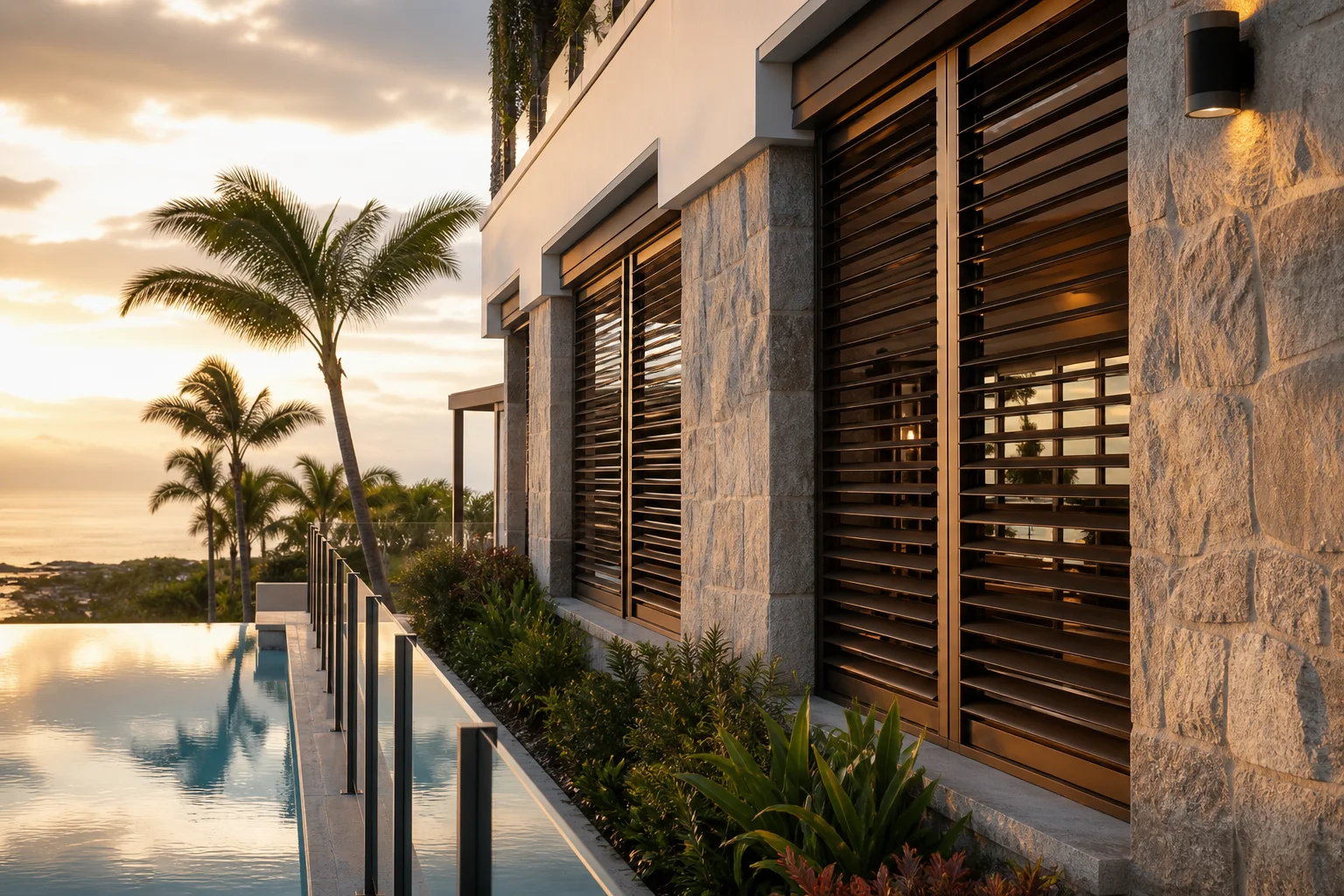
Adjustable blade shutters specified on sea-facing elevations with C5-M coating and SS316 pivots for salt exposure, blades set to ventilate while blocking inward views from the pool deck. Illustrative configuration; not a quoted project.
Example B — Ground-Floor Security Retrofit (Illustrative)
Motorized RC2-rated shutter banks installed over existing ground-floor glazing where ventilation and security were both required, with grouped control and wind-sensor protection. Illustrative configuration; not a quoted project.
12. Price Factors — What Drives Cost
Shutter windows are quoted per opening because security class and operation type dominate the cost. Cost drivers include:
- Blade width and count: wider or more numerous blades raise extrusion and assembly cost
- Security class: RC2 vs RC3 locks, reinforcement and anchorage detailing
- Operation: manual lever vs crank vs motorized actuation with controls
- Corrosion specification: standard coating vs C5-M-grade systems for coastal sites
- Blade infill: plain aluminium vs glazed blades for daylight
- Wind-load requirement: cyclone-tier specifications need heavier sections and pivots
- Automation extras: wind and rain sensors, zoning, BMS interface
13. Installation, Commissioning & Maintenance
Because shutters take direct weather and, in security applications, direct attack, installation quality decides whether the specification is met on site:
- Anchorage: security-rated fixings into sound substrate, with the anchorage detail matching the declared resistance class
- Reveal preparation: frame set plumb and square so blades align and the linkage does not bind
- Blade alignment: pivot holes set coaxial across the stack, verified before final fixing
- Motorized commissioning: limits, force settings and sensor thresholds programmed, with grouped zones tested
- Maintenance: periodic cleaning of drainage channels, pivot lubrication, and inspection of gaskets and security fixings
Handover documentation should record the applied security class, the anchorage method, the control logic for each zone, and the manual release procedure for motorized units.
14. 360° Service & Founder Philosophy
Richocean’s 360 service covers CAD shop drawings, wind-load and security-class review, anchorage detailing, actuator and control coordination, installation video guidance, and warranty terms on profiles, hardware and finishes. The founder’s philosophy — Passion Plus Extreme Requirements Equals Peace of Mind — means every blade, pivot and fixing must satisfy the strictest global standards.
15. Conclusion
The Shutter Windows Manufacturer China Factory Price Adjustable Blade Security Aluminum advantage is total — 6063-T6 extruded blades, SS316 pivots, RC2 / RC3 multilayer security options, C5-M coastal finishes, cyclone-tier configurations and 24 V DC motorization with BMS control, all delivered directly from Richocean’s Foshan factory. Send your elevation drawings and security requirements for a project-specific quotation.