Wholesale Tilt & Turn Windows from Foshan
1. System Overview — One Sash, One Load Path at a Time, and a Budget That Gets Spent
A tilt and turn window carries the heaviest moving mass of any common window format, and it supports that mass through exactly one mechanism at a time. That single sentence contains the whole engineering of the product. In turn mode the sash is a door leaf hung on a side hinge set, swung fully out of the frame, with the multi-point lock completely retracted — so nothing else in the assembly is touching it, and the hinges carry the entire weight as a cantilever whose moment arm is the full sash width. In tilt mode the sash pivots on a bottom corner and is held open by a scissor stay at the head, so the weight is carried by the bottom pivot and the stay only limits the angle. And between those two states there is an interval, occupied by the handle’s rotation, in which neither mechanism is fully engaged — an interval that is short in time and is nevertheless where most of the damage this format ever sustains actually occurs, because a sash that is heavy and unsupported for a fraction of a second is a sash that can fall, and a sash that falls damages the hinge corner, the glass edge, the frame and the person nearest it. Every other window format has a second thing holding the open sash: an awning has two arms and the frame still reacts against the sash; a casement has a friction stay; a sliding window has a track that never lets go; a hung window has two balances on either side. A tilt and turn sash in turn mode has none of that. It has a hinge set, and the hinge set is the whole load path.
And the hinge set is adjustable, which sounds like a virtue and is in fact the most consequential property in the product, because an adjustment range is a consumable. A three-axis adjustable hinge can be moved vertically to take out sag, horizontally to take out the tolerance between sash and frame and to set the gasket compression at the hinge side, and in compression to set the gasket squeeze all round the perimeter. Each of those movements has a finite travel, measured in a small number of millimetres, and every adjustment spends some of it. The travel is not there to correct an installation error — it is there to absorb the tolerance that remains after a correctly installed frame and, far more importantly, to absorb the progressive sag of a heavy sash over a service life of decades. When the travel is exhausted there is no further remedy inside the hardware: the sash cannot be brought back into alignment, so the lock cams stop entering their keepers squarely, the gasket stops compressing evenly, and the window stops delivering the classes it was rated for. Which leads to the single most common and most expensive mistake made with this format, and it is made in the first week of the building’s life rather than the twentieth: an installer who squares a sash by winding the hinges, rather than by shimming the frame in the opening, spends the entire service-life adjustment budget on a tolerance that should never have been given to the hinges in the first place. The window then works perfectly for a few years and becomes unadjustable before it is old.
The third leg of the argument is that the sag which consumes that budget is not merely an inconvenience — it silently destroys two rated classes at once. A sash sags at the handle corner, which is the corner furthest from the hinges and the corner that carries the lock’s most important cams. As it drops, the cams no longer align with their keepers and the engagement depth falls; the multi-point lock’s contribution to intrusion resistance is rated at full engagement, so a lock that is only partly engaged is not delivering its class. At the same time the sash drags the frame, which either forces the user to lift the handle harder or leaves a gap, and in both cases the gasket compression at the low corner falls — so air permeability and watertightness both degrade. One mechanism, two regulatory consequences, and neither is visible from inside the room until a draught appears or a test fails. That is why the hinge’s adjustment range is a budget rather than a feature, and why the specification has to state not only that the hinge is adjustable but how much travel it has in each axis, what the sash weight is, what the rated cycle life is at that weight, and how much of the travel is reserved for service rather than consumed at installation.
Richocean manufactures thermally broken aluminium tilt and turn windows in Foshan, Guangdong — 6063-T6 frames and sashes with PA66GF25 polyamide breaks, gear-driven espagnolette drive trains with a positive mode interlock, three-axis adjustable hinge sets rated for the actual sash weight and cycle count, multi-point locking with mushroom cams and full-length keeps, triple-barrier EPDM or silicone gaskets, laminated and insulating low-iron glass, and stainless hardware for marine exposure — for apartments, hotels, offices, hospitals, schools and high-rise residences across Europe, the Middle East, North America, Southeast Asia and coastal markets, each package documented with the sash weight and its hinge rating, the adjustment travel in all three axes and the amount reserved for service, the mode interlock’s positive-engagement verification, the lock engagement depth and its RC basis, the gasket compression range and the resulting operating force class, the swing envelope and the room-side clearance it requires, the net clear opening against the applicable escape requirement, and the thermal, acoustic and weathertightness classes behind the stated numbers.
2. Turn Mode — The Only Open Position in Any Window Format Where Nothing Else Holds the Sash
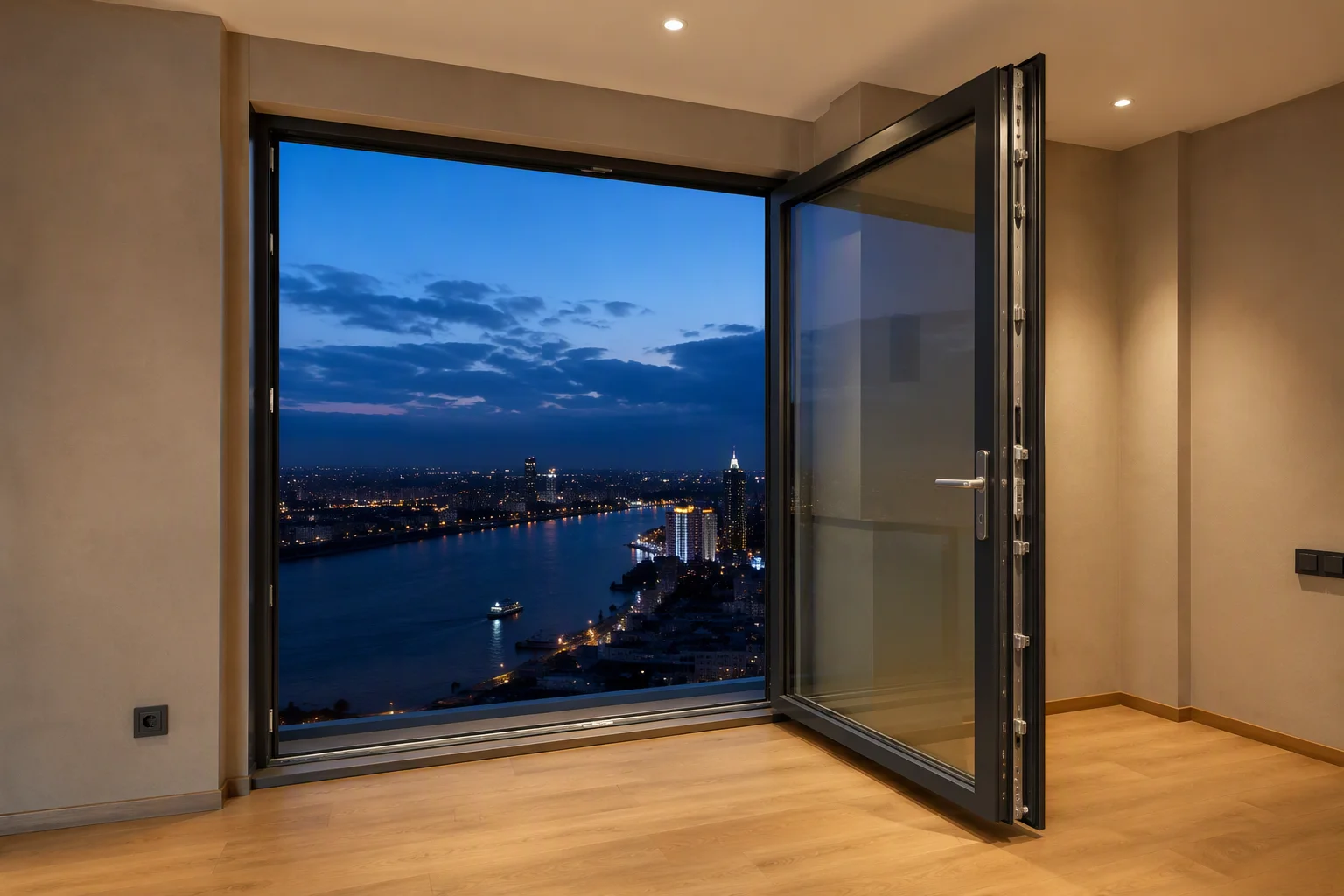
Consider what the open positions of the common formats actually are, in terms of support. A top-hung awning window, open, is a sash whose weight is reacted by two arms at the sides and whose top edge is still engaged in the frame’s head, so the frame itself contributes to the load path and the arms share the weight between them — the arms can fail one at a time without the sash falling, and the geometry is stable because the rotation axis is above the centre of mass. A side-hung casement, open, is a sash carried by its hinges and restrained by a friction stay, so there are two mechanisms and the stay is the one that decides the angle while the hinges carry the weight; the stay can be released and the sash is still hung. A sliding window, open, has its sash sitting in a track with rollers under it and a head restraint above it, so the load path never leaves the frame at all and the sash cannot fall out no matter what happens to any single component. A double-hung window, open, has two balances — one per side — carrying the sash weight along the direction of motion, so a balance failure is a falling mass but the sash remains inside the frame and the second balance still carries part of it. And a tilt and turn window in turn mode is a sash that has swung entirely out of the frame, hung on a hinge set at one vertical edge, with every lock point withdrawn, no stay, no arm, no track, no balance, and no contact with the frame anywhere except at the hinges themselves.
That is a different structural condition and it deserves to be stated plainly: in turn mode the entire weight of the sash, its glass and its hardware acts as a moment about the hinge axis, with a moment arm equal to the horizontal distance from that axis to the sash’s centre of mass, and that distance grows as the sash swings open, reaching its maximum when the sash is at right angles to the frame. So the load on the hinge set is not constant through the swing — it is smallest when the sash is closed and largest when it is fully open, which is exactly when a person is leaning on it, holding it, or letting it go. And the sash is the heaviest in this format because a tilt and turn sash has to be stiff enough to resist racking in two orthogonal planes — it is loaded as a cantilever in turn mode and as a bottom-pivoted plate in tilt mode — so it is built with more section, more corners, and more hardware than a sash that only does one of those things. Add a laminated insulating unit and the mass is substantial, and the hinge set is carrying it at full moment arm with nothing else in the load path.
Three consequences follow and each belongs in the specification. The first is that the hinge rating has to be against the actual sash weight as built, not against a nominal size, and the cycle count has to be against the actual duty — a hotel window opened several times a day for decades is a different duty from a bedroom window opened on weekends, and hardware durability classes exist precisely to state that duty rather than leave it assumed. The second is that the hinge has to be anchored into the sash’s structural aluminium and into the frame’s structural aluminium, never into the polyamide thermal break, because a polymer under a permanent moment creeps and eventually the anchorage walks out of position — the same rule that governs a hung window’s balance anchorage, an awning window’s head fixings, and a fixed light’s setting blocks, and for the same reason. The third is that the sash’s corner construction is a structural joint and not merely a mitre: the hinge-corner is where the moment is delivered into the sash, so the corner’s stiffness decides whether the sash stays square under the load, and a square sash is what keeps the lock cams aligned with their keeps and the gasket compressed evenly. A sash that racks under its own weight in turn mode is a sash whose lock engagement depth is falling, which is a security-class consequence rather than a cosmetic one.
The practical expression of all this is the sash weight limit, and it is worth being explicit that the limit is set by the hinge set’s rated duty rather than by the glass or the frame. A larger sash, a heavier glass build-up, a thicker laminated interlayer, a third pane — each raises the weight and each shortens the hinge’s life at the same cycle count, or requires a hinge set rated for the higher load, which is a bigger, more visible and more expensive component. So the decision to upgrade the glass on a tilt and turn window is not only a thermal or acoustic decision; it is a hardware decision with a durability consequence, and the glass build-up and the hinge rating have to be specified together. Where they are specified separately — a glass schedule from one supplier and a hardware schedule from another, which is how a great many projects are actually assembled — nobody owns the question of whether the hinge is rated for the glass, and the answer arrives as sagging sashes in year five with the adjustment range already spent.
3. The Frame Carries the Open Sash as a Moment Out of the Plane of the Wall
The load path does not stop at the hinge. The hinge delivers the sash weight and its moment into the frame’s hinge-side jamb, and the jamb is a vertical member fixed to the structure at intervals along its length, so the moment has to be resolved into a couple in those fixings — a pull-out force at the top fixing and an opposing force at the bottom, in the plane perpendicular to the wall. That is a load other window formats largely do not apply. A sliding window’s sash weight goes vertically down into the sill and thence into the head and jamb fixings as shear, which is the easy direction for a fixing. A hung window’s sash weight goes down through the jambs into the sill. An awning window’s arms deliver their load into the head and the jambs, again largely in-plane. A tilt and turn window in turn mode delivers a moment that tries to rotate the jamb about a horizontal axis and to pull the head and sill fixings out of the wall. And the magnitude rises with the sash width, since the moment arm is the distance from the hinge line to the sash’s centre of mass, and with how far the sash is swung, since that distance is greatest at ninety degrees.
So the frame’s fixing schedule on the hinge side is a structural calculation and not a standard spacing, and it has to be stated against the substrate rather than assumed. Masonry, concrete, lightweight block, timber stud, steel stud, and a curtain wall or a structural opening all behave differently under pull-out, and the substrate at the hinge side is often not the substrate the rest of the frame sees — a reveal may be built out, an insulation layer may sit between the frame and the structure, and a sub-frame or a cavity closer may be carrying the load instead of the wall. Each of those changes what the fixing is actually anchored into and therefore what it can resist. And the fixings have to be positioned so the couple they form is real: two fixings close together at the mid-height of the jamb cannot resist a moment, however strong each one is individually, because a moment requires a lever arm. So the correct schedule puts fixings near the head and near the sill on the hinge side, with the spacing between them providing the arm, and it verifies the pull-out capacity of each against the substrate rather than against a generic value.
The frame itself has to be stiff enough to deliver that couple without distorting, and this is where the format is unforgiving, because a jamb that bends under the open sash’s moment is a jamb that takes the frame out of square, and a frame that is out of square is a sash that cannot be adjusted into alignment — the hinge’s adjustment range is spent trying to correct a distortion that will keep returning. That is the mechanism by which an underspecified frame becomes an unadjustable window. It also means the corner joints of the frame matter in a way they do not in a fixed light: the frame is not merely a glazing rebate, it is a structure resisting a repeated out-of-plane moment at one of its verticals, and the joint at the head and the joint at the sill on the hinge side are where that moment is transferred. Reinforced corners, mechanical corner keys, and a joint detail that transfers moment rather than only shear are the difference between a frame that holds its geometry over decades of daily opening and one that gradually opens up at the hinge-side corners, letting the sash drop and the adjustment range run out.
Two further points close this load path. The reveal depth and the sash’s position within it decide the geometry of the swing: a deep reveal means the sash has to clear more material as it comes out of the frame, which changes both the required clearance inside the room and the angle at which the sash clears, and it changes the moment arm at the point of maximum load because the sash’s centre of mass is further from the hinge line when the sash is proud of the frame. And the sill and head have to be detailed so the moment they receive is transferred into the structure rather than into a finishing material: a sill that is a stone or a timber board sitting on a compressible layer will deform under the couple, and the deformation shows up as a sash that no longer closes squarely and an adjustment that has to be re-done every year until the travel is gone. Both are installation-stage decisions with design-stage consequences, which is why the fixing schedule and the substrate verification belong in the tender documents rather than in the site instructions.
4. The Transition Interval — Where a Sash Drop Comes From
Between turn mode and tilt mode there is an interval in which the sash’s support condition changes, and it is the only interval in the whole operation of the window where the load path is not defined. In turn mode the hinge set carries everything. In tilt mode the bottom pivot carries the weight and the scissor stay restrains the angle. In between — while the handle is being rotated from one position to the other — the drive train is moving the espagnolette rods, the mode-selection mechanism is switching which of the two hinge sets is engaged, the cams are travelling in or out of their keeps, and the sash is momentarily supported by whatever combination of those things happens to be engaged at that instant. If the sequence is correct and the mechanism is positively interlocked, the interval is a fraction of a second and nothing happens. If it is not, the sash drops.
The specific failure is well known to anyone who has serviced this format and it has a characteristic appearance. The handle is turned from the turn position toward the tilt position while the sash is standing open in turn mode, so the sash is out of the frame on its side hinges; the mode mechanism releases the side hinges and brings the scissor stay into engagement at the head; but the sash’s weight is now asking to be carried by the bottom pivot and the stay, and for part of that transfer neither is fully carrying it, because the sash is still geometrically in the turn position — swung out to the side rather than tipped in at the top. So the sash falls inward and downward, hanging at one corner on whichever mechanism engaged first. The consequences are predictable and cumulative: the hinge corner is loaded in a direction it was not designed for and is bent or torn; the sash’s corner joint is racked, which permanently takes the sash out of square; the glass edge at the low corner takes an impact against the frame or the sill, and a chip at a glass edge is a stress concentration with a known geometry in the location where bending tension is highest; the espagnolette rods are bent, since they are slender members being asked to carry a load they only transmit; and the gearbox in the drive train is shock-loaded, which is the classic way a gearbox loses teeth. And a person standing in the swing envelope can be struck by a heavy sash corner falling through an arc, which is why the operating sequence is a safety matter and not only a durability one.
The design answer is that the mode selection has to be positively interlocked, which means the mechanism physically prevents one mode’s engagement from beginning until the other’s has completed, and prevents the sash from being supported by an incomplete combination. Positive interlock is not the same as a spring-loaded detent or a friction-based selector, both of which can be overcome by a user turning the handle with more force than the selector expects — and users do turn handles with more force, particularly when a window is stiff, because stiffness reads as an obstruction to be overcome rather than a mechanism to be operated gently. So the interlock has to be a geometric one, where the parts cannot occupy the intermediate position at all, and it has to remain positive after wear, after dirt ingress, after the lubricant has dried, and after decades of cycling. The hardware’s durability class and the cycle rating behind it are what state that the interlock still works at the end of the rated life rather than only when new, and a specification that states a cycle count without stating that the mode selection remains positively interlocked at the end of it has specified the wrong thing.
Three specification items follow. The first is the handle’s operating sequence itself, which has to be unambiguous and has to have a positive feel at each position, because the sequence is the interface through which the user controls a machine that can drop a heavy sash — a handle that can be left between positions, or that gives no feedback about which mode is engaged, is a handle that invites the failure. The second is the sash’s behaviour if the wrong sequence is attempted anyway: a well-designed mechanism either refuses to move or moves to a safe intermediate state where the sash is still fully supported by the original hinge set, rather than transferring the load into an incomplete combination. The third is the instruction and the signage, which sounds trivial and is not: a tilt and turn window is operated by a handle whose positions mean different things, in a sequence, and a building full of people who have never been told what those positions mean will produce users who turn the handle while the sash is open. Where the building is a hotel, a hospital, a student residence or a block of rented apartments, the population of users turns over completely every few years and none of them has read a manual, so the operating sequence has to be either self-evident from the handle or documented at the window. That is a design-stage decision about the hardware, and it is one of the few places where a product’s durability depends on the legibility of its interface.
5. Sag — One Mechanism That Silently Destroys Two Rated Classes
A heavy sash on a side hinge set does not stay where it was put. It sags, and the sag is progressive, and it appears at the corner furthest from the hinges — the handle corner — because that is the point with the longest lever arm from the hinge axis and the point where nothing else supports the sash. The causes are cumulative rather than singular: the hinge’s own bearing surfaces wear and the sash settles into a slightly lower position within the hinge’s clearance; the sash’s corner joints loosen very slightly under repeated out-of-plane loading, which takes a small amount of square out of the sash and drops the far corner; the fixings at the hinge side creep or loosen in a substrate that is compressible, which rotates the whole jamb and drops the sash with it; the gasket takes a compression set, which changes the reaction the sash sees when closed and therefore the position it settles into; and the frame itself may deflect slowly if it is underspecified for the moment described in section 3. Each of these is small. Their sum over years is not small, and it is the reason a tilt and turn window that was perfect at handover needs adjustment at intervals.
What makes sag the defining durability issue of this format is that it does not announce itself as a structural problem; it announces itself as a loss of two rated classes, and both losses are invisible from inside the room. The first is security. A multi-point lock resists intrusion by the engagement depth of its cams in their keeps, and the class it is rated for — on the EN 1627 basis, or under PAS 24 — assumes full engagement at every locking point. A sash that has dropped shifts every cam relative to its keeper by the same amount, and because the cams are mushroom-shaped and the keeps are machined pockets, a small vertical shift reduces the depth of engagement at all of them simultaneously. So a lock that is still fully functional to operate — the handle still turns, the cams still move — is delivering less intrusion resistance than it was rated for, and nothing about its appearance or its operation tells the user so. That is a class failure with no symptom, which is the worst kind, because the building’s security specification says one thing and the building’s windows do another, and the only way to find out is to measure the engagement depth.
The second is weathertightness and air permeability, and it degrades through the same geometry. The gasket’s sealing performance is a function of its compression, and compression is set by the distance between the sash and the frame, which is what the lock’s throw and the hinge’s compression adjustment establish. A dropped sash drags at the low corner, so the gasket there is either over-compressed — which accelerates its compression set and shortens its life — or, more commonly, the sash lifts at the hinge side as it drops at the handle side, opening a gap along the top edge and the hinge-side edge where the compression falls below what the gasket needs to seal. Air permeability rises first, because air finds a small gap readily; watertightness follows, because the same gap under a wind-driven rain event is a water path, and on the windward face of a high-rise the pressure driving that water is substantial. Then the draught becomes noticeable to occupants, the condensation at the cold edge worsens because the interior surface temperature there falls with the increased infiltration, and the acoustic rating collapses, since sound travels through a gap far more readily than through the glass it was specified to defeat. A window that was rated at one acoustic class and has a one-millimetre gap at its top corner is not delivering anything close to that class, and again nothing about its appearance says so.
So sag has to be treated as a scheduled maintenance item with a measurement, not as a defect that will be noticed. The measurement is straightforward and belongs in the maintenance regime: the sash’s position relative to the frame is checked at all four corners with the sash closed, the diagonal dimensions of the sash are compared to detect racking, the lock’s engagement depth is checked at each locking point, and the gasket compression is checked — by the impression the gasket leaves, or by measuring the gap the lock’s throw has to close. Those four measurements, taken at handover and recorded, become the baseline against which every later check is judged, and the rate of change is the useful datum: a sash that settles once in its first year and then stops is behaving normally, while one that continues to drop at a steady rate is telling you that something in the load path is creeping — usually the hinge-side fixings in a compressible substrate, or the frame’s corner joints. And the adjustment that corrects it has to be recorded too, because the cumulative adjustment applied over the life of a window is exactly the amount of the hinge’s travel that has been consumed, and it is the number that tells you how much service life remains in the hardware.
Two design responses close this out. The first is that the lock’s keeps should be full-length rather than isolated pockets wherever the specification allows, because a full-length keep maintains engagement over a range of sash positions rather than at one precise position, which buys tolerance against the sag that will occur anyway and extends the interval between adjustments. The second is that the gasket’s compression has to be specified as a range with the hardware’s throw able to reach both ends of it: a gasket that needs high compression to seal is a gasket whose compression will fall out of range quickly as it takes a permanent set, while one specified for the compression the hardware can actually maintain over life is a gasket that keeps sealing. Neither response eliminates sag — a heavy cantilevered mass will move — but both convert sag from a failure into a maintenance item, which is the most that can be asked of any hardware system. What cannot be asked of it is unlimited adjustment, and that is the subject of the next section.
6. Three-Axis Adjustability — and Why the Adjustment Range Is a Consumable
The hinge set on a tilt and turn window is adjustable in three axes, and each axis exists for a different reason. The vertical adjustment raises or lowers the sash relative to the frame, and it exists to take out sag — it is the one that gets used most often and the one whose travel is consumed fastest. The horizontal adjustment moves the sash toward or away from the hinge side, and it exists to take out the tolerance between sash and frame and to set the gasket compression on the hinge-side edge, which is the edge the lock cannot reach. The compression adjustment moves the sash in and out relative to the frame across the whole perimeter, and it exists to set the gasket squeeze that produces the air and water classes. Three axes, three jobs, and a finite travel in each — typically a small number of millimetres, which is a great deal when the sash is being installed and very little when the sash has been sagging for fifteen years.
The travel is finite for a structural reason rather than a manufacturing convenience. A hinge that could be adjusted without limit would have to carry the sash through an infinitely long lever or an infinitely loose joint, and either destroys the hinge’s stiffness — which is precisely the property that keeps the sash square and the cams aligned. So the adjustment mechanism is a short-travel device by design, and its travel has to be spent on the things it exists for: the residual tolerance after a correctly installed frame, and the progressive sag over the service life. The mistake, and it is the most common one made with this product, is to spend it on something else. An opening that is out of plumb, a frame installed without packing so it takes the shape of a distorted reveal, a sub-frame that is not square, a sill that is not level — each of these produces a sash that does not sit correctly in the frame, and each of them can be made to look correct at handover by winding the hinges. The window then passes its inspection, the snag list is closed, and the entire vertical adjustment travel has been consumed in the first week to correct an error that the hinges were never meant to absorb. Five years later, when the sash sags by the ordinary amount, there is no travel left to take it out, and the only remedies are new hinges, a new sash, or a window that no longer delivers its classes.
So the discipline is a division of labour that has to be stated in the installation specification rather than left to site practice: the frame is squared in the opening, by shims and packers, against verified datum points, with the opening’s plumb, level and diagonal measured and recorded before the frame goes in and any deviation corrected in the opening rather than in the hardware. The hinge adjustment is then used for its own two jobs — the residual sash-to-frame tolerance, and the gasket compression — and the amount used for each is recorded, so that the remaining travel is known at handover. That record is the single most useful document in a tilt and turn window’s maintenance file, because it converts the adjustment range from an invisible property into a tracked budget. A building whose windows have a known remaining travel can be maintained on a schedule; one whose windows were adjusted at some point by somebody for reasons nobody recorded cannot, and the first anyone knows is that a sash will not come back into alignment.
Three further points make the budget real. The adjustment has to remain operable over life, which means the adjusting mechanism has to be reachable after the window is installed and furnished — a hinge whose vertical adjustment is behind a fixed cover, or accessible only from outside, or blocked by the reveal, cannot be adjusted without dismantling, which is why the adjustability has to be verified in the as-built condition and not only in the hardware catalogue. The adjustment has to hold, which means the adjusting mechanism has to lock against vibration, thermal cycling and the repeated shock of a heavy sash being closed — an adjustment that works out by itself is worse than no adjustment, because it produces a window that drifts out of alignment on an unpredictable schedule and cannot be relied on at any given inspection. And the adjustment has to be symmetrical between the two hinge sets, because the turn hinges and the tilt pivot are different mechanisms and adjusting one without checking the other produces a sash that is aligned in one mode and out of alignment in the other — which is a fault specific to this format and invisible to anyone who only ever uses one of the two modes. That last point is worth emphasising: a tilt and turn window has to be verified in both modes at commissioning, because a sash that is perfect in turn mode can be dragging the frame in tilt mode, and the user who only ever tilts it will never find out until the seal fails.
The comparison with the other formats is instructive and it is not favourable to them, which is why this one is a genuine advantage rather than a caveat. A sliding window’s adjustment is roller height, which is also finite but is a much cheaper component to replace, and a hung window’s sash position is set by its balances, which are replaced in pairs rather than adjusted — so those formats spend components where this one spends travel. A casement’s friction stay is adjustable and its hinges are often adjustable, but its sash is lighter and its load path in the open position includes the stay, so it sags less. A fixed light has no adjustment at all, which is precisely why every time-dependent mechanism in it has to be closed at design stage. A tilt and turn window has the most adjustment of any format and the heaviest sash to adjust for, so it has both the greatest capability and the greatest consumption. The specification’s job is to make sure the capability is not spent on the wrong thing, and the maintenance regime’s job is to track what remains.
7. Closing Force Grows Over Life, and the Gearbox Is Where It Breaks
A tilt and turn window is closed by a handle that turns a gearbox, which drives espagnolette rods up and down the sash, which move cams into their keeps. The force the user applies at the handle is therefore amplified through a gear ratio and transmitted through slender rods to a number of locking points, each of which has to compress a gasket against a frame. That is a machine, and like any machine its efficiency and its load capacity change with time — and for a window the change is in one direction only. The closing force required grows over the service life, for four reasons that act together. The gasket takes a compression set, so a greater displacement is needed to achieve the same sealing pressure, and the cam has to travel further into the keep to get it. The cams and keeps wear, so the ramp the cam rides up as it engages becomes shallower or rougher, changing the mechanical advantage at exactly the point where the load is highest. Dirt, dried lubricant and corrosion in the rod guides raise the friction the rods have to overcome, and on a tall sash the rod’s own weight and its friction in the guides is a substantial part of the total. And the sash position drifts, as described above, so the cams no longer enter their keeps on the alignment they were designed for and each engagement becomes slightly less efficient.
The consequence is that the gearbox sees a rising load, and the gearbox is the weakest element in the drive train — it is the only part with gear teeth, and gear teeth fail by bending fatigue and by wear at the mesh, both of which accelerate with load. So a window whose closing force has grown is a window whose gearbox is being loaded closer to its capacity on every operation, and gearbox failure is the classic end-state of an unmaintained tilt and turn window: the handle turns but nothing moves, or turns freely with a lost tooth, or jams. And the route to that failure usually runs through the user rather than the mechanism, because a stiff handle is read as an obstruction to be overcome. People force stiff handles. They use both hands, they lean on them, they use a tool, and each of those applies a torque far above the level the drive train was designed to transmit — the shock load that breaks gear teeth and bends espagnolette rods almost always comes from a person overcoming a stiffness that was a symptom rather than an obstacle. So the growing closing force is not only a durability problem, it is a user-behaviour problem with a hardware consequence.
Which is why the operating force is a rated property and not an outcome. Windows are classified for their operating forces on the EN 12217 basis, which exists precisely to state the force required to open, close and lock the sash, and to put it in classes so a specification can require one. Specifying an operating-force class does three things. It sets an upper limit on the closing force when new, which constrains the gasket compression the hardware has to achieve and therefore constrains the gasket’s specification — a gasket chosen for its sealing performance alone can easily require a closing force that no class admits. It sets the acceptance criterion at commissioning, so the force is measured rather than judged by feel, and a window that is stiff on day one is rejected rather than accepted with a note that it will free up. And it defines the maintenance trigger, because a window whose measured operating force has risen toward the top of its class is a window that needs attention before the gearbox is being overloaded on every use — the force measurement is the earliest available indicator of the whole cascade, earlier than draught, earlier than a visible gap, and far earlier than a broken gearbox.
Three design responses follow, and they interact. The gasket has to be specified jointly with the hardware’s throw and the operating-force class, since the three are one system: a gasket whose sealing pressure requires a compression the hardware can only reach at the top of its force class will not stay in class as it ages, and one specified with margin will. The gasket material matters here in a specific way — a compound with low compression set retains its sealing pressure at a lower compression and therefore keeps the closing force down over life, which is exactly the property a long-life window needs, and it is why silicone and high-grade EPDM compounds are specified on this format rather than the cheapest elastomer that seals when new. And the drive train has to be lubricated for life and sealed against ingress, because the friction growth in the rod guides is a large part of the force growth and it is the part that maintenance can actually reverse: cleaning and re-lubricating the rods, guides and cams restores a measurable amount of the original operating force, which is why it is the first item in any service regime for this format and the one with the best ratio of effort to benefit. The gearbox itself is not a service item — it is a replacement item, and its life is a function of the load it has been carrying, which is why the operating force is the number to watch.
8. The Swing Envelope Is a Volume of the Room, Not a Detail of the Window
An inward-opening sash occupies space inside the building, and in turn mode it occupies a great deal of it: a sash swung fully open describes an arc whose radius is the sash width, and the volume it sweeps is a quarter-cylinder of that radius for the full height of the sash, plus the sash’s own thickness standing into the room at the end of the swing. That volume has to exist, clear, every time the window is opened — and it is a volume that the room’s other contents want too. Curtains and drapes hang in it. Blinds and shutters sit in it. A radiator sits under it, and a radiator is exactly where a sill-level obstruction is most likely, which is why tilt and turn windows and radiators are a recurring conflict in retrofit projects. Furniture is placed in it, because a window’s swing envelope is invisible in a floor plan and entirely obvious only once somebody opens the window into a bedside table. A window reveal with a deep internal return reduces the angle the sash can reach before it hits the reveal, which changes both the clearance required and, importantly, whether the sash can be swung fully open at all — and a sash that cannot be fully opened is a sash whose net clear opening for escape is less than the frame aperture, which is a compliance consequence rather than a convenience one.
So the swing envelope is a coordination item between the window schedule and the interior design, and it has to be resolved on the drawings rather than on site. The items to coordinate are specific: the clear volume required for the full swing, measured from the hinge line; the reveal depth and internal return, which set the maximum achievable opening angle; the position and projection of any sill, radiator, pipe, socket, switch or finish that intrudes into that volume; the position of curtain tracks, blind boxes and shutter reveals, all of which sit precisely where the sash needs to go; the furniture layout, including furniture that will be brought in later, since a window’s swing envelope is a permanent constraint on a room whose contents are not; and the position of the handle at the end of the swing, since a handle projecting into the room at head or body height is a snag and an impact hazard in a space people walk through. Each of these is a dimension, and each belongs in the coordination drawings at design stage, where moving a curtain track costs nothing, rather than at handover, where the alternatives are a window that cannot be opened or an interior that has to be re-planned.
Two safety consequences follow and both are real. The first is the open sash itself: a fully swung sash presents a vertical edge and a hard corner projecting into the room, at a height that varies with the sash but which on a tall window includes head height for a standing adult and face height for a child. A person walking toward a window that is open, in a room they know well, does not expect a rigid aluminium corner standing in their path, and the impact is against a mass that is heavy enough not to move. So the swing envelope is not only a clearance requirement but a circulation hazard that has to be considered wherever people move past an open window — corridors, hotel rooms where the window is left open for comfort, hospital wards, classrooms where a window is opened for ventilation during a lesson. The mitigations are the usual ones and each is a design decision: restrictors that limit the opening angle, handles positioned so the open sash is visible, opening protocols in managed buildings, or a different format on elevations where the circulation requires it. The second is the sash in motion: a heavy sash swung by wind, or released by a user who did not expect its weight, moves through that same volume with substantial momentum, and the scissor stay in tilt mode is the only thing that limits it there. Which is why the tilt mode’s angle-limiting device is a safety component and not a convenience feature, and why its rating has to be against the actual sash weight and the actual wind exposure of the elevation rather than against a nominal duty.
And there is a maintenance consequence that is easily missed: the swing envelope has to be accessible for service. The hinge set, the gearbox, the espagnolette rods, the cams and the keeps, the scissor stay and the gasket all need to be reached for inspection, cleaning, lubrication and adjustment, and on an inward-opening sash much of that hardware is on the sash’s perimeter, which means the sash has to be swung to a position where the hardware is reachable — inside the swing envelope. So the volume that has to be clear for the sash to open also has to be clear for a person to work in while the sash is open, which is a larger requirement than the sash’s own clearance and one that is almost never drawn. A window whose hardware cannot be reached without moving furniture is a window whose hardware will not be maintained, and the failure sequence in section 7 will run to its conclusion uninterrupted. That is a design-stage coordination item with a twenty-year consequence, and it costs one line on a drawing to solve.
9. Turn Mode Delivers the Largest Net Clear Opening of Any Window Format
Everything above is a cost, and it is paid for something: turn mode opens the whole frame aperture. The sash swings entirely out of the opening, so what remains is the clear space between the frame’s jambs and head and sill, with no sash standing in it, no balance, no meeting rail, no roller track, no stay crossing the aperture and no second sash to obstruct it. That is the largest net clear opening any window format delivers per unit of frame area, and it is larger than a casement’s, because a casement’s sash — although it also opens inward or outward on side hinges — remains partly within the aperture at every angle short of a full swing, and its hinge side is obstructed by the hinge stack itself; and it is much larger than a hung window’s, whose sash occupies half the aperture even when fully raised, and whose net clear opening is calculated as the width multiplied by the height from the sill to the underside of the raised sash’s bottom rail rather than as the glazed area. So the format that carries the heaviest sash, the most complex hardware and the largest swing envelope is also the format that performs best on the one criterion that cannot be engineered around: whether a person can get out.
And that criterion is a regulation, not a preference. Habitable rooms in most markets require an escape opening of a stated minimum net clear area, a stated minimum width and height, and a stated maximum sill height above the floor, with the opening operable from inside without a key, a tool or specialist knowledge. The arithmetic has to be done on the net clear opening rather than on the frame size or the glass area, and the two are not the same: the frame’s jambs, head and sill all reduce it, the sash reduces it in every format except turn mode, and any restriction on the opening angle reduces it further. So a window that is nominally large enough can deliver a net clear opening that is not, and the deficit is found either at design stage on paper or at handover by a measuring tape — and there is no third place it can be found, because the escape performance of a window cannot be inferred from its schedule. Which means the frame size on an elevation with habitable rooms has to be set by working backwards from the required net clear opening, through the frame’s section depths and the achievable swing, to the aperture, exactly as it does on a hung window — with the difference that here the answer is usually favourable, because turn mode’s obstruction is essentially zero.
Three conditions qualify that, and each is a coordination item rather than a calculation. The first is the swing itself: an inward-opening sash in a small room can obstruct the very opening it serves, because the escape route passes through the volume the sash occupies, and a sash swung fully open standing across a window recess can reduce the usable width of the escape path even while the aperture behind it is completely clear. That is a genuine and frequently overlooked conflict, and it is resolved by the room’s geometry — where the window is in a deep recess with limited width, an inward-opening sash may need to be limited in angle for escape purposes even though its hardware allows a full swing. The second is the operating requirement: the window has to be openable from inside without a key or a tool, so a lockable handle, a restrictor that requires a key to release, or a child-safety device that cannot be operated by an adult in an emergency each defeats the escape function while satisfying the security or safety requirement that motivated it. Where both requirements apply — and in a residential building they usually do — the hardware has to deliver both, which means a restrictor that limits the tilt or the turn angle for safety and child protection while being releasable without a key for escape, or a lockable handle whose key is permanently and visibly available at the window. That is a hardware selection decision with a regulatory consequence, and it has to be made explicitly rather than left to whatever the catalogue offers. The third is the sill height: a window whose sill is above the maximum permitted height does not qualify as an escape opening regardless of its net clear area, so on an elevation where the sill is set by the facade’s design rather than by the room’s requirement, the escape opening has to be provided elsewhere — and that decision has to be visible on the schedule, because a facade full of large windows with high sills can leave a building with no compliant escape opening in a room that appears generously glazed.
The tilt mode contributes to this picture in a smaller way and it is worth stating what it does and does not do. A tilted sash provides a permanent, weather-protected ventilation opening at the head of the window, which is a genuine and valuable function — it allows secure background ventilation in rain and in the absence of the occupant, because the opening is at the top, the sash shields it, and the multi-point lock is still engaged at every point around the perimeter except where the scissor has released the head. That is the reason the format dominates in markets where secure night ventilation is a requirement, and it is why a tilt and turn window can be left open in an unoccupied building in a way no side-hung or top-hung window can. But a tilted sash does not provide an escape opening: the aperture is obstructed by the sash standing into the room at an angle, the clear opening is a narrow slot at the head, and nobody can pass through it. So tilt mode is a ventilation and security function, and turn mode is the escape function, and a specification that counts the tilt opening toward the escape requirement has made an error that will not be discovered until the measuring tape arrives.
10. Performance Envelope — What a Tilt and Turn Window Is Rated Against
| Property | Standard / Basis | Design Basis |
|---|---|---|
| Sash weight as built | Measured, not nominal | The hinge rating, the cycle duty, the operating force and the frame’s moment capacity are all set by the actual weight including glass, hardware and sash section — a glass upgrade is a hardware decision |
| Hinge set rating | EN 13126 basis, stated weight and cycle count | In turn mode the hinge set is the entire load path at maximum moment arm; the rating has to be against the actual duty, since a hotel window and a bedroom window are different duties |
| Turn-mode load path | Cantilever, arm to the centre of mass | The only open position in any common format with no stay, no arm, no track, no balance and no frame contact — the moment peaks with the sash at right angles, which is when people lean on it |
| Moment into the jamb | Out-of-plane couple in the fixings | A moment other formats do not apply; requires fixings near head and sill on the hinge side so the couple has a real lever arm, verified against the actual substrate |
| Hinge-side substrate | Pull-out capacity per fixing | Masonry, lightweight block, stud, sub-frame, cavity closer and insulation layer all behave differently; the substrate at the hinge side is often not the substrate the rest of the frame sees |
| Frame stiffness at the jamb | Deflection under repeated out-of-plane moment | A jamb that bends takes the frame out of square, and an out-of-square frame is a sash that cannot be adjusted into alignment — this is how an underspecified frame becomes an unadjustable window |
| Frame corner joints | Moment transfer, not shear only | Reinforced corners and mechanical keys; a joint that opens up at the hinge-side corners lets the sash drop and the adjustment travel run out |
| Hinge anchorage | Into structural aluminium, never into PA66 | A polymer under a permanent moment creeps and the anchorage walks out of position — the same rule as a hung window’s balance anchorage and a fixed light’s setting blocks |
| Mode interlock | Positive, geometric, retained after wear | A detent or friction selector is overcome by a user turning harder; the parts must not be able to occupy the intermediate position at all, and must still not be able to after dirt ingress, dried lubricant and decades of cycling |
| Wrong-sequence behaviour | Refuse, or return to full support | If the handle is turned from turn toward tilt with the sash open, the mechanism must not transfer the load into an incomplete combination — that is the interval where the sash drops |
| Sash-drop consequences | Hinge corner, corner joint, glass edge, rods, gearbox | A racked corner joint permanently takes the sash out of square; a chip at the glass edge is a stress concentration where bending tension is highest; a shock-loaded gearbox loses teeth |
| Handle sequence legibility | Positive feel at each position | The handle is the interface through which a user controls a machine that can drop a heavy sash; where the user population turns over every few years the sequence must be self-evident or documented at the window |
| Sag monitoring | Corner position, diagonals, engagement depth, compression | Four measurements recorded at handover as the baseline; the rate of change is the useful datum, since continued steady drop means something in the load path is creeping |
| Lock engagement depth | EN 1627 / PAS 24 basis at full engagement | A dropped sash reduces the engagement at every cam simultaneously while the lock still operates normally — a class failure with no symptom, findable only by measurement |
| Keep type | Full-length vs isolated pockets | A full-length keep maintains engagement over a range of sash positions, buying tolerance against the sag that will occur anyway and extending the interval between adjustments |
| Gasket compression loss | Air and water class basis | A dropped sash over-compresses at the low corner and under-compresses along the head and hinge side; air permeability rises first, then watertightness, then the acoustic rating collapses through the same gap |
| Adjustment travel, three axes | Stated mm per axis, and the amount reserved | Vertical takes out sag, horizontal takes out tolerance and sets hinge-side compression, compression sets the perimeter squeeze — each finite, and the cumulative adjustment applied over life is the travel consumed |
| Installation vs service budget | Frame squared in the opening by packing | Winding the hinges to correct an out-of-plumb opening spends the whole service-life travel in week one; the record of travel used at handover converts the range from an invisible property into a tracked budget |
| Adjustment accessibility | Reachable in the as-built condition | A hinge whose vertical adjustment is behind a fixed cover, reachable only from outside, or blocked by the reveal cannot be adjusted without dismantling |
| Adjustment retention | Locked against vibration, cycling and closing shock | An adjustment that works itself out is worse than none, since it produces unpredictable drift that no inspection can rely on |
| Both-mode verification | Turn and tilt checked separately | Turn hinges and the tilt pivot are different mechanisms; adjusting one without the other gives a sash aligned in one mode and dragging in the other, invisible to a user who only ever tilts |
| Operating force class | EN 12217 basis | Sets the upper limit on closing force when new, the acceptance criterion at commissioning, and the maintenance trigger — the earliest available indicator of the whole cascade |
| Force growth over life | Compression set, cam wear, guide friction, drift | All four act together and in one direction; the gearbox sees a rising load and its teeth fail by bending fatigue, which is the classic end-state of an unmaintained unit |
| Forcing risk | User torque above the drive train’s rating | A stiff handle reads as an obstruction to be overcome; the shock load that breaks gear teeth and bends rods almost always comes from a person overcoming a symptom |
| Gasket compression set | Low-set compound specified for life, not for new | A low-set compound holds sealing pressure at lower compression, so it keeps the closing force down over life — the reason silicone and high-grade EPDM are specified on this format |
| Drive-train serviceability | Rod, guide and cam cleaning and re-lubrication | The only part of the force growth that maintenance can reverse, and the item with the best ratio of effort to benefit; the gearbox itself is a replacement item, not a service one |
| Swing envelope | Clear volume for the full arc plus the sash thickness | A permanent constraint on a room whose contents are not; invisible in a floor plan and obvious only once the sash meets a bedside table |
| Reveal depth and internal return | Maximum achievable opening angle | A deep return can prevent a full swing, so the net clear opening for escape is less than the frame aperture — a compliance consequence, not a convenience one |
| Obstructions in the envelope | Curtain track, blind box, shutter reveal, radiator, sill projection | All sit precisely where the sash needs to go; resolved on coordination drawings where moving a track costs nothing rather than at handover |
| Open-sash hazard | Rigid corner projecting into circulation | At head height for an adult and face height for a child, in a room people know well, against a mass too heavy to move on impact — restrictors, handle position and opening protocols are design decisions |
| Sash in motion | Scissor stay rated against actual weight and exposure | A heavy sash swung by wind or released by a user who did not expect its weight carries substantial momentum; the angle-limiting device is a safety component, not a convenience feature |
| Service access volume | Larger than the sash’s own clearance | Hinge, gearbox, rods, cams, keeps, scissor and gasket all sit on the sash perimeter, so a person must work inside the envelope; a window whose hardware cannot be reached will not be maintained |
| Net clear opening | Width and height of the unobstructed aperture | Turn mode delivers the largest of any format per unit of frame area, since the sash leaves the aperture entirely; calculated on the net clear opening, never on the frame size or the glass area |
| Escape operability | From inside, without key or tool | A lockable handle, a keyed restrictor or a child-safety device defeats the escape function while satisfying the requirement that motivated it; both have to be delivered explicitly |
| Sill height | Maximum above finished floor | A sill above the limit disqualifies the opening regardless of its area, so a facade set by design rather than by the room’s requirement can leave a generously glazed room with no compliant escape |
| Sash obstructing its own escape | Room geometry, deep recesses | An inward-opening sash in a narrow recess can reduce the usable escape path while the aperture behind it is fully clear — may require an angle limit for escape even where the hardware allows a full swing |
| Tilt mode as ventilation | Secure background ventilation, lock engaged | Head opening, sash shields it, perimeter locked except where the scissor has released the head — the reason the format dominates where secure night ventilation is required; it is not an escape opening |
| Air permeability | EN 12207 basis | Three gasket lines and a multi-point lock compressing them uniformly; the class is a function of the compression the hardware can maintain over life, not only of the gasket when new |
| Watertightness | EN 12208 basis | Achievable at a high class because the closed sash is compressed into the frame at every lock point; in tilt mode the head opening is a designed water path and the drainage has to be verified in that mode |
| Wind resistance | EN 12210 / EN 12211 basis | The sash is tested closed and the deflection criterion governs; the open positions are not covered by the class, so an elevation left open in a storm is outside the rated condition entirely |
| Thermal transmittance | Uw on EN ISO 10077 basis | Component breakdown stated; the sash section and the three gasket lines are the penalty against a fixed light, and the lock’s compression is what keeps that penalty from growing over life |
| Acoustic rating | EN ISO 10140 / 717-1 basis | Governed by the glass build-up and by gasket compression at every point; a one-millimetre gap at one corner defeats the class that the glass was specified to achieve |
| Perimeter fRsi | ISO 10211 basis | Computed at the sash-to-frame junction and at the glass edge as their own lines, since infiltration from a sagged sash lowers the interior surface temperature there and condensation follows |
| Mechanical durability | EN 12400 basis, repeated open-close cycles | Stated against the cycle count the project’s duty implies, with the requirement that the mode selection remains positively interlocked and the operating force remains in class at the end of it |
| Safety glass | EN 12600 basis | Required by position and size; laminated where the sash opens over a circulation route or where retention after breakage matters, since an inward-opening sash brings its glass into the room |
| Corrosion class | ISO 9227 salt-spray basis | Stainless hardware for marine exposure with galvanic isolation between dissimilar metals; a corroded cam or rod guide raises the operating force, which is the load that breaks the gearbox |
| Commissioning record | Both modes, all four corners, travel used | Sash position, diagonals, engagement depth, compression, operating force and the adjustment travel consumed — the baseline every later check is judged against |
11. Five Window Formats Compared by What Holds the Sash When It Is Open
| Question | Tilt & Turn — Turn Mode | Tilt & Turn — Tilt Mode | Side-Hung Casement | Top-Hung Awning | Double-Hung |
|---|---|---|---|---|---|
| Does the sash leave the frame when open? | Entirely — swung clear of the aperture | Partly — the head comes in, the sill edge stays | Partly at every angle short of a full swing | Partly — the bottom swings out, the head stays engaged | Never — the sash travels inside the frame |
| Is the multi-point lock engaged when open? | No — fully retracted | Yes, at every point except where the scissor has released the head | No, unless an auxiliary restrictor is fitted | No | Not applicable — a sash lock, not a perimeter lock |
| How many mechanisms carry the sash weight? | One — the turn hinge set | One carrier plus one restraint — the bottom pivot carries, the scissor limits the angle | One carrier plus one restraint — hinges carry, friction stay sets the angle | Two carriers — the arms share the weight between them | Two carriers — a balance per side |
| Does the frame still react the load? | No — only at the hinges | Yes, at the sill edge and the scissor’s head anchorage | Yes, through the stay’s frame anchorage | Yes, at the head where the sash remains engaged | Yes, continuously — the jambs carry the balances |
| Form of the moment on the supporting hardware | Cantilever, arm growing to the sash’s full width at ninety degrees | Moment about the bottom pivot, reacted by the scissor in tension or compression | Cantilever about the hinge line, arm limited by the stay’s geometry | Moment about the head axis, proportional to weight, arm and the sine of the opening angle | No moment — the weight acts along the direction of motion |
| When is the load on the hardware greatest? | Fully open, which is exactly when people lean on it, hold it or let it go | Fully tilted, at the maximum angle the scissor allows | At the maximum angle the stay allows | With the sash horizontal, where the arm is at its longest effective angle | Constant through the travel, since the balance opposes the weight directly |
| Is there an interval where support is incomplete? | Yes — the mode transition, while the handle rotates between turn and tilt and neither mechanism is fully engaged | Yes — the same transition, shared with turn mode since it is one machine | No — the sash is either closed on its hinges or open on its hinges and stay | No — one motion, one axis, one set of arms | No — the balances are engaged throughout the travel |
| What does that interval cost if it goes wrong? | A dropped sash — bent hinge corner, racked corner joint, chipped glass edge, bent rods, shock-loaded gearbox, and a person in the swing envelope | As turn mode, since the drop occurs during the transfer between the two | Not applicable | Not applicable | Not applicable |
| Where is the adjustment that takes out sag? | Three axes in the hinge set — vertical, horizontal and compression, each with finite travel | Shared with turn mode, plus the scissor’s setting | Hinge adjustment plus the stay’s friction setting | Arm length and friction setting | None — the balances are replaced, not adjusted, and replaced in matched pairs |
| Is that adjustment consumed by sag over life? | Yes — and it is the format’s defining consumable, since the sash is the heaviest and travels the furthest out of the frame | Yes, shared with the turn hinges; adjusting one mode without checking the other gives a sash aligned in one and dragging in the other | Yes, but less — the sash is lighter and the stay shares the load in the open position | Partly — arm friction and length wear, but the geometry is inherently stable since the axis is above the centre of mass | No — there is no adjustment to consume, which is why the failure is sudden rather than gradual |
| What is the remedy when the budget is spent? | New hinge sets, or a new sash — the travel cannot be recovered | As turn mode, plus a new scissor stay | New hinges and a new stay — both inexpensive, replaceable components | New arms — inexpensive, replaceable, and the sash remains supported during the work | New balances in matched pairs — a serviceable component by design |
| What does the supporting mechanism’s failure look like? | A sash hanging at one corner, since there is no second carrier; or progressive sag that reduces lock engagement and gasket compression without any visible symptom | Scissor failure lets the sash fall inward onto the room, still hung at the bottom pivot | Stay failure lets the sash swing further than intended; hinge failure lets it fall, still inside the frame’s plane | One arm failing leaves the sash supported by the other but racked; both failing lets it drop onto the sill | A falling mass inside the frame, which can also block the escape opening it serves |
| Net clear opening when fully open | Largest of any format — the whole aperture, with no sash, no balance, no meeting rail and no stay in it | Not an escape opening — a narrow slot at the head, obstructed by the sash standing into the room | Large, but the sash remains partly in the aperture and the hinge side is obstructed by the hinge stack | Restricted by the arms and by the sash standing out at the head — the bottom of the aperture is the clear part | Width times the height from the sill to the underside of the raised sash’s bottom rail — never the glazed area |
| Can the open sash obstruct its own escape route? | Yes — in a narrow or deeply recessed opening the swung sash can reduce the usable escape path even though the aperture behind it is fully clear | Not applicable — it is not an escape opening | Yes, where it opens inward into a small room | No — it opens outward and away | Yes, when the balance fails — a dropped sash can block the opening it was meant to provide |
| Secure ventilation while unoccupied | Yes, in tilt mode — the head opening is shielded by the sash and the perimeter remains locked, which is why the format dominates where secure night ventilation is required | This is its primary function | Only with a restrictor, and then the opening is limited | Yes — the sash shields the opening from above and the arms hold it | Only with a limiting device, and the opening is at the head or the sill |
| Room-side volume the format requires | Largest — a quarter-cylinder of the sash width for the full sash height, plus the sash’s thickness at the end of the swing, plus the volume a person needs to work in for service | Moderate — the head swings in by the tilt angle | Large if inward-opening, none if outward-opening | None | None — the sash travels inside the frame |
| Which component is designed to be replaced in service? | Gearbox, rods, cams, keeps, scissor, gasket — but the hinge’s adjustment travel cannot be replaced, only reset by new hinges | Scissor stay and gasket | Hinges, stay and gasket — all inexpensive | Arms and gasket | Balances, in matched pairs — the format whose principal mechanism is a serviceable component |
| Best suited to | Where the largest escape opening, secure night ventilation, inside glass cleaning and high weathertightness are all required from one unit, and where the room can give up the swing volume and the maintenance regime can track the adjustment budget | As the ventilation and security function of the same unit; never counted toward an escape requirement | Where a large opening is needed and the room cannot give up the swing volume, or where the hardware budget is limited | Where secure weather-protected ventilation is required with no room-side volume, and where the opening must never serve as an escape route | Where the sash must never enter the room, no swing volume exists, and the principal mechanism has to be a serviceable rather than an adjustable component |
12. Technical FAQ
It is neither, in the sense that neither answer is useful — it is the format’s known transition interval being reached by a user who was never told the sequence exists, and the diagnosis has to separate three questions that are usually conflated. The first is whether the mechanism was positively interlocked. In turn mode the sash has swung entirely out of the frame with the multi-point lock fully retracted, so nothing but the turn hinge set is carrying it; in tilt mode the bottom pivot carries the weight and the scissor stay at the head limits the angle. Between those two states, while the handle rotates, the drive train is moving the espagnolette rods, the mode selector is switching which hinge mechanism is engaged, the cams are travelling in or out of their keeps, and the sash is momentarily supported by whatever combination happens to be engaged at that instant. A positively interlocked mechanism makes that interval geometrically impossible — the parts cannot occupy the intermediate position at all — so turning the handle with the sash open either does nothing or returns the sash to full support on the original hinge set. A detent or a friction-based selector does not, and it can be overcome by a user turning the handle harder than the selector expects, which is exactly what people do when a window feels stiff, because stiffness reads as an obstruction to be overcome rather than as a mechanism to be operated gently. So the hardware question is specific and testable: with the sash open in turn mode, can the handle be rotated toward the tilt position, and if it can, does the load transfer into an incomplete combination? If it can, the interlock was not positive and that is a hardware specification matter. If it cannot, the drop came from something else and the second question follows. The second is whether the interlock still worked at that point in the window’s life, because positive engagement is a property that has to be retained after wear, after dirt ingress, after the lubricant has dried and after decades of cycling — a selector that was positive when new and has become sloppy is delivering the same failure with a different cause, and the durability class and the cycle rating behind it are what state that the interlock still works at the end of the rated life rather than only at the start. That is why a specification that states a cycle count without stating that the mode selection remains positively interlocked at the end of it has specified the wrong thing. The third question is the one that decides what you do next, and it is about your building rather than your hardware: in a hotel, the user population turns over completely every few years and none of them has read a manual, so the operating sequence has to be either self-evident from the handle — unambiguous positions with a positive feel at each — or documented at the window. That is a design-stage decision and it is one of the few places where a product’s durability depends on the legibility of its interface. As to the damage now in front of you, it is characteristic and cumulative rather than random: the hinge corner was loaded in a direction it was not designed for and is bent or torn; the sash’s corner joint is racked, which is why it will not lock — a racked sash is permanently out of square, so its cams no longer enter their keeps squarely and the lock cannot be made to engage by adjustment, because adjustment moves the sash within the frame while the sash itself has lost its own geometry; the glass edge at the low corner took an impact against the frame or the sill, and a chip at a glass edge is a stress concentration with a known geometry in the location where bending tension is highest, so that pane needs inspecting and recording even though it looks intact; the espagnolette rods are likely bent, since they are slender members that transmit load rather than carry it; and the gearbox was shock-loaded, which is the classic way a gearbox loses teeth, so it should be replaced rather than trusted. The practical answer is a racked sash is usually not repairable to its original squareness — the corner joint has to be re-made or the sash replaced — and while it is out, the hinge set, the rods, the cams and the gearbox should all be renewed as a set rather than individually, since they were all shock-loaded in the same event. And the adjustment travel you use to bring the new or re-made sash back into alignment should be recorded, because that travel is a budget and you will want to know how much is left.
Because the adjustment was almost certainly used up before the building was handed over, and used on something it was never meant to absorb. A three-axis adjustable hinge has vertical travel to take out sag, horizontal travel to take out the tolerance between sash and frame and to set the gasket compression at the hinge side, and compression travel to set the gasket squeeze all round the perimeter. Each has a finite travel, and the travel is finite for a structural reason rather than a manufacturing convenience: a hinge that could be adjusted without limit would have to carry the sash through an infinitely long lever or an infinitely loose joint, and either destroys the hinge’s stiffness — which is precisely the property that keeps the sash square and the cams aligned with their keeps. So the travel exists to absorb two things and only two: the residual tolerance after a correctly installed frame, and the progressive sag over the service life. The mistake, and it is the single most common one made with this product, is to spend it on a third thing. An opening that is out of plumb, a frame installed without packing so it takes the shape of a distorted reveal, a sub-frame that is not square, a sill that is not level — each produces a sash that does not sit correctly in the frame, and each can be made to look correct at handover by winding the hinges. The window then passes its inspection, the snag list is closed, and the entire vertical travel has been consumed in week one to correct an error that belongs to the opening rather than to the hardware. Seven years later, when the sash sags by the entirely ordinary amount a heavy cantilevered mass sags, there is no travel left to take it out. That is what your contractor is finding, and “nobody has adjusted them since handover” is consistent with it rather than contradictory, because the budget was spent by whoever installed them. To confirm the diagnosis rather than assume it, there are four measurements worth taking on a sample of the affected windows and one record worth looking for. Measure the sash’s position relative to the frame at all four corners with the sash closed; compare the sash’s diagonals to detect racking, since a sagged sash and a racked sash have different remedies and the second is not curable by adjustment at all; check the lock’s engagement depth at each locking point, because a dropped sash shifts every cam relative to its keeper by the same amount and, since the cams are mushroom-shaped and the keeps are machined pockets, a small vertical shift reduces the engagement depth at all of them simultaneously — which means the intrusion resistance class is being lost with no symptom at all, since the handle still turns and the cams still move; and check the gasket compression, either from the impression the gasket leaves or by measuring the gap the lock’s throw has to close. Then look for the handover commissioning record, and specifically for whether it recorded the adjustment travel used at installation. A window whose travel was recorded can be assessed; one whose was not leaves you measuring what remains. As to the remedy, the options are ordered by cost and by what they actually fix. Where travel genuinely remains and the sash is merely sagged, re-adjust in the vertical axis and record the amount used, then re-check both modes, since the turn hinges and the tilt pivot are different mechanisms and adjusting one without checking the other gives a sash aligned in turn mode and dragging in tilt mode — a fault specific to this format and invisible to a resident who only ever tilts the window. Where travel is exhausted but the frame is square, new hinge sets restore it, and this is the ordinary remedy and is far cheaper than a sash. Where the frame itself is not square — and this is the case worth checking, because it is the one that recurs — the hinges are not the problem and replacing them buys nothing; a jamb that bent under the open sash’s out-of-plane moment, or a frame corner joint that has opened up at the hinge side, takes the frame out of square continuously, so the sash has to be re-adjusted every year until the travel is gone, and the real remedy is in the frame’s fixings and its corners rather than in the hardware. And where the sash is racked from a drop event, no amount of adjustment will square it, because the sash has lost its own geometry and the corner joint has to be re-made or the sash replaced. For the project going forward, the fix is procedural and it belongs in the installation specification: the frame is squared in the opening by shims and packers against verified datum points, with the opening’s plumb, level and diagonals measured and recorded before the frame goes in and any deviation corrected in the opening rather than in the hardware; the hinge adjustment is then used only for the residual sash-to-frame tolerance and the gasket compression; and the amount used for each is recorded at handover, so the remaining travel is known. That record converts the adjustment range from an invisible property into a tracked budget, and a building whose windows have a known remaining travel can be maintained on a schedule, whereas one whose windows were adjusted at some point by somebody for reasons nobody recorded cannot be, and the first anyone knows is that a sash will not come back into alignment.
Something else is driving it, and the stiffening handles are the symptom rather than the problem. A tilt and turn window is closed by a handle turning a gearbox, which drives espagnolette rods up and down the sash, which move cams into their keeps, each of which compresses a gasket against the frame. That is a machine, and for a window its efficiency changes over time in one direction only: the closing force required grows, for four reasons that act together. The gasket takes a compression set, so a greater displacement is needed to achieve the same sealing pressure and the cam has to travel further into the keep to get it. The cams and keeps wear, so the ramp the cam rides up as it engages changes and the mechanical advantage falls at exactly the point where the load is highest. Dirt, dried lubricant and corrosion in the rod guides raise the friction the rods have to overcome, and on a tall sash the rod’s own weight and its friction in the guides is a substantial part of the total. And the sash position drifts, so the cams no longer enter their keeps on the alignment they were designed for and each engagement becomes less efficient. All four feed the same place: the gearbox, which is the only element in the drive train with gear teeth, and gear teeth fail by bending fatigue and by wear at the mesh, both of which accelerate with load. So a window whose closing force has grown is a window whose gearbox is being loaded closer to its capacity on every single operation, and gearbox failure is the classic end-state of an unmaintained tilt and turn window rather than evidence of poor hardware. There is also a human element in the route to failure, and it is usually the last step. A stiff handle is read as an obstruction to be overcome, so people force it — both hands, leaning on it, sometimes a tool — and each of those applies a torque far above what the drive train was designed to transmit. The shock load that breaks gear teeth and bends espagnolette rods almost always comes from a person overcoming a stiffness that was a symptom. So the sequence in your project is probably: force growth from the four causes, residents reporting stiff windows, residents and maintenance staff forcing them, gearboxes failing. Specifying good hardware does not interrupt that sequence, because the gearbox is not being defeated by its own quality but by the load it is being asked to carry. The interruption has to happen earlier, and there are three places to do it. The first is to make the operating force a rated property rather than an outcome, which is what the EN 12217 basis is for: it classifies the force required to open, close and lock the sash, and specifying a class does three things at once — it sets an upper limit on the closing force when new, which constrains the gasket compression the hardware has to achieve and therefore constrains the gasket specification, since a gasket chosen for its sealing performance alone can easily require a closing force no class admits; it sets the acceptance criterion at commissioning, so the force is measured rather than judged by feel and a window that is stiff on day one is rejected rather than accepted with a note that it will free up; and it defines the maintenance trigger, because a window whose measured operating force has risen toward the top of its class needs attention before the gearbox is being overloaded on every use. That force measurement is the earliest available indicator of the whole cascade — earlier than a draught, earlier than a visible gap, and far earlier than a broken gearbox. The second is to specify the gasket jointly with the hardware’s throw and the force class, since the three are one system rather than three selections: a gasket whose sealing pressure requires a compression the hardware can only reach at the top of its force class will not stay in class as it ages, while one specified with margin will. The gasket compound matters specifically here — a low compression-set material retains its sealing pressure at a lower compression and therefore keeps the closing force down over life, which is exactly the property a long-life window needs, and it is the reason silicone and high-grade EPDM compounds are specified on this format rather than the cheapest elastomer that seals when new. The third is the maintenance item that actually reverses part of the growth: cleaning and re-lubricating the rods, guides and cams restores a measurable amount of the original operating force, because guide friction is a large part of the total and it is the part maintenance can act on. That is the first item in any service regime for this format and has the best ratio of effort to benefit of anything on the list. Note also the corrosion dimension, since it feeds the same mechanism: at a coastal or marine-exposed site, a corroded cam or a corroded rod guide raises the operating force, which is the load that eventually breaks the gearbox — so stainless hardware with the right corrosion class on the ISO 9227 basis, and galvanic isolation between dissimilar metals, is a drive-train durability decision and not only an appearance one. What is not worth doing is replacing the gearboxes and leaving everything else alone. The gearbox is a replacement item, not a service item, and its life is a function of the load it has been carrying — so replacing three gearboxes into a drive train whose force is still growing will produce three more failures, on roughly the same interval.
Probably three separate things, and they are worth separating because each has a different remedy. The first is the arithmetic basis. An escape requirement is expressed as a net clear opening — a minimum clear area, a minimum clear width and height, and a maximum sill height above the finished floor, with the opening operable from inside without a key, a tool or specialist knowledge. The net clear opening is not the frame size and it is not the glass area: the frame’s jambs, head and sill all reduce it, the sash reduces it in every format except turn mode, and any restriction on the achievable opening angle reduces it further. So a window that is nominally large enough can deliver a net clear opening that is not, and the deficit is found either at design stage on paper or at handover with a measuring tape, because escape performance cannot be inferred from a window schedule. In turn mode your windows are in the best position of any format, since the sash swings entirely out of the aperture and what remains is the clear space between the jambs and head and sill with no sash, no balance, no meeting rail, no roller track, no stay crossing the aperture and no second sash obstructing it — but “no obstruction” still has to be demonstrated against the frame’s actual internal dimensions, which is the calculation they are most likely asking to see. The second objection is about the tilt position, and it is the one I would expect to be raised explicitly: a tilted sash provides a permanent, weather-protected ventilation opening at the head of the window, with the multi-point lock still engaged at every point around the perimeter except where the scissor has released the head, which is precisely why the format dominates in markets where secure night ventilation is a requirement and why these windows can be left open in an unoccupied building in a way no side-hung or top-hung window can. But a tilted sash is not an escape opening. The aperture is obstructed by the sash standing into the room at an angle, the clear opening is a narrow slot at the head, and nobody can pass through it. So counting tilt toward ventilation is correct and counting it toward escape is an error — and if your submission presents both positions as contributing to the same requirement, that is likely the specific query. The third is the room, and it is where your radiators and curtain tracks become a compliance matter rather than an interior-design one, in two directions. Inward-opening sashes occupy a volume inside the room: a sash swung fully open describes an arc whose radius is the sash width, sweeping a quarter-cylinder of that radius for the full sash height, plus the sash’s own thickness standing into the room at the end of the swing. That volume has to exist, clear, every time the window is opened — and it is a volume the room’s other contents want too. Curtain tracks and blind boxes sit precisely where the sash needs to go, which is why tilt and turn windows and curtain tracks are a recurring coordination failure; radiators sit under the sill, which is exactly where a sill-level obstruction is most likely and why tilt and turn windows and radiators are a recurring conflict in retrofit projects; and a deep internal reveal return reduces the angle the sash can reach before it hits the reveal, which changes not only the clearance but whether the sash can be swung fully open at all — and a sash that cannot be fully opened delivers a net clear opening less than the frame aperture, which is the compliance consequence rather than a convenience one. The other direction is more subtle and is the one most often missed: an inward-opening sash in a small room, or in a narrow or deeply recessed opening, can obstruct the very escape route it serves, because the route passes through the volume the sash occupies, and a sash swung fully open standing across a window recess can reduce the usable width of the escape path even while the aperture behind it is completely clear. So the geometry has to be checked in plan, not only in elevation. Two more items will be examined alongside these. Operability: the window has to be openable from inside without a key or a tool, so a lockable handle, a keyed restrictor, or a child-safety device that cannot be operated by an adult in an emergency each defeats the escape function while satisfying the security or safety requirement that motivated it — and where both requirements apply, which in residential bedrooms they usually do, the hardware has to deliver both explicitly, meaning a restrictor that limits the angle for safety and child protection while being releasable without a key for escape, or a lockable handle whose key is permanently and visibly available at the window. Sill height: a window whose sill is above the maximum permitted height does not qualify as an escape opening regardless of its net clear area, so where the sill is set by the facade’s design rather than by the room’s requirement, the escape opening has to be provided elsewhere and that decision has to be visible on the schedule, because a facade full of large windows with high sills can leave a building with no compliant escape opening in a room that appears generously glazed. The way to close this out is to produce three drawings rather than one argument: a section through the window and the reveal showing the internal dimensions from which the net clear opening is derived, with the radiator projection, the sill projection and the reveal return all marked; a plan of the room at the window showing the full swing arc, the curtain track and blind box positions, the furniture that will occupy the envelope including furniture to be brought in later, and the escape route through it with the sash fully open; and a schedule stating, per room, the required net clear area and dimensions, the achieved net clear opening in turn mode, the sill height, the operability arrangement including how a keyed restrictor is released without a key, and — where the tilt position is being claimed — an explicit statement that it is claimed for ventilation only and not for escape. Where the swing arc cannot be reconciled with the room’s contents or with the escape route, the options are an angle-restricting device that still leaves the net clear opening compliant, a change of furniture and curtain coordination, or a different format on that elevation — and the decision is far cheaper now than after the curtain tracks are installed. One further coordination item that is almost never drawn and will cost you later: the swing envelope also has to be clear for service. The hinge set, the gearbox, the espagnolette rods, the cams and keeps, the scissor stay and the gasket all sit on the sash perimeter, so the sash has to be swung to a position where that hardware is reachable — which is inside the swing envelope. A window whose hardware cannot be reached without moving furniture is a window whose hardware will not be maintained, and the force-growth and gearbox-failure sequence will run to its conclusion uninterrupted.
13. China Market Positioning — Why Foshan, Why Richocean
A tilt and turn window is a machine whose duty is defined by a mass it has to carry on one mechanism at a time, and whose service life is defined by how much adjustment that mechanism has left. That combination makes it the most supply-chain-dependent format in the window catalogue, because the components that decide its behaviour are not interchangeable: a hinge set is rated for a specific sash weight at a specific cycle count with a specific travel in each of three axes; a gearbox is rated for a specific input torque; an espagnolette is dimensioned for a specific sash height and a specific cam spacing; a scissor stay is rated for a specific sash weight and a specific wind exposure; a gasket is specified for a compression range that the hardware’s throw has to reach and stay inside over life; and all of these have to be mutually consistent, because they are one drive train rather than a set of parts. Foshan in Guangdong runs that chain — aluminium extrusion to tight section tolerances in 6063-T6, with sash sections stiff enough to resist racking in the two orthogonal planes this format loads them in, and with frame sections deep enough to carry the out-of-plane moment at the hinge-side jamb; PA66GF25 polyamide break rolling with the hinge anchorage designed into structural aluminium and never into the break; corner joint systems with mechanical keys and moment transfer rather than shear only; gear-driven espagnolette drive trains with positively interlocked mode selection verified to remain positive at the end of the rated cycle count; three-axis adjustable hinge sets rated against actual sash weights with the travel stated per axis; multi-point locking with mushroom cams and full-length keeps where the specification allows; scissor stays rated for the actual sash weight; triple-barrier gasket systems in low-compression-set EPDM or silicone compounds; insulating and laminated low-iron glass; anodising and PVDF coating with salt-spray-verified performance; stainless hardware and SS316 fixings for marine exposure with galvanic isolation — and the engineering discipline that keeps a sash weight, a hinge rating, an adjustment travel, an interlock verification, a lock engagement depth, a gasket compression range, an operating force class, a swing envelope and a net clear opening inside one package rather than across six.
The interlock point deserves emphasis, because it is where an export manufacturer either earns the format’s reputation or destroys it. A tilt and turn window is operated by a handle whose positions mean different things, in a sequence, and a building whose occupants have never been told what those positions mean will produce users who turn the handle while the sash is standing open — which is the one action that puts the load path into the transition interval where neither mechanism is fully carrying the sash. So a positive, geometric interlock is not a premium option on this product; it is the difference between a format that is safe in untrained hands and one that is not, and it has to be verified to remain positive after wear, dirt ingress and dried lubricant, not only when new. Where the building is a hotel, a hospital, a student residence or a block of rented apartments, the user population turns over completely every few years and none of them reads a manual, so the specification also has to address the interface: unambiguous handle positions with positive feel at each, a mechanism that either refuses the wrong sequence or returns the sash to full support, and — where the format is being introduced into a market that has not used it before — documentation at the window rather than in a drawer. That last item is a genuine export consideration and it is one that a manufacturer who has supplied into markets where the format is unfamiliar handles differently from one who has not, because the failure mode is not a warranty claim but a dropped sash in an occupied room.
Richocean manufactures thermally broken aluminium tilt and turn windows in Foshan for apartments, hotels, offices, hospitals, schools and high-rise residences across Europe, the Middle East, North America, Southeast Asia and coastal markets, delivering turn-and-tilt, tilt-only, tilt-before-turn, turn-only, fixed light with matching sightlines, and French-door configurations on the same section family — including projects where the sash weight is at the limit of the hinge set’s rated duty, resolved by specifying the hinge against the actual weight as built rather than against the frame size, and by setting the maximum sash dimension from the hardware rating instead of from the aesthetic. Each package is delivered with the documentation this format demands: the sash weight as built and the hinge set’s rating against it with the cycle duty stated on the EN 13126 basis; the adjustment travel in each of the three axes and the amount reserved for service; the mode interlock’s positive-engagement verification and its retention after the rated cycle count; the lock engagement depth at every point and the RC class basis on EN 1627 or PAS 24; the gasket compression range, the compound’s compression-set characteristic and the resulting operating force class on the EN 12217 basis; the frame’s fixing schedule on the hinge side with the pull-out verification against the stated substrate; the swing envelope dimensions and the room-side clearance they require, including the service access volume; the net clear opening in turn mode against the applicable escape requirement, with the sill height and the operability arrangement; the mechanical durability class on the EN 12400 basis; air, water and wind classes on the EN 12207, 12208 and 12210/12211 bases; Uw with the component breakdown on the EN ISO 10077 basis; the acoustic rating with the glass build-up behind it on the EN ISO 10140 and 717-1 basis; perimeter fRsi on the ISO 10211 basis; safety glass on the EN 12600 basis; corrosion class on the ISO 9227 basis; and the commissioning record of sash position, diagonals, engagement depth, compression, operating force and adjustment travel used, in both modes.
14. Example Applications
Illustrative configuration; not a quoted project. A high-rise residential development in a Central European market, specifying thermally broken aluminium tilt and turn windows throughout with the turn position serving as the bedroom escape opening and the tilt position serving as secure night ventilation: sash weights established as built, including the laminated insulating glass build-up, and the hinge sets rated against those weights at the cycle duty the project’s occupation implies rather than against a nominal frame size, on the reasoning that in turn mode the hinge set is the entire load path at maximum moment arm and a glass upgrade is therefore a hardware decision rather than only a thermal or acoustic one; hinge anchorage into structural aluminium with the PA66 break explicitly excluded from the load path; the frame’s hinge-side fixing schedule calculated for the out-of-plane couple the open sash applies, with fixings near the head and near the sill so the couple has a real lever arm and each verified for pull-out against the stated substrate, since a sub-frame and an insulation layer between frame and structure change what the fixing is anchored into; frame corners specified with mechanical keys and moment transfer, since a joint that opens up at the hinge side lets the sash drop and the adjustment travel run out; a positively interlocked mode selector, geometric rather than detent-based, specified with verification that it remains positive at the end of the rated cycle count after wear, dirt and dried lubricant, since the building’s residents will include people who have never operated this format and who will turn the handle with the sash standing open; handle positions specified as unambiguous with positive feel at each, and an operating card provided at every window on the reasoning that a rented apartment’s user population turns over completely every few years and none of them reads a manual; three-axis adjustment travel stated per axis with the amount reserved for service, and the installation specification requiring the frame to be squared in the opening by shims and packers against verified datum points with the opening’s plumb, level and diagonals measured and recorded before the frame goes in, so the hinge travel is never spent correcting an error that belongs to the opening — the single most common cause of an unadjustable window at year seven; gasket specified jointly with the hardware’s throw and the operating force class on the EN 12217 basis, in a low-compression-set compound, so the closing force stays inside its class as the gasket ages rather than growing until residents force the handle and the gearboxes fail; full-length keeps specified where the section allows, so engagement is maintained over a range of sash positions and the interval between adjustments is extended; the swing envelope drawn per room type with the full arc, the sash thickness at the end of the swing, the curtain track and blind box positions, the radiator projection, the reveal return and the service access volume, coordinated with the interior fit-out on the drawings rather than resolved on site; the net clear opening in turn mode calculated from the frame’s internal dimensions and checked against the applicable escape requirement with the sill height and the no-key operability stated, and the tilt position explicitly claimed for ventilation only and never for escape; restrictors specified that limit the angle for child safety while remaining releasable without a key for escape, since both requirements apply in a bedroom and the hardware has to deliver both explicitly; a maintenance regime specified around the four sag measurements recorded at handover as the baseline — sash position at all four corners, diagonals, engagement depth at each locking point, gasket compression — plus the measured operating force as the earliest indicator of drive-train overload, with rod, guide and cam cleaning and re-lubrication as the first service item since it is the only part of the force growth that maintenance can reverse; and the commissioning record capturing all of it in both modes, since a sash aligned in turn and dragging in tilt is invisible to a resident who only ever tilts.
Illustrative configuration; not a quoted project. A coastal hotel and serviced-apartment building in a Gulf market, specifying thermally broken aluminium tilt and turn windows with laminated low-iron insulating glass on the sea elevation, where the brief combines secure ventilation in an unoccupied room, a large escape opening, inside access for glass cleaning on floors above reach height, and a severe corrosion environment: the tilt position specified as the primary ventilation mode for guest rooms, on the reasoning that it provides a permanent weather-protected opening at the head of the window with the multi-point lock engaged at every point around the perimeter except where the scissor has released the head — which is why the format can be left open in an unoccupied building in a way no side-hung or top-hung window can, and why it dominates where secure night ventilation is a requirement; the scissor stay rated against the actual sash weight as built and against the elevation’s wind exposure, since a heavy sash swung or released by wind carries substantial momentum through the room and the angle-limiting device is a safety component rather than a convenience feature; laminated glass throughout the sea elevation with the interlayer’s exposed edge detailed so it cannot absorb water from the perimeter and delaminate inward, since the inward-opening sash brings its glass into the room where a delaminating pane is visible to guests and not repairable; stainless hardware in the specified corrosion class on the ISO 9227 basis with galvanic isolation between dissimilar metals, on the reasoning that a corroded cam or rod guide raises the operating force and the operating force is the load that eventually breaks the gearbox — so corrosion protection on this format is a drive-train durability decision rather than an appearance one; the drive train specified as lubricated for life and sealed against ingress, with salt-laden air and dust explicitly considered, and the service regime built around rod, guide and cam cleaning at an interval set by the measured operating force rather than by the calendar; the operating force class specified and measured at commissioning on every unit rather than sampled, since a hotel’s maintenance load is proportional to how early a stiffening window is caught; the hinge-side fixing schedule and frame corner joints specified for the out-of-plane moment with the substrate verified, since a hotel facade’s reveal construction often differs from the structural wall behind it; the swing envelope coordinated with the guest-room fit-out including the curtain track, the blind box, the desk position and the luggage storage, all of which sit precisely where the sash needs to go, and including the service access volume so the hardware can be reached without dismantling the room — a window whose hardware cannot be reached will not be maintained and the force-growth sequence will run to its conclusion uninterrupted; the net clear opening in turn mode calculated against the applicable escape requirement for sleeping accommodation with the sill height stated and the no-key operability verified, with the restrictor arrangement specified so that child safety and escape are both delivered explicitly rather than one defeating the other; the open-sash circulation hazard assessed for guest rooms and corridors, since a fully swung sash presents a rigid aluminium corner at head height for a standing adult and face height for a child in a room the occupant believes they know, and the mitigations — restrictors limiting the angle, handle positions making the open sash visible, and an opening protocol for housekeeping — are design decisions rather than housekeeping notes; the gasket compression range and the perimeter fRsi computed on the ISO 10211 basis at the sash-to-frame junction and at the glass edge as their own lines, since infiltration from a sagged sash lowers the interior surface temperature there and condensation follows in a humid climate with a heavily air-conditioned interior; and the handover documentation carrying the sash weights, the hinge ratings, the adjustment travel used, the interlock verification, the engagement depths, the measured operating forces, the sag baseline measurements and the net clear openings per room, so that a defect in year ten can be diagnosed against a recorded baseline rather than argued about from memory.
15. Price Drivers — What Actually Moves the Cost
On tilt and turn windows the cost is driven by the mass the hardware has to carry and by the duty it has to carry it for, and both of those are set by decisions that look like they belong to other trades. Sash size and weight lead, since the weight decides the hinge set’s rating, the cycle duty it must survive, the operating force the drive train must deliver, and the out-of-plane moment the frame and its hinge-side fixings must resist — so a larger sash is not linearly more expensive, it is more expensive in five places at once. The glass build-up then feeds directly back into that weight: a third pane, a laminated ply, a thicker interlayer, a heavier acoustic construction each raise the sash mass and each shorten the hinge’s life at the same cycle count or require a hinge set rated higher, which is a bigger and more expensive component. So a glass upgrade on this format is a hardware decision with a durability consequence, and the glass build-up and the hinge rating have to be specified together — where a project’s glass schedule and hardware schedule come from different suppliers and nobody owns the question of whether the hinge is rated for the glass, the answer arrives as sagging sashes in year five with the adjustment travel already spent.
The hardware itself is priced by rating rather than by brand. A hinge set priced by its rated sash weight, its cycle count on the EN 13126 basis and its stated adjustment travel in all three axes is a different component from one priced as a generic size, and the difference shows up as the interval between adjustments and as the amount of service life left in the window at year fifteen. A positively interlocked mode selector, geometric rather than detent-based and verified to remain positive at the end of the rated cycle count, prices the one safety property this format cannot do without. A gearbox rated for the actual drive-train torque with margin for the force growth that will occur prices the difference between a component that lasts the duty and one that becomes the first failure in the cascade. Full-length keeps price tolerance against sag, which is worth having because sag will occur. A scissor stay rated against the actual sash weight and the elevation’s wind exposure prices a safety component rather than a convenience one. And the gasket prices a compression-set characteristic: a low-set compound in silicone or high-grade EPDM costs more than the cheapest elastomer that seals when new, and it buys a closing force that stays inside its operating-force class over life rather than growing until residents force the handle — which is the cheapest line in the whole package relative to the gearbox failures it prevents.
Frame and installation detail price the load path and, more importantly, price the adjustment budget. A sash section stiff enough to resist racking in the two orthogonal planes this format loads it in costs more than one sized for a single motion, and it is what keeps the sash square so the cams stay aligned. A frame section deep enough to carry the out-of-plane moment at the hinge-side jamb, with corner joints that transfer moment rather than only shear and mechanical keys rather than adhesively assembled corners, prices the geometry that has to survive decades of a repeated moment. A hinge-side fixing schedule calculated for the couple and verified for pull-out against the actual substrate — including whatever sub-frame, cavity closer or insulation layer sits between the frame and the structure — prices an installation that will not creep. And the installation specification itself prices the adjustment budget, at essentially zero cost: requiring the frame to be squared in the opening by shims and packers against verified datum points, with the opening’s plumb, level and diagonals measured and recorded before the frame goes in, and requiring the hinge travel used at installation to be recorded so the remaining travel is known at handover, costs a few hours per building and is the difference between a window that can still be adjusted at year twenty and one that cannot be adjusted at year seven. No other line in the package has that ratio.
Swing envelope coordination prices a room, which is why it belongs in the design fees rather than the window price. The full arc of the sash, the sash’s thickness at the end of the swing, the curtain track and blind box positions, the radiator projection, the reveal return and the service access volume together define a clear volume that has to exist inside the building every time the window is opened — and reconciling it with the interior fit-out on the drawings costs almost nothing, while reconciling it after the curtain tracks are installed and the furniture is in costs either a window that cannot be opened or an interior that has to be re-planned. Escape compliance prices the same coordination from the other direction: the net clear opening in turn mode has to be calculated from the frame’s internal dimensions, checked against the applicable requirement with the sill height and the no-key operability stated, and reconciled with a restrictor arrangement that delivers child safety and escape simultaneously rather than one defeating the other; where the reveal return prevents a full swing, or where the swung sash obstructs the escape route in a narrow recess, the remedies — an angle-restricting device that still leaves the net clear opening compliant, a change of reveal geometry, or a different format on that elevation — are all cheap at design stage and expensive afterwards. Certification prices the test programme behind the stated classes: mechanical durability on the EN 12400 basis against the cycle count the duty implies, operating force on the EN 12217 basis, air, water and wind on the EN 12207, 12208 and 12210/12211 bases, thermal on the EN ISO 10077 basis with the component breakdown, acoustic on the EN ISO 10140 and 717-1 basis, security on the EN 1627 or PAS 24 basis at full engagement depth, safety glass on the EN 12600 basis, and corrosion on the ISO 9227 basis. Coating prices the exposure: PVDF or anodising to the stated class, stainless hardware at marine sites, galvanic isolation between dissimilar metals.
Two cost drivers are invisible until late. The adjustment budget is the first, and it is invisible precisely because it is consumed silently at installation by people whose job was to make the windows pass inspection — so the correct response is a recorded travel figure at handover rather than a better hinge, and the cost of that response is a line in the installation specification. The maintenance regime is the second: a tilt and turn window’s operating force is the earliest available indicator of everything that will eventually break, and measuring it costs an inspection visit, while ignoring it costs a gearbox, bent rods, a racked sash and a window that has lost its security class and its weathertightness class with no symptom either. Indicative ranges only, not offers; final pricing depends on sash size and weight as built, glass build-up and its contribution to sash mass, hinge set rating and cycle duty, adjustment travel per axis, mode interlock type and its verification, gearbox and drive-train rating, keep type, scissor stay rating, gasket compound and compression range, operating force class, sash and frame section stiffness, corner joint type, hinge-side fixing schedule and substrate, coating and corrosion class, restrictor and escape-operability arrangement, certification scope, and the swing-envelope and net-clear-opening coordination required. Richocean prices tilt and turn windows against the mass and the duty, quoting the sash weight as built, the hinge rating against it, the adjustment travel with the amount reserved for service, the interlock verification, the engagement depth, the operating force class and the net clear opening together with the classes, because a tilt and turn window selected on Uw and area alone transfers its cost into a racked sash, a dropped corner, three failed gearboxes and a window that cannot be adjusted back into the classes it was sold on.
16. Installation, Commissioning, Maintenance and the Richocean Philosophy
Installation of a tilt and turn window begins in the opening rather than at the hardware, and the reason is the adjustment budget. The opening is measured for plumb, level and both diagonals, and the measurements are recorded, because the frame has to be squared in the opening by shims and packers against verified datum points — not left to take the shape of a distorted reveal and then made to look correct by winding the hinges. The frame is set, packed, plumbed and fixed, with the hinge-side fixings installed per the calculated schedule near the head and near the sill so the couple the open sash applies has a real lever arm, and with each fixing’s pull-out capacity appropriate to the actual substrate, including whatever sub-frame, cavity closer or insulation layer sits between the frame and the structure. The frame is checked for square and for freedom from distortion before the sash goes in, since a frame that is out of square at this point will consume the hinge’s vertical travel in week one and will keep returning out of alignment for as long as the window exists. Then the sash is hung, and the hardware is set: the hinge set adjusted for the residual sash-to-frame tolerance, the compression set for the gasket squeeze the specification requires, the cams and keeps checked for alignment and engagement depth, the espagnolette rods checked for free travel in their guides, the gearbox checked for smooth operation through the full handle rotation, and the scissor stay set for the tilt angle. The gasket is verified continuous and uncompressed at the corners, and the drive train is lubricated and its ingress protection confirmed. Throughout, the adjustment travel used is recorded per axis — a small administrative act that converts an invisible property into a tracked budget and is the most valuable single document in the window’s maintenance file.
Commissioning is the physical protocol the design promised, and on this format it has to be run in both modes, because the turn hinges and the tilt pivot are different mechanisms and a sash that is perfect in turn mode can be dragging the frame in tilt mode — a fault specific to this product and invisible to any user who only ever tilts the window. In turn mode the sash is swung to the full opening angle and the achievable angle is verified against the reveal’s internal return, since a return that prevents a full swing means the net clear opening for escape is less than the frame aperture; the sash is checked for free movement through the whole arc without contacting the reveal, the sill, the radiator, the curtain track or the blind box; and it is checked at the end of the swing for the position of the handle and of the sash’s leading edge in the room’s circulation. In tilt mode the sash is tilted to the set angle and the scissor stay is verified to hold it there under a load applied in the direction wind would apply it, since the stay is a safety component rather than a convenience feature. In both modes the mode interlock is tested by attempting the wrong sequence with the sash open — turning the handle from turn toward tilt while the sash stands out of the frame — and the requirement is that the mechanism either refuses to move or returns the sash to full support on the original hinge set rather than transferring the load into an incomplete combination. That test is the one that catches a non-positive interlock, and it should be done on a sample at commissioning and on every unit where the building’s user population is transient. Then the measurements: sash position relative to the frame at all four corners with the sash closed; the sash’s diagonals, to detect racking; the lock’s engagement depth at each locking point, against the RC class basis; the gasket compression, from the impression the gasket leaves or by measuring the gap the lock’s throw has to close; and the operating force to open, close and lock, against the EN 12217 class, measured rather than judged by feel, since a window that is stiff on day one should be rejected rather than accepted with a note that it will free up. Air and water field testing is carried out on the sample the specification requires, in the closed position and, where the specification asks for it, in tilt mode with the head opening as a designed water path. Safety glass identification is verified. The escape requirement is verified by measuring the net clear opening in turn mode against the applicable figures, with the sill height and the no-key operability recorded. And the handover documentation is assembled: the sash weight as built, the hinge rating against it, the adjustment travel used per axis and the amount remaining, the interlock test result, the engagement depths, the compression and force measurements, the sag baseline, the net clear openings per room, the swing envelope dimensions with the service access volume, the class ratings with their test bases, and the operating sequence documentation that will be provided at the window.
Maintenance of a tilt and turn window is a measured regime rather than an occasional clean, because the format’s failure modes are all progressive and all silent until late. The drive train comes first: the espagnolette rods, guides, cams and keeps are cleaned and re-lubricated at the specified interval, since guide friction is a large part of the total operating force and it is the one part of the force growth that maintenance can reverse. The operating force is measured at each service, because it is the earliest available indicator of the whole cascade — earlier than a draught, earlier than a visible gap, and far earlier than a broken gearbox — and a force rising toward the top of its class is a window that needs attention before the gearbox is overloaded on every use. The four sag measurements are repeated against the handover baseline: sash position at all four corners, diagonals, engagement depth, compression. The rate of change is the useful datum, since a sash that settles once in its first year and then stops is behaving normally, while one that continues to drop steadily is saying that something in the load path is creeping — usually the hinge-side fixings in a compressible substrate, or the frame’s corner joints — and the remedy for that is in the frame rather than in the hardware. The adjustment travel used at each service is recorded cumulatively, so the remaining travel is always known and a hinge replacement can be planned rather than discovered. The gasket is inspected for compression set, hardening, cracking and shrinkage, and replaced on the compound’s characteristic rather than on its appearance, since the gasket’s compression is what holds the air, water and acoustic classes and what keeps the closing force inside its class. The mode interlock is re-tested by attempting the wrong sequence with the sash open, on the reasoning that positive engagement is a property that has to be retained after wear, dirt and dried lubricant. The scissor stay is inspected for wear, for the integrity of its anchorage into the sash and the frame, and for its ability to hold the sash at the set angle under load. The hinges are inspected for wear at their bearing surfaces, for the retention of their adjustment mechanisms against vibration and closing shock, and for corrosion — since a corroded cam or guide raises the operating force, which is the load that breaks the gearbox. The frame’s hinge-side fixings and corner joints are checked for movement, since a frame that has lost its squareness cannot be corrected by adjustment and will consume travel every year. Drainage paths are cleared and the discharge observed, including in tilt mode where the head opening is a designed water path. The glass is inspected for edge damage, particularly at the low corner, where a chip from a drop event or from handling is a stress concentration in the location where bending tension is highest. And the swing envelope is re-verified, because rooms change: furniture arrives, curtain tracks are replaced, radiators are boxed in, and a volume that was clear at handover may not be clear in year ten — which is both an opening problem and a service access problem, since the hardware sits on the sash perimeter and has to be reached from inside that same volume.
Richocean works tilt and turn windows as one machine with a mass to carry and a budget to manage: the sash weight established as built and the hinge set rated against it at the duty the project implies, on the EN 13126 basis, with the anchorage into structural aluminium and the polyamide break excluded from the load path; the frame’s hinge-side fixings calculated for the out-of-plane couple and verified against the actual substrate, with corner joints that transfer moment; a positively interlocked mode selector, geometric rather than detent-based, verified to remain positive at the end of the rated cycle count on the EN 12400 basis, with the wrong-sequence behaviour specified as refuse-or-return-to-full-support and tested at commissioning; three-axis adjustment travel stated per axis with the amount reserved for service, and the installation specification requiring the frame to be squared in the opening by packing so the travel is never spent on an error that belongs to the opening; the gasket specified jointly with the hardware’s throw and the operating force class on the EN 12217 basis in a low-compression-set compound, so the closing force stays in class as the gasket ages; full-length keeps where the section allows, so engagement survives the sag that will occur anyway; a scissor stay rated against the actual sash weight and the elevation’s wind exposure; the swing envelope and the service access volume drawn and coordinated with the interior fit-out; the net clear opening in turn mode calculated from the frame’s internal dimensions against the applicable escape requirement, with the sill height and the no-key operability stated and the tilt position claimed for ventilation only; and the commissioning record capturing sash position, diagonals, engagement depth, compression, operating force and travel used in both modes. OEM and ODM service covers turn-and-tilt, tilt-only, tilt-before-turn, turn-only, matching fixed lights and French-door configurations on the same section family for apartments, hotels, offices, hospitals, schools and high-rise residences, delivered with the documentation a machine with a budget demands: the weight and the rating, the travel and the amount remaining, the interlock verification, the engagement depths, the force class, the envelope, the net clear opening and the classes with their test bases.
17. Conclusion — Two Windows in One Frame, and One Budget
A tilt and turn window is two machines sharing one sash, and at any moment only one of them is carrying it. That is the fact the whole format rests on, and it is what makes the format both the most capable window in the catalogue and the one that most needs to be specified, installed and maintained as a system rather than assembled from parts. In turn mode the sash leaves the frame entirely with the multi-point lock fully retracted, so a single hinge set carries the heaviest moving mass in any common window format as a cantilever at its maximum moment arm, at exactly the moment when a person is leaning on it, holding it, or letting it go. In tilt mode a bottom pivot carries the weight and a scissor stay limits the angle, and the perimeter stays locked, which is why this is the format that can be left open in an unoccupied building. And between the two there is an interval occupied by the handle’s rotation in which neither mechanism is fully engaged — short in time, and the place where most of the damage this format ever sustains actually occurs.
The capability that interval is traded against is real and is not available from any other format. Turn mode opens the whole aperture: no sash in it, no balance, no meeting rail, no track, no stay, and no second sash to obstruct, which makes it the largest net clear opening per unit of frame area of any window and therefore the best-performing format on the one criterion that cannot be engineered around. The tilt position provides secure, weather-protected background ventilation with the lock engaged, which is why the format dominates wherever secure night ventilation is a requirement. Both modes give inside access to the outer glass face, which on floors above reach height is the difference between a cleanable facade and one that needs a cradle. And the three gasket lines compressed by a multi-point lock deliver air and water classes that a sliding or hung format cannot reach on the same glass.
But every one of those capabilities has a cost that is paid in adjustment travel, and travel is finite for a structural reason: a hinge that could be adjusted without limit would have to carry the sash through an infinitely long lever or an infinitely loose joint, and either destroys the stiffness that keeps the sash square and the cams aligned. So the travel exists to absorb two things — the residual tolerance after a correctly installed frame, and the progressive sag of a heavy cantilevered mass over decades — and the mistake that defines a badly run tilt and turn project is spending it on a third thing. A frame squared by winding the hinges instead of by packing the opening passes inspection, closes the snag list, and consumes the entire service-life budget in week one, producing a window that works perfectly for a few years and becomes unadjustable before it is old. And the sag that consumes the budget is not a cosmetic issue: it reduces lock engagement depth at every cam simultaneously while the lock still operates normally, so the security class is lost with no symptom; and it moves the gasket compression out of range, so air permeability rises first, watertightness follows, and the acoustic rating collapses through the same gap. Meanwhile the closing force grows from compression set, cam wear, guide friction and drift, the gearbox is loaded closer to its capacity on every operation, residents force a handle that reads as an obstruction, and teeth break. None of that is bad hardware. All of it is an unmanaged budget.
The founding philosophy follows directly. A tilt and turn window is not two windows in one frame; it is one machine with one load path at a time, a mass that has to be rated rather than assumed, a safety-critical interlock that has to remain positive after decades of cycling, an adjustment range that is a consumable and has to be tracked like one, an operating force that is the earliest indicator of everything that will eventually fail, a swing envelope that is a volume of the building and not a detail of the product, and a net clear opening that has to be calculated rather than inferred from a schedule. So the sash weight is established as built and the hardware is rated against it; the mode selector is positively interlocked and tested by attempting the wrong sequence; the travel is stated per axis and the installation is specified so it is never spent on an error belonging to the opening; the gasket, the throw and the force class are specified as one system; the frame’s hinge-side fixings and corners are calculated for the moment rather than spaced by standard; the envelope is drawn including the volume a person needs in order to service the hardware; the net clear opening is derived from the frame’s internal dimensions with the sill height and the no-key operability stated and the tilt position claimed for ventilation only; and everything that cannot be seen after handover is measured and recorded — sash position, diagonals, engagement depth, compression, force, travel used — so a defect in year ten can be diagnosed against a baseline instead of argued about from memory. That is what a tilt and turn document set is for, and it is why Richocean quotes the weight and the rating, the travel and the remainder, the interlock verification, the engagement depth, the force class and the net clear opening alongside the classes rather than separately. For a project quotation, a sash weight and hinge rating review, an adjustment travel and installation specification review, a mode interlock and wrong-sequence test protocol, a drive-train and operating force specification against the EN 12217 and EN 12400 bases, a swing envelope and interior coordination package, a net clear opening and escape compliance calculation, a hinge-side fixing and substrate verification, a maintenance regime built around the four sag measurements and the force trend, or a complete package from the section family, send the elevations, the opening sizes, the glass build-up, the room types and their occupancy, the escape requirement that applies, the interior fit-out drawings including curtain tracks, blind boxes and radiators, the substrate at the hinge side, and the exposure class: the machine will be rated, interlocked, adjusted within budget, measured, documented and delivered as one system.