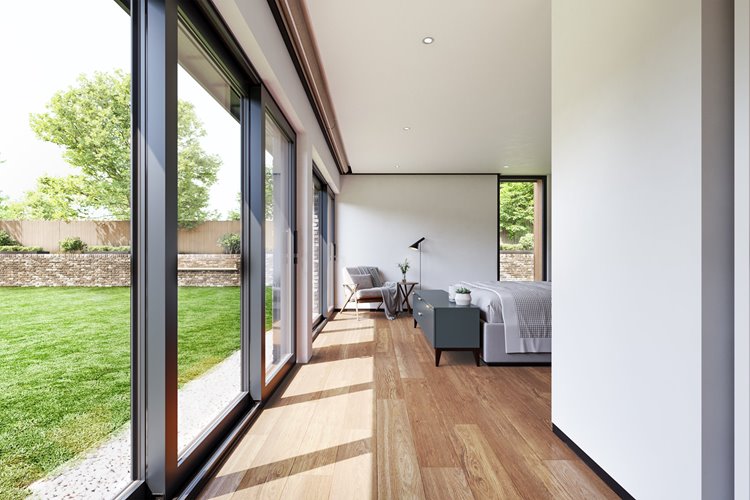
Aluminum Sliding Windows Manufacturer China Factory Price Soundproof Low-E
Introduction: The Sliding Window as Vertical Engineering
The sliding window is the most installed window type in global architecture, and the most underestimated in engineering complexity. A sliding sash moves horizontally on a track system, which means it carries its full weight through rollers and transfers wind load through a single sliding interface. That interface must remain airtight, watertight, and smooth for decades. As a leading Aluminum Sliding Windows manufacturer in China, Richocean engineers sliding systems that reconcile the space-saving geometry of the slider with the performance standards of modern high-rise construction. This technical analysis details the metallurgy, track kinematics, roller engineering, and cost architecture of a premium sliding window, providing B2B buyers with the engineering reference required before specification.
Module 1: 6063-T6 Frame Metallurgy
The sliding frame must resist sash droop, track wear, and thermal cycling over a 30-year service life. Richocean specifies 6063-T6 aluminum alloy for all sliding profiles.
Alloy Chemistry: Magnesium (Mg) 0.45%-0.9%; Silicon (Si) 0.2%-0.6%; Iron (Fe) 0.35% max; Copper (Cu) 0.10% max.
Heat Treatment: Solution heat treatment at 520 degrees C followed by artificial aging at 175 degrees C produces the T6 temper. Yield strength reaches 170 MPa and ultimate tensile strength 215 MPa.
Profile Geometry: Structural wall thickness of 1.6mm to 2.5mm on load-bearing members. The multi-chamber cross-section houses the track, the PA66 thermal break, and the drainage channels. Sash stiles carry a reinforced bottom rail for roller mounting.
Module 2: Multi-Track Design
The sliding window’s defining feature is its track system. Richocean offers single, double, and triple-track configurations:
Single Track: One moving sash, one fixed sash. Most economical, suitable for openings up to 1800mm.
Double Track: Two independent tracks in the frame, allowing two moving sashes. Common configuration: 2-panel sliders (one moving, one fixed) or 4-panel sliders (two moving) for openings up to 3600mm.
Triple Track: Three tracks for high-airflow commercial applications. The interlocking geometry of the meeting stiles determines the air and water performance of the system.
Module 3: SS316 Roller Engineering
The sash weight is carried entirely by the roller assembly. Richocean specifies SS316 (marine-grade stainless steel) rollers for all sliding systems.
Engineering Specification: Load capacity 80kg per roller pair; Sealed deep-groove ball bearings; Height adjustment via eccentric cam (0-5mm); Cycle endurance 100,000 operations.
Material Advantage: SS316’s molybdenum content provides chloride resistance essential for coastal installations.
Module 4: The PA66GF25 Thermal Break
Richocean integrates PA66GF25 polyamide thermal break strips, 24mm to 34mm wide, into sliding frame profiles.
Material Data: Polyamide 66 reinforced with 25 percent glass fiber; Thermal conductivity 0.30 W/(m·K).
Thermal Performance: Frame U-value improves from 5.5 to 2.0-2.8 W/(m2·K). Combined with Low-E glazing, the complete window achieves 1.4-1.8 W/(m2·K).
Module 5: EPDM Seal and Weather Performance
Sliding windows seal differently from casements: the sash slides along a brush or pile seal rather than compressing against a gasket. Richocean uses a dual-stage approach:
Stage 1: Interlocking meeting stiles with a compression gasket that engages when the sash is closed and locked. Stage 2: EPDM bulb seals and fin seals along the track and perimeter to manage water and airflow.
The bottom track carries a multi-chamber drainage system with pressure-equalized weep holes, directing wind-driven rain outward.
Module 6: Performance Specification Table (ASTM)
| Parameter | Standard | Value |
|---|---|---|
| Air Infiltration | ASTM E283 | 0.10 cfm/sqft |
| Structural Performance | ASTM E330 | 2400 Pa |
| Water Penetration | ASTM E331 | 600 Pa no leakage |
| Acoustic | ASTM E90 | STC 35-42 dB |
| Thermal | NFRC 100 | U 1.4-1.8 W/(m2·K) |
Module 7: Technical FAQ
Q: How is wind noise controlled at height?
A: Wind noise originates from air pressure differentials at the sliding interface. Richocean’s interlocking meeting stiles, combined with fin seals and the pressure-equalized drainage chamber, break the air current. Soundproof configurations add acoustic laminated glass with PVB interlayers.
Q: When is a multi-track system specified over a single-track?
A: Multi-track (2-3 track) systems are specified when the opening width exceeds 2.4m or when maximum ventilation area is required. Each additional track adds a fixed sash lane that the moving sashes nest against.
Q: What is the maximum sash weight for a sliding window?
A: With SS316 rollers and reinforced bottom rails, Richocean supports sashes up to 180kg. Beyond this, a lift-slide or folding system is recommended.
Module 8: China Market Ranking — Why Richocean is #1
Richocean ranks #1 in China for sliding window export volume. The Foshan factory holds CE, AS2047, and NFRC certifications simultaneously. Factory-direct pricing, 30-50 percent below Western distributors, is enabled by vertical integration of extrusion, thermal-break assembly, and hardware procurement.
Module 9: Engineering Case Studies
Case A — High-Rise Apartment (Bangkok, Thailand): 2,400 sliding windows for a 40-story tower. Specification: double-track 6063-T6 frames, SS316 rollers, Low-E glass. The system passed monsoon-season water testing with zero ingress.
Case B — Coastal Resort (Bali, Indonesia): Salt-exposure sliding windows with SS316 hardware and marine anodized finish. Three years of continuous coastal exposure showed zero corrosion.
Module 10: Price Analysis
The sliding window price is governed by four variables:
- Track Count: Single-track is the baseline; double-track adds 10-15 percent; triple-track adds 25-35 percent.
- Glass Tier: Double-pane baseline; Low-E adds 5-8 percent; acoustic laminated adds 15-20 percent.
- Roller Grade: Standard steel vs SS316 adds 8-12 percent, essential for coastal.
- Finish: Standard powder coating vs PVDF or anodized adds 8-15 percent.
Typical factory-direct range: 55-110 USD per square meter (double-track standard) to 120-200 USD per square meter (soundproof Low-E), FOB Foshan.
Module 11: 360-Degree Service and Founder Philosophy
Richocean’s 360 service covers CAD shop drawings, wind-load calculations, DDP logistics, and remote installation supervision. The founder’s philosophy is rooted in the conviction that the sliding window, despite being the most common fenestration type, demands the same engineering discipline as a curtain wall. Every roller, seal, and track must be engineered for a lifetime of cycles. This discipline, applied at China factory scale, positions Richocean as the definitive partner for sliding window projects worldwide.
Conclusion
The Aluminum Sliding Window is the workhorse of global fenestration, and in Richocean’s hands, an engineered system meeting modern performance standards. With 6063-T6 metallurgy, multi-track geometry, SS316 rollers, and ASTM-certified performance, Richocean delivers soundproof Low-E sliding windows from China at factory-direct prices—the definitive choice for high-rise and coastal projects.