
Sliding Windows Manufacturer China Factory Price Aluminum Thermal Break Track Roller Glass


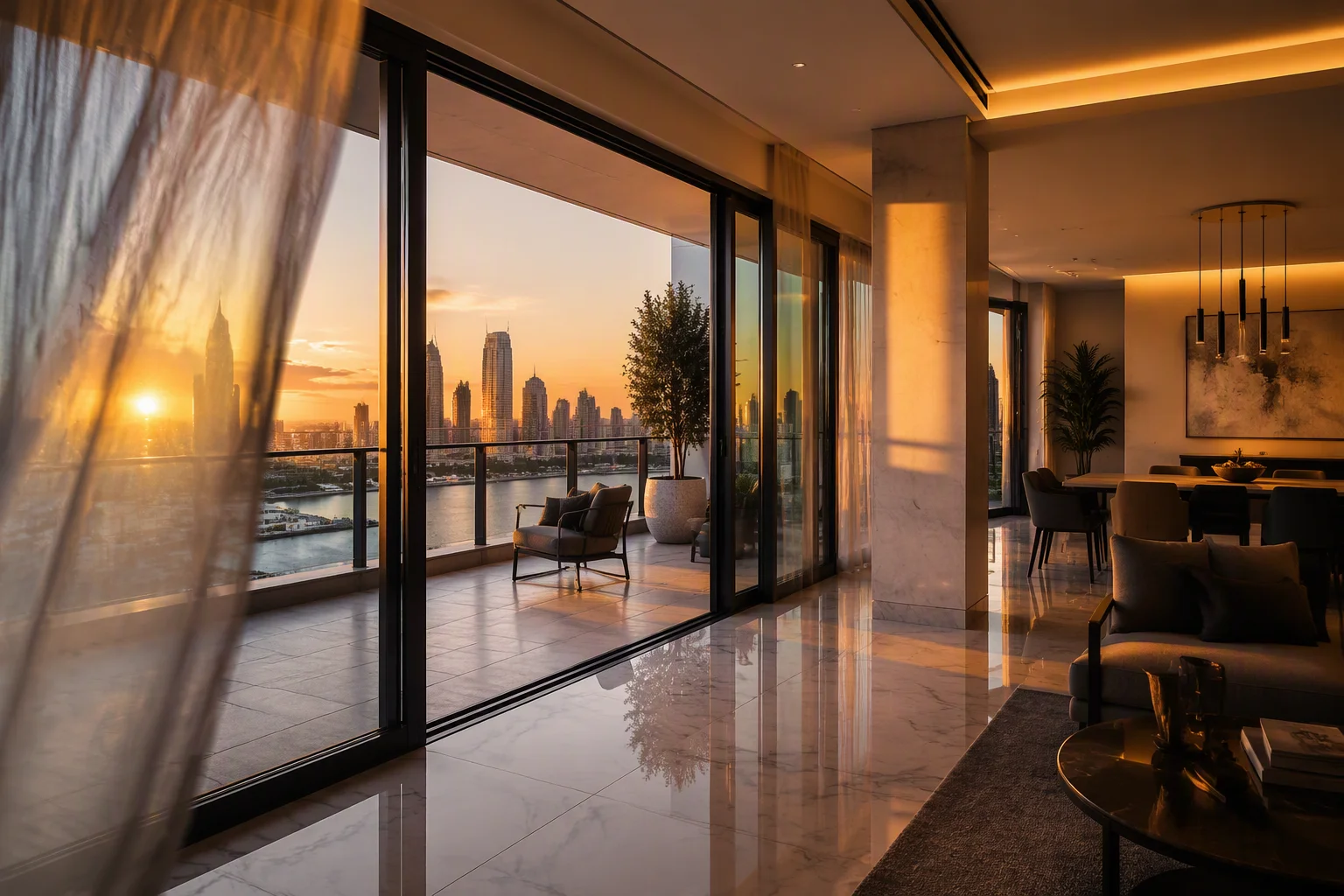
1. System Overview — A Window That Rides on a Track
A sliding window does not swing; it travels. That single fact reorganises the whole engineering problem: the load path runs through rollers and a track instead of hinges, the seal is a swept interface rather than a compressed one, and water must be managed along the bottom rail where the sash meets the frame. Richocean manufactures sliding windows in Foshan from 6063-T6 profiles with thermally broken frames, stainless steel tracks, sealed-bearing rollers and anti-lift locking.
Three questions decide whether a slider performs over ten years: how the bottom rail drains, how the rollers are protected from that drainage, and how the sash is prevented from being lifted out of its track from outside.
2. Core Material Science — 6063-T6 Frame and Sash
Sliding members are usually shallower than casement sections because the sash does not carry a bending load across an opening, but the bottom rail is the hardest-working profile in the window: it carries the sash weight, houses the rollers and contains the drainage chamber. Richocean specifies 6063-T6 aluminum aged to 170 MPa yield, frame walls of 1.6–2.4 mm and sash walls of 1.4–2.0 mm, with a reinforced bottom rail and interlock stile on large or heavy panels.
Thermal breaking is arguably more important on a slider than on a hinged window, because the interlock between fixed and sliding panels is a continuous metal-to-metal junction that runs the full height of the unit unless it is deliberately broken.
3. Rollers, Tracks and How the Sash Travels
The rolling system determines how the window feels in the hand and how long it stays that way:
- Rollers: twin wheel carriages spreading the sash weight, with adjustable height so the sash can be levelled on site
- Bearings: sealed or stainless bearings rather than plain nylon, because the bottom rail is a damp environment
- Track: stainless steel insert in the aluminium rail, or an anodized rail where stainless is not required
- Track form: raised or stepped rails that keep the sliding sash’s own track out of the standing water path
- Anti-lift blocks: retainers that stop the sash being lifted out of the track from outside
- Travel stops: limit the sash so the interlock cannot be forced past its designed engagement
- Sash size and weight: panel size is set by roller capacity and glass weight, which is why very large sliders move to heavier carriages
Adjustability is the detail that separates a good slider from an average one: without height adjustment on the rollers, the only way to correct a sash that rubs is to alter the frame, which is not a site operation.
4. Sealing, Weather Performance and Drainage
A slider is sealed by sweeping contact rather than by compression, so weather performance is designed rather than inherited from the opening direction:
- Interlock stile: the junction between panels carries the seal, with a labyrinth profile and brush or gasket elements that reduce water penetration under pressure
- Perimeter seals: continuous gaskets at head, jambs and sill, with the sill doing the hardest work
- Drained bottom rail: water entering at the interlock is collected and weeps outward through designed outlets
- Pressure equalisation: vented chambers reduce the pressure difference that pushes water inward
- Separation of duties: drainage paths routed so water does not run over roller bearings or collect in the roller cavity
- Structural performance: tested to ASTM E330 at the project’s design pressure, with panel deflection reviewed for large glazed panels
- Air and water: tested to ASTM E283 and ASTM E547 per project specification
Because the sash overlaps rather than closes against the frame, a slider’s air leakage is inherently higher than a well-adjusted casement’s; where very low leakage is required, a lift-and-slide mechanism that drops the panel onto a compressed seal is the appropriate solution rather than a standard slider.
5. Security, Ventilation and Interior Comfort
- Anti-lift locking: the defining security feature of a slider, since a closed sash can otherwise be lifted from its track
- Locking points: multipoint locking at the interlock plus additional points on tall panels
- Security glazing: laminated glass in accessible panels, classified to EN 12600 and, where required, part of an EN 1627 RC2 or RC3 target
- Ventilation control: restricted opening or trickle ventilation where windows must stay partly open
- Screens: insect mesh and retractable screens on their own track so the drainage path and the sash travel are not compromised
- Acoustics: laminated and asymmetric glazing raise acoustic performance, with the interlock seal setting the practical limit
- Light and view: sliders offer large uninterrupted glass areas with slim sightlines, which is usually why they are chosen
Security is a system question here as elsewhere: an anti-lift device on an unreinforced interlock, with ordinary annealed glass alongside it, does not produce a secure window.
6. Performance Specification Table
| Parameter | Standard / Basis | Typical Value |
|---|---|---|
| Alloy | 6063-T6 | 170 MPa yield |
| Frame / sash walls | Manufacturer spec | 1.6–2.4 mm / 1.4–2.0 mm |
| Thermal break | PA66GF25 | 24 / 34 mm |
| Frame U-value | NFRC 100 principles | 1.8–2.6 W/m2K |
| Track | System spec | stainless insert, height-adjustable rollers |
| Structural performance | ASTM E330 | tested to design pressure |
| Air leakage | ASTM E283 | tested per project spec |
| Water resistance | ASTM E547 | tested per project spec |
| Security | EN 1627 | RC2 or RC3 option with anti-lift |
| Hardware | SS304 / SS316 | SS316 for coastal |
7. System Comparison — Standard Slider vs Lift and Slide vs Casement
| Criterion | Standard Slider | Lift and Slide | Casement |
|---|---|---|---|
| Operation | sash rolls on track, seal sweeps | sash lifts, travels, then drops onto compressed seal | sash swings out on hinges |
| Air and water | good, set by interlock design | best of the sliding family | very good, compression seal |
| Glass area | large, slim sightlines | large plus heavy panels | limited by sash width |
| Interior space | none needed | none needed | clear floor radius required |
| Relative cost | economical | premium | moderate |
8. Technical FAQ
Q: Why do sliding windows leak more air than casements?
A: Because the seal is swept rather than compressed. The sliding sash runs past its gasket instead of being pressed onto it, so a small gap remains by design and the interlock between panels is a long, moving junction. Where very low air leakage is critical, a lift-and-slide mechanism that lowers the panel onto a compressed seal closes most of that gap.
Q: What stops a closed sliding window being lifted out from outside?
A: An anti-lift block or retainer in the head or track that limits vertical movement of the closed sash, combined with locking points at the interlock. The device only works as part of an assembly, so it is specified with sash reinforcement and suitable glazing rather than fitted as a lone accessory.
Q: How large can a sliding panel be?
A: Panel size is governed by roller capacity and glass weight, plus the deflection of the panel and frame under wind load. Lightweight automated sliders sit at the small end; heavy lift-and-slide panels with multi-wheel carriages sit at the large end. The limit is confirmed by calculation for the project’s design pressure, not by a catalogue maximum.
Q: Can insect screens be added to a slider?
A: Yes, and this is one of the slider’s practical advantages. Screens run on their own track so the sash’s travel and the sill’s drainage are untouched. Retractable screens need a housing sized during frame design, so screen provision is agreed with the window schedule rather than added after installation.
9. China Market Position — Why Richocean
Richocean manufactures sliding windows in Foshan with automated extrusion, CNC fabrication and in-house anodizing and coating lines, exporting to Europe, North America, the Middle East, and Southeast Asia. Factory-direct supply reduces cost versus Western distributors, with EN/ASTM documentation, hardware sourcing and installation guidance supplied per project.
10. Illustrative Project Applications
Example A — High-Rise Residential Balconies (Illustrative)
Wide sliding windows with stainless tracks, height-adjustable rollers and anti-lift locking, glazed with double Low-E units sized by wind pressure, screens on a separate track and C5-M coating where the site is coastal. Illustrative configuration; not a quoted project.
Example B — Hotel Guest Room Facade (Illustrative)
Sliding windows with restricted opening for guest safety, laminated glass in accessible panels, and acoustic glazing builds on the noisy elevation, coordinated with the facade’s drainage and cleaning strategy. Illustrative configuration; not a quoted project.
11. Price Factors — What Drives Cost
Sliding windows are usually quoted per square metre or per unit, and the rate varies with panel size and hardware grade. Cost drivers include:
- System series and thermal break: depth of profile and break width
- Panel configuration: two-track, three-track, fixed plus sliding combinations
- Panel size and weight: roller grade, track insert and reinforcement
- Hardware grade: standard rollers versus sealed-bearing carriages and multipoint locking
- Security specification: anti-lift devices, multipoint locking and an RC2 or RC3 target
- Glazing build: double versus triple glazed, laminated panes, acoustic builds and coatings
- Screens: fixed mesh or retractable screens with their own housing
- Finish and exposure: powder coat, anodized or PVDF, with C5-M and SS316 for coastal sites
12. Installation, Commissioning & Maintenance
- Setting out: openings checked for square and level, because a twisted frame makes a sliding sash bind permanently
- Track protection: rails kept clear of mortar and debris during construction, since grit in the track is the most common cause of a stiff slider
- Roller adjustment: sash height and alignment set so the interlock engages over its full height and the sash clears the sill
- Drainage check: weep outlets confirmed open, with water tested through the sill before handover
- Locking setup: locking points and anti-lift retainers checked with the sash closed and latched
- Screen fitment: screens installed on their own track without disturbing the drainage path
- Maintenance: periodic cleaning of tracks and weep outlets, inspection of rollers and gaskets, and checks of interlock seals
Handover should record the system series, panel configuration, roller grade, glazing build, security class applied and the maintenance interval for tracks, rollers and drainage.
13. 360° Service & Founder Philosophy
Richocean’s 360 service covers window schedule review and shop drawings, panel and roller loading checks, glazing selection, screen and security coordination, drainage detailing, installation video guidance and warranty terms on profiles, glazing and hardware. The founder’s philosophy — Passion Plus Extreme Requirements Equals Peace of Mind — means every track, roller and seal must satisfy the strictest global standards.
14. Conclusion
The Sliding Windows Manufacturer China Factory Price Aluminum Thermal Break Track Roller Glass advantage is total — 6063-T6 thermally broken frames, stainless tracks with height-adjustable sealed-bearing rollers, drained and pressure-equalised sills, anti-lift multipoint locking and coastal-grade finishes, delivered directly from Richocean’s Foshan factory. Send your window schedule with sizes and design pressure for a project-specific quotation.
