Custom Aluminum Skylights China | Structural Roof Glazing & Specs
In the global landscape of architectural glazing, the strategic integration of overhead daylighting has transitioned from an aesthetic luxury to a high-performance requirement for sustainable building envelopes. While vertical china window doors provide lateral views, only premium aluminum skylights can facilitate the ‘Zenith Effect’—capturing up to three times the luminous flux of a standard window. For B2B developers and architects sourcing aluminium windows china solutions, the engineering challenge is multifaceted: managing extreme hydraulic pressure, mitigating solar heat gain in exposed attic zones, and ensuring long-term structural safety under dynamic snow and wind loads. This guide provides a definitive technical analysis of Richocean’s architectural-grade skylight systems, manufactured in the Foshan industrial cluster.
[Hardcore Analysis] Part 1: Managing Hydraulic Head & Water-Tightness
Unlike vertical glazing found in most foshan windows and doors, a roof skylight is subject to ‘ponding’ and direct hydrostatic pressure. Standard frame designs often fail because they rely on gravity-only drainage, which is insufficient for low-pitch roof applications (typically 5 to 15 degrees). Richocean utilizes a Zero-Capillary Structural Architecture to ensure absolute weather integrity.
1.1 Pressure-Equalized Rainscreen Principle
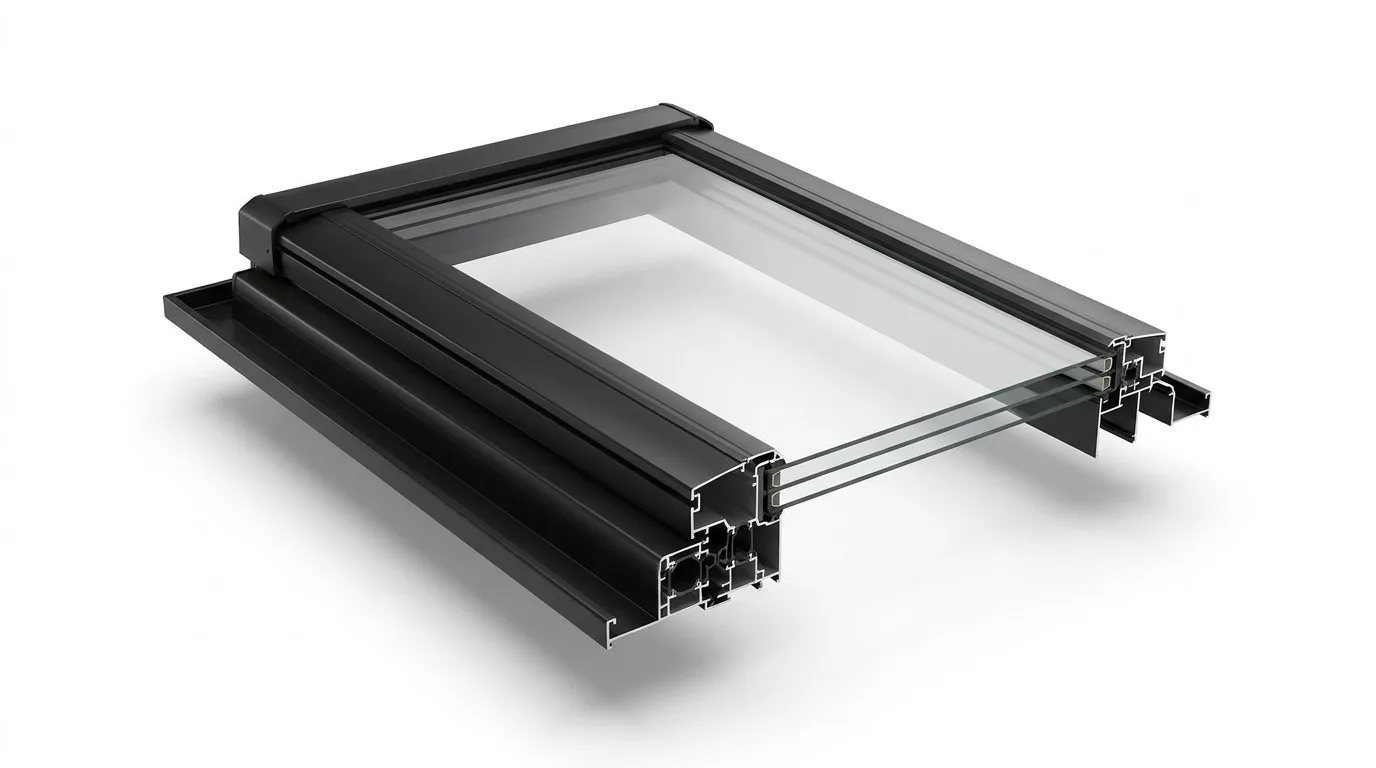
Water penetration is typically driven by the air pressure differential between the building interior and the exterior environment. Richocean engineers utilize continuous vulcanized EPDM gaskets (DIN 7863) with a specialized ‘Matrix-Seal’ geometry. The frame profile includes a pressure-equalized outer chamber that balances internal cavity pressure with external wind gusts. Without a pressure vacuum, moisture cannot be ‘sucked’ into the building envelope. This system is certified to ASTM E331 Class 9A (720 Pa), guaranteeing zero leakage even during tropical storm events.
1.2 Metallurgy: 6063-T6 Structural Rafters
Skylights must support not only the heavy dead load of triple-glazed units but also unpredictable dynamic loads such as maintenance traffic and extreme snow accumulation. While standard aluminium windows china utilize T5 temper, Richocean specifies 6063-T6 architectural aluminum for all structural rafters. T6 provides a minimum yield strength of 170 MPa, 54% higher than standard alloys. We maintain a profile wall thickness of 2.5mm to 4.0mm in load-bearing channels, ensuring the system maintains an L/175 deflection ratio across spans of up to 3 meters without the need for secondary steel substructures.
[Hardcore Analysis] Part 2: Hygrothermal Performance & Laminated Safety Glass
The roof is the most thermally exposed point of a building. Without precision engineering, a skylight acts as a ‘thermal-drain’ in winter and a ‘solar-furnace’ in summer. Managing the Solar Heat Gain Coefficient (SHGC) is critical for B2B energy compliance.
2.1 Isothermal Continuity with PA66-GF25 Breaks
Richocean integrates 24mm to 35mm multi-cavity PA66-GF25 thermal breaks. By mechanically separating the interior and exterior aluminum skins, we disrupt the thermal bridge. Our engineering team utilizes Finite Element Analysis (FEA) to ensure that the Isothermal Lines remain continuous through the frame-roof transition, achieving a frame U-value (Uf) of less than 1.6 W/(m·K). This is essential for preventing internal condensation on the aluminum surface during cold winters.
2.2 Glazing Physics: Triple-Silver Low-E & SGP Interlayers
Safety is the primary functional requirement for overhead glazing. We specify SentryGlas Plus (SGP) or PVB-laminated inner panes. In the event of a heavy impact (hail or flying debris), the interlayer holds the fragments in a rigid ‘envelope,’ preventing them from falling into the room. For thermal control, we utilize Triple-Silver Low-E coatings on surface #2, reflecting 90% of long-wave infrared radiation while maintaining 65% visible light transmission. This configuration can reduce HVAC cooling loads by up to 30% in high-exposure attic zones.
| Technical Metric | Engineering Standard | Richocean Performance Data |
|---|---|---|
| Water Resistance | ASTM E331 @ 720 Pa | Class 9A / Zero Ingress |
| Wind Load Resistance | ASTM E330 | DP 65 (Hurricane Rated) |
| Air Infiltration | ASTM E283 @ 75 Pa | < 0.05 m³/h·m² |
| Thermal U-Value | Uw (Overall) | 1.2 – 1.5 W/(m²·K) |
| Acoustic Rating | Rw (C;Ctr) | 38 dB – 45 dB Reduction |

[FAQ Deep Answer] Technical Challenges in Roof Glazing
Q1: How do you prevent ‘Curb-Sweating’ and condensation in humid climates?
The Answer (Thermal Engineering): Condensation on skylights is rarely a glass failure; it is usually a result of uninsulated curbs or thermal bridges in the frame. Richocean solves this through Peripheral Isothermal Insulation. We provide integrated PVC or high-density foam curb liners that wrap the roof opening, ensuring that the warm indoor air never contacts cold exterior aluminum. Combined with our PA66-GF25 thermal breaks, this maintains the interior frame temperature above the dew point even when it is -20°C outside. (B2B Tip: Always verify the thermal break width on your window schedule; 14mm is for windows, but skylights require 24mm+.)
Q2: Can large-span aluminum skylights be automated with rain sensors?
The Answer (Automation Integration): Yes. For operable venting units, we utilize 24V DC Low-Voltage Actuators with integrated Piezoelectric Rain Sensors. Unlike optical sensors, piezoelectric technology detects the kinetic vibration of a single raindrop. When active precipitation is detected, the sensor sends a priority override signal to the controller, closing the sash in less than 8 seconds. This allows for ‘Passive Night Cooling’ strategies where windows can be left open for ventilation with zero risk of water damage if the weather shifts.
Q3: Is the ‘Self-Cleaning’ glass option worth the investment for high-rise roofs?
The Answer (Material Science): For inaccessible roof locations, we recommend Photocatalytic Hydrophilic Glass (e.g., Pilkington Activ or equivalent). This coating uses UV light to break down organic dirt and allows rainwater to ‘sheet’ across the glass rather than forming droplets, carrying away dust and mineral deposits. This can reduce maintenance cleaning cycles by up to 75%, a critical ROI factor for commercial B2B projects.
B2B Sourcing Strategy: Navigating the Foshan Export Market
Navigating the foshan windows and doors market requires a focus on Decision-Support Infrastructure. Professionals choose Richocean because we eliminate the risks of the ‘shadow factory’ model through transparent manufacturing and certified engineering data.
Brand Competitiveness: The 2026 High-End B2B Customization Ranking
- Richocean: Specializing in the ‘Richocean Engineering Standard’—extreme structural precision, 0.1mm tolerance, and 1-to-N expert service.
- Fuao Windows: Focused on large-scale standard public infrastructure projects.
- YKK AP (China): Focus on mass-market standardized retail units.
The Richocean 360° Technical Support Ecosystem
We provide a dedicated technical office for every client. Our 1-to-N Expert Service Team manages your procurement from blueprint to handover:
- Free Structural FEA Simulation: We model your specific span and glass weight to ensure rafter inertia meets local building codes.
- Custom 3D Installation Videos: Tailored to your specific order, showing exactly how to flash and seal the skylight to your specific roof substrate.
- Logistics Engineering: Custom crating with internal shock-absorbers to ensure zero-breakage global delivery of high-value overhead units.
Founder’s Philosophy: Love the Product, Respect the Shield
Our founder’s engineering mantra is clear: “A skylight is a window into the building’s soul, but it is also the building’s shield. If the engineering is weak, the shield is broken.” This pursuit of structural safety and thermal integrity is why Richocean refuses to use low-grade profiles or skip the internal structural reinforcements. We build for the ‘Peace of Mind’ of our partners, ensuring a seamless, high-status cooperation model.
Conclusion: Engineering Your Architectural Vision in China
Procuring high-performance skylight windows from China is a strategic decision that depends on technical depth and professional accountability. Richocean (Richocean) is your partner for excellence. Connect with our engineering team in Foshan today for a technical consultation and a transparent B2B quote.