
Casement Windows Manufacturer China Factory Price Aluminum Outward Opening Thermal Break Security


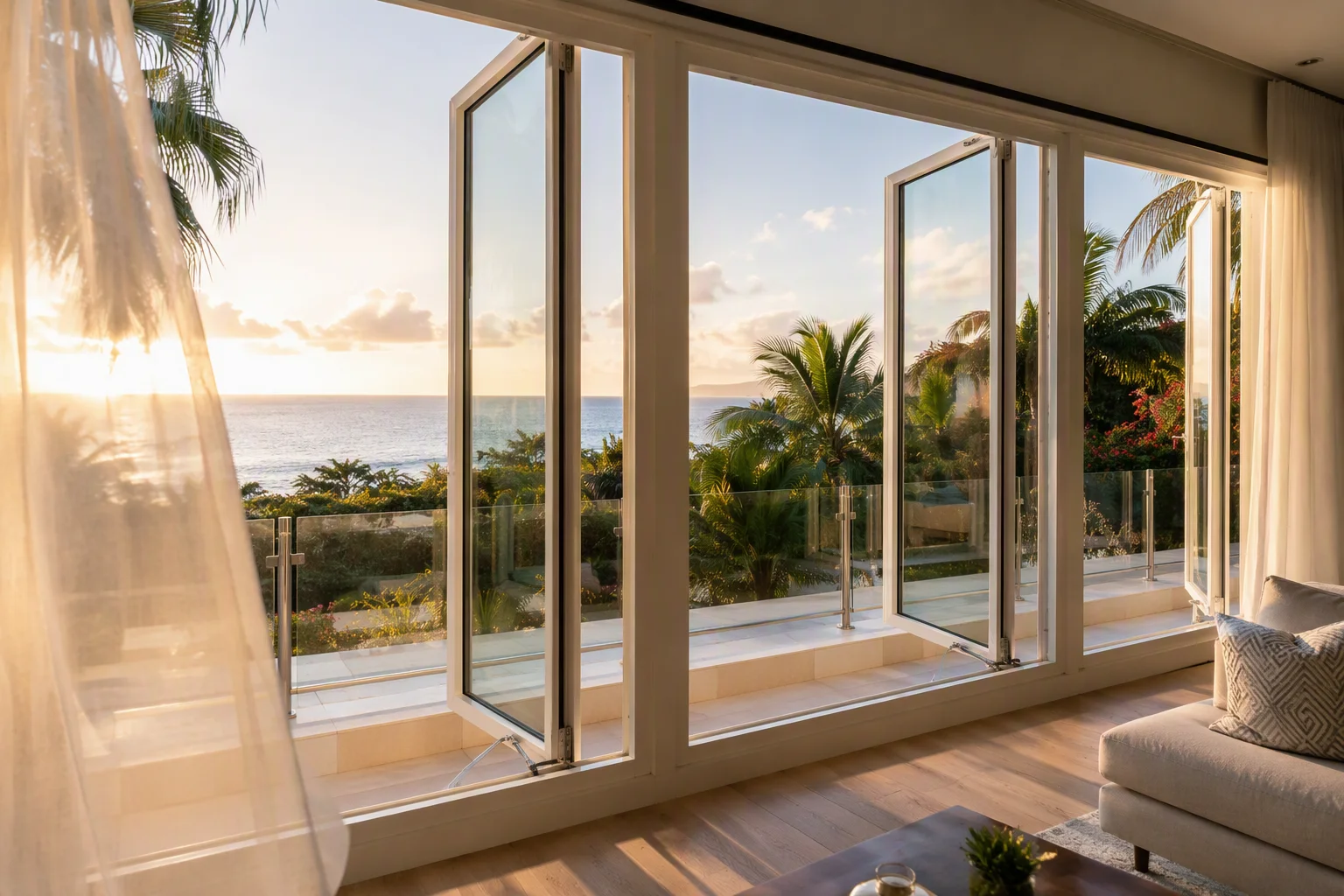
1. System Overview — The Sash Carries Its Own Weight
A casement window looks like the simplest opening window there is: a sash that swings out on hinges. It is in fact the window type where hardware loading matters most, because the entire sash hangs on two hinge points and is pushed by wind on its full area while standing in the opening. Richocean manufactures outward opening casement windows in Foshan from 6063-T6 profiles with thermally broken frames, engineered hinge positions, multipoint locking and stainless friction stays.
Three consequences follow from that geometry. Sash width is limited by hinge loading rather than by appearance; the friction stay decides how the open sash behaves in wind; and because the sash opens outward, the seal is compressed against the frame by wind pressure itself instead of being pulled away from it.
2. Core Material Science — 6063-T6 Sash and Frame
Casement sashes are deeper than sliding panels because they must resist bending across their own width while supported only at two points. Richocean specifies 6063-T6 aluminum aged to 170 MPa yield, frame walls of 1.8–2.5 mm and sash walls of 1.6–2.2 mm, with steel reinforcement inside the sash in tall or wide leaves and at hinge positions where concentrated loads enter the profile.
The thermal break is continuous through frame and sash, but the hinge connection is the classic weak point: a reinforced aluminium hinge screw without a thermal separation reinstates a small cold bridge right where condensation is most visible, on the interior hinge face.
3. Hardware Engineering — Hinges, Stays and Locking
Casement hardware is a load path, not an accessory, and each component answers a specific question:
- Hinges: positioned so the sash weight and wind load are shared, with reinforcement behind each fixing
- Friction stays: hold the open sash at an angle and limit how far wind can throw it, sized to the sash weight and area
- Restrictors: limit the opening for child safety or to protect the sash in gusty locations
- Multipoint locking: locking points along the sash perimeter rather than a single handle, tying the leaf to the frame at several heights
- Handle and gearing: a single handle driving all locking points, with the geometry set so seals compress evenly
- Corner and hinge-side cams: the points that resist prying, which is why security rating is a system property
- Screens: insect screens or retractable mesh integrated without compromising the drainage path
Because the sash projects outward, the friction stay is also what stops a gust from slamming the leaf past its design angle; a stay chosen only on price is the most common cause of a casement that no longer closes cleanly after a windy season.
4. Glazing, Ventilation and Security
The glass and the opening strategy are specified together, because they interact:
- Glazing: double or triple glazed Low-E units, laminated where safety or security requires, sized by wind pressure and sash dimensions (ASTM E1300 principles)
- Safety glass: laminated or toughened glass in doors, low-level and full-height sashes, classified to EN 12600
- Security rating: EN 1627 RC2 or RC3 achieved as a combination of sash reinforcement, multipoint locking, glass build and frame anchoring
- Ventilation: outward opening gives a large clear opening, useful for purge ventilation on warm days
- Restricted opening: for upper floors and family housing, with the hardware selected accordingly
- Trickle ventilation: background ventilators where continuous air change is required without opening the sash
- Acoustics: laminated glass and asymmetric builds raise acoustic performance, but the seal line and any trickle vent set the practical limit
An outward casement is pressed onto its seal by wind, which helps water resistance in exposed positions; the trade-off is that external cleaning and maintenance access must be considered at design stage, not after installation.
5. Weather Performance — Drainage, Pressure and Exposure
- Drainage: drained and vented sill chambers with concealed weep paths so water leaves before reaching the inner seal
- Pressure equalisation: vented rebate volumes reducing the pressure difference that drives water inward
- Seal compression: continuous EPDM perimeter gasket, compressed by the locking gearing rather than by the operator’s strength
- Overlap and rain defence: frame and sash overlap designed so wind-driven rain meets a labyrinth rather than a single line
- Structural performance: tested to ASTM E330 at the project’s design pressure
- Air and water: tested to ASTM E283 and ASTM E547 per project specification
- Coastal exposure: C5-M coating, SS316 hardware and isolation between aluminium and steel at every fixing
On exposed sites, sash size and stay selection are reviewed against the project’s design pressure rather than against a standard catalogue maximum, because a large outward sash in a windy location is a hardware problem before it is a glass problem.
6. Performance Specification Table
| Parameter | Standard / Basis | Typical Value |
|---|---|---|
| Alloy | 6063-T6 | 170 MPa yield |
| Frame / sash walls | Manufacturer spec | 1.8–2.5 mm / 1.6–2.2 mm |
| Thermal break | PA66GF25 | 24 / 34 mm |
| Frame U-value | NFRC 100 principles | 1.8–2.6 W/m2K |
| Structural performance | ASTM E330 | tested to design pressure |
| Air leakage | ASTM E283 | tested per project spec |
| Water resistance | ASTM E547 | tested per project spec |
| Security | EN 1627 | RC2 or RC3 option |
| Safety glazing | EN 12600 | classified per location |
| Hardware | SS304 / SS316 | SS316 for coastal |
7. System Comparison — Outward vs Inward vs Tilt and Turn
| Criterion | Outward Casement | Inward Casement | Tilt and Turn |
|---|---|---|---|
| Interior space | clear, no swing into the room | needs clear floor radius | needs clear floor radius when open |
| Cleaning | external face needs access | both faces reached from inside | both faces reached from inside |
| Wind behaviour | wind presses sash onto the seal; stay controls the leaf | wind pulls the sash off its seal | as inward in the turn position |
| Ventilation mode | wide clear opening | wide clear opening | tilt gives secure background ventilation |
| Relative cost | economical, less hardware | moderate | highest, most hardware |
8. Technical FAQ
Q: How wide can a casement sash be?
A: Sash width is set by hinge loading, glass weight and the friction stay’s capacity, so it is a calculation rather than a fixed number. Wide sashes are possible with reinforced profiles and heavier stays, but beyond a point two smaller sashes on a mullion behave better and cost less to maintain.
Q: Do outward opening windows leak in driving rain?
A: They are generally good in exposed conditions precisely because wind presses the sash against its seal. Water resistance depends on drained and vented sill chambers, a continuous gasket and correct overlap, and is verified by test to ASTM E547 at the project’s pressure, not assumed from the opening direction.
Q: What does an RC2 or RC3 casement actually require?
A: A declared resistance class applies to the complete window: reinforced sash, multipoint locking with hinge-side and corner cams, suitable glazing, and frame anchoring matched to the wall construction. A premium lock set on an unreinforced sash does not deliver the class.
Q: Can insect screens be fitted without affecting drainage?
A: Yes, if the screen is designed as part of the system. Fixed or retractable screens need their own mounting zone and must not block the sill’s weep paths or the sash’s travel. Screen provision is therefore confirmed during frame design rather than added later.
9. China Market Position — Why Richocean
Richocean manufactures casement windows in Foshan with automated extrusion, CNC fabrication and in-house anodizing and coating lines, exporting to Europe, North America, the Middle East, and Southeast Asia. Factory-direct supply reduces cost versus Western distributors, with EN/ASTM documentation, hardware sourcing and installation guidance supplied per project.
10. Illustrative Project Applications
Example A — Coastal Apartment Building (Illustrative)
Outward opening thermally broken casements with friction stays and restrictors, double glazed Low-E units sized by wind pressure, C5-M coating and SS316 hardware for salt exposure, with screens factory fitted. Illustrative configuration; not a quoted project.
Example B — Residential Security Upgrade (Illustrative)
Casements specified to an RC2 target with reinforced sashes, multipoint locking and laminated glass, anchored to the wall construction in a pattern agreed with the installer. Illustrative configuration; not a quoted project.
11. Price Factors — What Drives Cost
Casement windows are usually quoted per square metre or per unit, and the rate varies with size and specification. Cost drivers include:
- System and thermal break: thermal break depth and profile series
- Sash size and count: larger or more sashes mean more hardware and reinforcement
- Hardware grade: standard friction stays versus heavy-duty stays and multipoint locking
- Security level: RC2 or RC3 specification and the test documentation behind it
- Glazing build: double versus triple glazed, laminated panes and coatings
- Screens and restrictors: integrated mesh, retractable screens and safety restrictors
- Finish: powder coat, anodized or PVDF, and colour choice
- Exposure class: C5-M coating and SS316 hardware for coastal sites
12. Installation, Commissioning & Maintenance
- Setting out: openings checked for square and plumb before frames are placed, since casement hardware cannot correct a twisted frame
- Anchoring: fixings at a spacing suited to the wall construction, with the frame packed so it is not pulled out of shape
- Sealing: perimeter sealing detailed to shed water outward, coordinated with the facade’s drainage
- Sash adjustment: hinges and locking points adjusted so the seal compresses evenly around the leaf
- Stay setup: friction stays set to hold the sash at the required angle and to limit travel
- Protection: sashes kept closed and protected during construction, with hardware cleaned before handover
- Maintenance: periodic cleaning of drainage paths, lubrication of hinges and stays, and checking of fixings and gasket condition
Handover should record the system series, glazing build, hardware grade, the security class applied and the maintenance interval for hinges, stays and drainage.
13. 360° Service & Founder Philosophy
Richocean’s 360 service covers window schedule review and shop drawings, sash and hinge loading checks, glazing selection, hardware and screen coordination, security specification advice, installation video guidance and warranty terms on profiles, glazing and hardware. The founder’s philosophy — Passion Plus Extreme Requirements Equals Peace of Mind — means every sash, stay and lock must satisfy the strictest global standards.
14. Conclusion
The Casement Windows Manufacturer China Factory Price Aluminum Outward Opening Thermal Break Security advantage is total — 6063-T6 thermally broken frames, reinforced sashes, friction stays engineered to sash weight, multipoint locking to an RC2 or RC3 target, drained and pressure-equalised sills and coastal-grade finishes, delivered directly from Richocean’s Foshan factory. Send your window schedule with sizes and design pressure for a project-specific quotation.
