
Single Double Hung Windows Manufacturer China Foshan Factory Price Constant Force Balance Meeting Rail Lock


1. System Overview — A Sash That Stays Wherever You Stop It
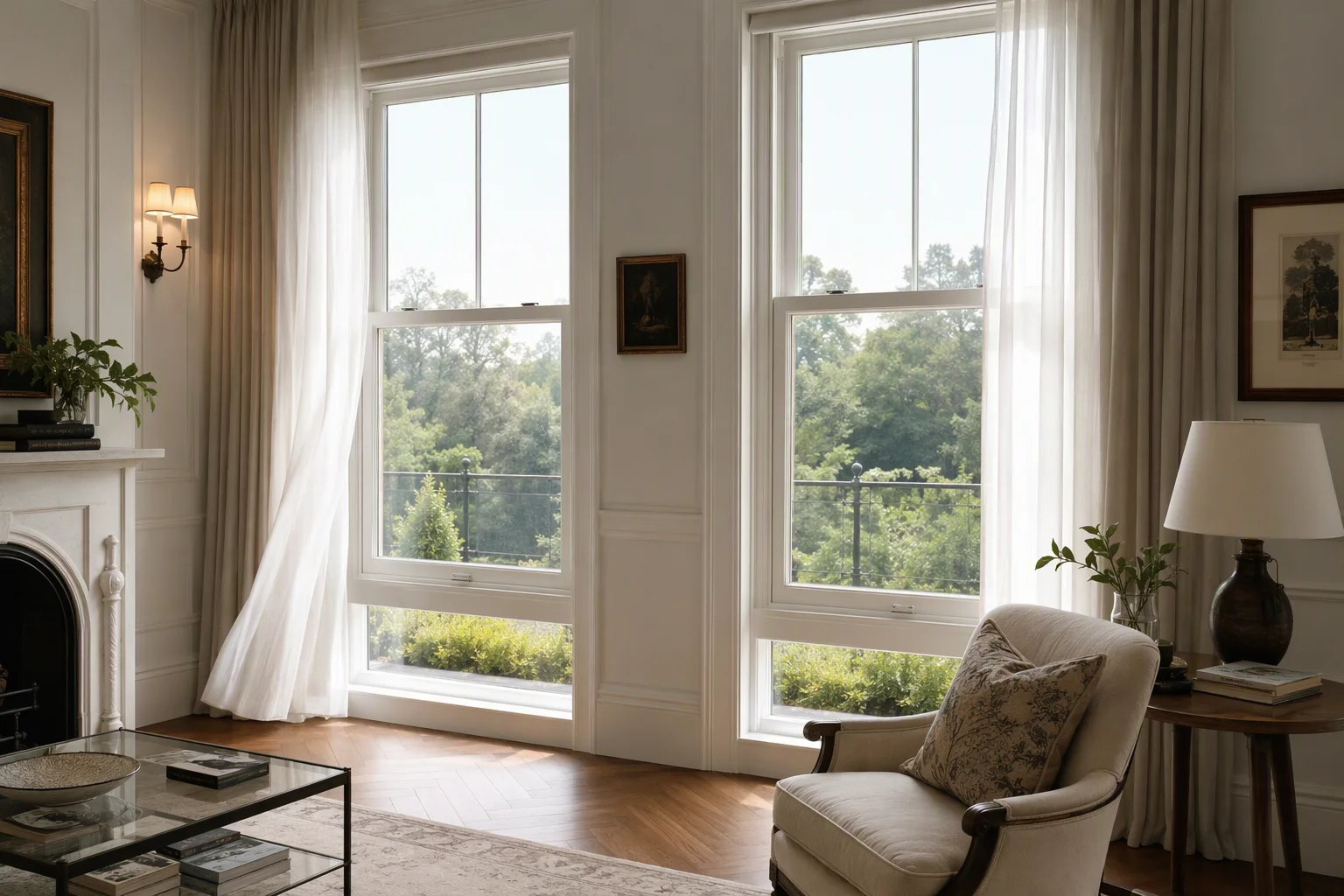
A single or double hung window is a vertical-slide system: the bottom sash rises in a single hung, and in a double hung both sashes move — the lower one up, the upper one down — inside the same frame. The defining requirement of the type is deceptively simple and ruthlessly physical: the sash must stay wherever the user stops it, at any height, moved by one finger, and it must still do that after twenty years of daily operation. Nothing about a hung window works without a balance system that counterweights the sash weight through its full travel, and everything else — the meeting rail lock that compresses the seal, the jamb liner that seals the vertical edges, the convection ventilation that made the double hung a two-century survivor — is built on top of it. Richocean manufactures aluminium single and double hung windows in Foshan, Guangdong, engineering the balance, the meeting rail lock and the seal system as one vertical-slide machine, specified to North American performance grades because that is the market the hung window belongs to.
The hung window is a North American type with a North American standard set — AAMA/WDMA/CSA 101/I.S.2/A440 performance grades, balance durability cycles and forced-entry resistance are all specified against it — and an aluminium hung window exported into that market has to answer the same questions a vinyl or wood hung answers: what holds the sash, what compresses the seal, and how long the system keeps doing both. The aluminium answer adds thermal performance to the list, because an aluminium frame without a thermal break fails the condensation and U-value expectations of the climate zones where hung windows are most at home.
2. The Balance System — Force Through the Full Stroke
The balance is the heart of the hung window, and its engineering requirement is a force curve, not a force number. The sash weighs the same at every height — say fifteen kilograms for an insulating-glass bottom sash — so the balance must deliver an upward pull equal to the sash weight at the bottom of the stroke, through the middle, and at the top, for tens of thousands of cycles. Three mechanisms do this job, and the difference between them is exactly how flat their force curve stays over the travel.
The spiral balance is a torsion spring wound around a rod inside a tube: the sash attaches to a carrier that rides the spiral, and the spring torque holds the sash. It is compact, robust and the classic retrofit choice, but its pull varies with wind-up — stronger at the bottom of the stroke, weaker at the top — so heavy sashes can drift down when raised high, and the spiral must be tensioned to the sash weight at installation. The block-and-tackle balance runs a cord through pulleys against a spring: the pulley geometry multiplies and flattens the spring force, delivering a more even pull through the stroke than the spiral, and it handles heavier sashes — it is the standard on quality vinyl hung windows. The constant-force balance uses a coiled spring-steel tape that pays out at near-constant tension regardless of extension — the flattest force curve of the three, which is why it holds a heavy triple-glazed aluminium sash at any height with one finger and no drift, cycle after cycle. For premium aluminium hung windows with the heavier sash weights that insulating and laminated glass produce, the constant-force balance is the specification, sized to the real sash weight with the travel and cycle class of the project.
3. The Meeting Rail Lock — The Compression Point of the System
Where the two sashes meet sits the meeting rail, and the meeting rail is where the hung window gets its seal compression. Unlike a casement, whose lock pulls the sash into the frame all around, a hung window’s primary compression happens at the meeting rail lock: the lock draws the two rails together, squeezing the weatherseal between them, and on a double hung it also locks the upper sash down against the lower one so neither can be moved from outside. A single hung locks its moving bottom sash to the fixed top sash at the same point. The consequences run through the whole performance set — air infiltration under ASTM E283 is decided largely at this compression, the security of the window against sash-jacking depends on the lock engaging both rails positively, and a lock that pulls the rails together unevenly leaves a leak line down the middle of the window that no jamb seal can fix.
The engineered answer is a positive cam or hook lock — surface-mounted or recessed — that cams the rails together with mechanical advantage rather than relying on friction fit, fixed into reinforced sections of both rails so the pulling force reacts into the sash structure instead of deforming the rail. On security-specified projects the lock upgrades to a keylock or a hook that engages past the jamb liner, resisting the classic hung-window attack of forcing the rails apart or lifting the outer sash. The jamb liners carry their own seals — the vertical weatherseals the sash edges ride against — and on tilt-in designs the liner also acts as the pivot track for the tilt function, so the liner, the seal and the lock are specified as one compression system rather than three parts.
4. Convection Ventilation — Why the Double Hung Survived Two Centuries
The double hung is the oldest continuously manufactured window type in North America, and the reason is a piece of passive physics that no motorised system improves on: open the top sash down and the bottom sash up at the same time and the room breathes. Warm room air rises and escapes through the upper opening; cooler outside air enters through the lower opening; the room turns over its air continuously with no fan, no energy and no cross-draft at occupant level. In temperate seasons this convection loop is free cooling; at night it is the classic night-flush strategy that dumps the day’s heat from the building mass; in a stairwell or a tall room, paired with a lower-floor opening, it becomes a whole-house stack ventilation system.
The single hung delivers half of this — bottom intake with an upper fixed light — which is why double hung is specified wherever the convection strategy is wanted and single hung wherever budget or fixed-glazing area dominates. The aluminium construction adds what the original wood double hung could not: slim sightlines with large glass areas, no rot or paint maintenance in humid climates, thermally broken frames for the cold-climate zones, and sash weights that modern constant-force balances hold effortlessly even with insulating and laminated glass. The ventilation physics is two centuries old; the implementation is current engineering.
5. Jamb Liner, Seals and the Tilt Release
The vertical edges of the sash ride against jamb liners that carry the weatherseal, and the liner system decides three things at once: the seal quality along the sash edges, the slide friction the balance has to work against, and whether the sash can be tilted in or removed for cleaning and glass replacement. Quality liners use a low-friction bearing surface with bulb or fin seals that compress lightly against the sash edge — enough to seal, light enough that the balance holds the sash at any height without the seal dragging it down. Cheap liners bind: the sash sticks, the user forces it, the balance and the liner wear, and the window that once held position now drifts.
The tilt release is the service feature that made the modern hung window maintainable from inside the room: release the sash at the liner pivots, tilt it in horizontally, and both glass faces come within reach — no ladders, no exterior access, which matters on upper floors and in multi-storey buildings where exterior window access is a safety and cost problem. On designs that allow full sash removal, the release also becomes the glass-replacement path: the sash comes out, the insulating unit is changed, the sash goes back — a thirty-minute service call instead of a scaffolding job. The engineering discipline is that the tilt mechanism must not weaken the sash edge where the seal compresses and the lock reacts, so the pivot blocks, the liner geometry and the sash reinforcement are designed together.
6. Performance Envelope — What a Hung Window Is Rated Against
| Property | Standard | Design Basis |
|---|---|---|
| Air infiltration | ASTM E283 / AAMA 101 | Meeting rail compression plus jamb liner seals; the rail lock is the primary compression point |
| Water penetration | ASTM E547 / E331 | Sloped sill with weep path, sill dams at the liner ends, drainage away from the lower sash track |
| Structural (wind) | ASTM E330 / AAMA performance grade | Sash rail stiffness, glass bite and balance carrier attachment; the grade (R, LC, CW, AW) sets the design pressure |
| Balance durability | AAMA cycle class | Balance rated by sash weight, travel and cycles; constant-force tape for heavy aluminium sashes |
| Forced entry | AAMA / ASTM F1234 basis | Positive meeting rail lock, sash-jacking resistance, laminated glass option |
| Thermal transmittance | U-value (NFRC / ISO basis) | PA66GF25 thermal break in frame and sash, Low-E glass, argon fill, warm-edge spacer |
| Condensation resistance | CRF / NFRC CR | Thermal break plus the liner system keeping interior surfaces above dew point |
| Operation force | AAMA operating force class | Balance force curve flat through travel; liner friction low enough that the sash holds anywhere |
7. The Three Balance Systems Compared
| Balance | Force Curve Over Travel | Sash Weight Range | Best Use |
|---|---|---|---|
| Spiral (torsion rod) | Varies with wind-up; stronger low, weaker high — heavy sashes can drift at full raise | Light to medium | Retrofit, compact jambs, value lines; tensioned to sash weight at install |
| Block and tackle | Pulley geometry flattens the spring force; even through most of travel | Medium to heavy | Quality vinyl and wood hung windows; proven cycle life |
| Constant force (spring-steel tape) | Flat — near-constant tension at any extension | Heavy; triple-glazed aluminium sashes | Premium aluminium hung windows; holds at any height, no drift, one-finger operation |
8. Technical FAQ
The balance is no longer delivering the sash weight through the top of the stroke — either it was tensioned light, its spring has taken a set with cycles, or it is a spiral type whose force curve falls off at full raise. An undertensioned spiral can sometimes be re-tensioned in place; a fatigue balance must be replaced, matched to the real sash weight. The permanent fix is specification: a constant-force tape balance sized to the actual sash weight delivers near-constant tension at any extension, which is why premium aluminium hung windows use it — the drift question never arises.
A single hung moves only the bottom sash; the top light is fixed, so it needs one balance set and one meeting rail lock between a moving sash and a fixed one. A double hung moves both sashes — lower up, upper down — needing two balance sets and a lock that secures both rails to each other. The payoff is the convection strategy: both sashes open means top exhaust and bottom intake in one window, the free passive cooling that made the double hung a two-century survivor. Single hung is the value and fixed-glazing choice; double hung is the ventilation choice.
Aluminium conducts roughly a thousand times faster than wood or vinyl, so an unbroken aluminium hung window in a cold climate is a condensation machine and an energy leak. The viable aluminium hung is thermally broken — a PA66GF25 polyamide bar separating inside from outside aluminium in both frame and sash — with Low-E insulating glass, argon fill and a warm-edge spacer, specified to the U-value and condensation-resistance class of the climate zone. Built that way, the aluminium hung delivers the slim sightlines, strength and no-rot durability that wood and vinyl cannot, at thermal performance that meets northern codes.
The tilt release disengages the sash from its slide position at the liner pivots so the sash tips in horizontally — both glass faces come within reach from inside the room, no ladders, no exterior access, which is the whole point on upper floors. On full-removal designs the same release lets the sash come out for glass replacement. The engineering discipline is that the pivot blocks, liner geometry and sash reinforcement are designed together, so the tilt mechanism does not weaken the sash edge where the seal compresses and the meeting rail lock reacts. A correctly engineered tilt-in hung is as tight closed and as secure locked as a fixed-jamb one, and far more serviceable over its life.
9. China Market Positioning — Why Foshan, Why Richocean
The hung window is a North American type, and exporting it from China successfully means speaking its standard language: AAMA/WDMA/CSA 101/I.S.2/A440 performance grades, balance cycle classes, operating force classes and forced-entry resistance. Foshan in Guangdong is the densest aluminium window and door manufacturing cluster in China — 6063-T6 extrusion, balance and lock hardware, insulating glass, powder coating and CNC machining within one short supply radius — so Richocean builds aluminium hung windows in Foshan to the grades the export market specifies rather than adapting a domestic slider. Every hung line is specified against the project’s real inputs: sash weight and travel set the balance — constant-force tape for heavy triple-glazed sashes — the meeting rail lock and jamb liner are designed as one compression system, the frame is thermally broken to the climate zone’s U-value and condensation class, and tilt-in or full-removal service features are engineered without weakening the seal edges. The window is verified as a system against its performance grade before it ships.
10. Example Applications
Illustrative configuration; not a quoted project. A New England residential renovation specifying thermally broken aluminium double hung windows to replace failing wood units: 6063-T6 frame and sashes with PA66GF25 thermal breaks, constant-force balances sized to the triple-glazed sash weights, positive cam meeting rail locks, tilt-in sashes for interior-only cleaning, Low-E insulating glass with argon and warm-edge spacer to the northern U-value target, and an AAMA performance grade matching the site’s design pressure. The controlling decisions are the balance sizing to the heavy sash, the thermal break for the climate and the tilt serviceability without exterior access.
Illustrative configuration; not a quoted project. A coastal-humidity southern development choosing aluminium single hung units for their no-rot durability in a marine-adjacent atmosphere: thermally broken frames, SS316-grade hardware and fixings for the corrosion category, spiral balances tensioned to the insulating-glass sash weight, meeting rail locks with sash-jacking resistance, sloped sills with weep paths and sill dams for storm-driven rain, and laminated glass on the ground-floor elevations for impact and security. Here the controlling decisions are the corrosion category driving the hardware grade and the sill drainage for the storm exposure.
11. Price Drivers — What Actually Moves the Cost
The cost of an aluminium hung window concentrates in the vertical-slide machine. The balance system is first: constant-force tape balances rated to a heavy sash with a long cycle class cost multiples of light-duty spirals, and they are the component the daily feel of the window hangs on. The meeting rail lock and jamb liner system follow — a positive cam lock into reinforced rails and a low-friction sealed liner cost more than a friction latch in a binding liner, and they produce the compression that the air, water and security numbers are built on. The thermal break width, the glass build-up — double or triple, Low-E surfaces, gas fill, warm edge — the tilt mechanism, the finish and the performance grade complete the picture, with quantity setting the unit economics. The specification discipline is to spend where the physics acts: balance, lock, liner and thermal break. Indicative ranges only, not offers; final pricing depends on the specification, the hardware class and the volume.
12. Installation, Commissioning and Maintenance
Installation sets the frame plumb and square — a twisted frame binds the sash in its liners and no balance can compensate — anchors it at the designed fixing points and seals the perimeter, with the sloped sill draining to daylight through its weeps. Commissioning verifies the four field-critical behaviours: the sash holds at any height with no drift, the operating force stays within its class through the whole stroke, the meeting rail lock draws even compression without binding, and the tilt release engages and re-seats cleanly. Maintenance is light and scheduled: keep the liner bearing surfaces and the sill track clean, lubricate the lock and the tilt pivots annually, inspect the seals for compression set, and verify the balance at the annual check — a sash that has begun to drift is a balance losing tension, and catching it early is a re-tension or a matched replacement instead of a forced sash and a worn liner. Every wear item — balance, lock, liner, seal — is replaceable in service, which is why a maintained aluminium hung outlasts the building façade around it.
13. 360° Service and the Richocean Engineering Philosophy
Richocean works from drawing to delivery on every hung window line: the project states its performance grade, sash weights, climate zone and service strategy; Richocean sizes the balance to the real weight and travel, designs the meeting rail lock and liner as one compression system, breaks the thermal path to the zone’s U-value and condensation class, and engineers the tilt or removal function without weakening the seal edges — then verifies the assembled window against its grade before shipment. OEM and ODM service covers custom profiles, hardware schedules to stated cycle classes, finishes and export packaging for North American and other hung-window markets. The founding philosophy fits the hung window especially well, because its quality is felt daily and judged over years: the sash that stops where you leave it, the lock that compresses evenly, the window that still holds position in year twenty. Engineering to the twentieth year, rather than to the showroom, is the standard every Richocean hung window is built against.
14. Conclusion — The Vertical-Slide Machine, Done Right
A single or double hung window is a vertical-slide machine whose entire quality reduces to one sentence: the sash stays wherever you stop it, seals tight where you leave it, and still does both in twenty years. That sentence is written by the balance force curve — flat through travel, sized to the real sash weight — by the meeting rail lock that compresses the seal positively, by the jamb liner that seals without binding and releases for service, and by the thermal break that keeps the aluminium honest in the climates where hung windows live. Add the convection ventilation that made the double hung a two-century survivor, and the specification writes itself. Richocean manufactures aluminium single and double hung windows in Foshan, Guangdong, to AAMA performance grades, engineering the balance, lock and liner as one system and verifying it as one system. For a hung-window specification, a balance schedule sized to your sash weights, or a project quotation, send the opening sizes, the performance grade and the climate zone, and the window will be built to hold its position for twenty years.
