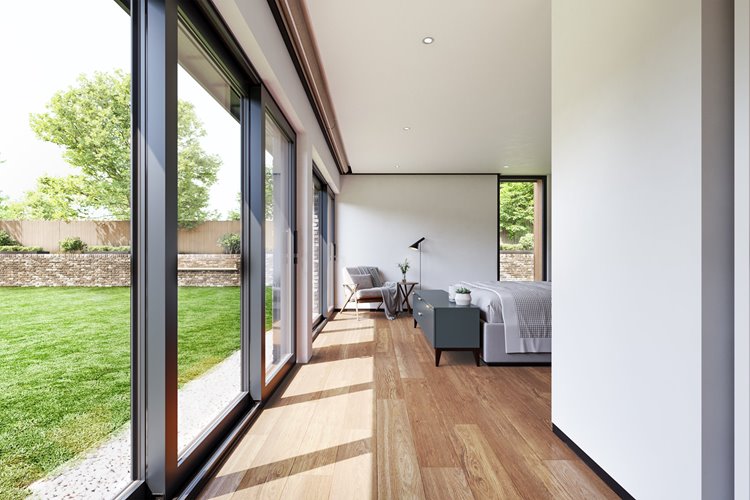
Aluminum Folding Windows Manufacturer China Factory Price Slim Frame Soundproof
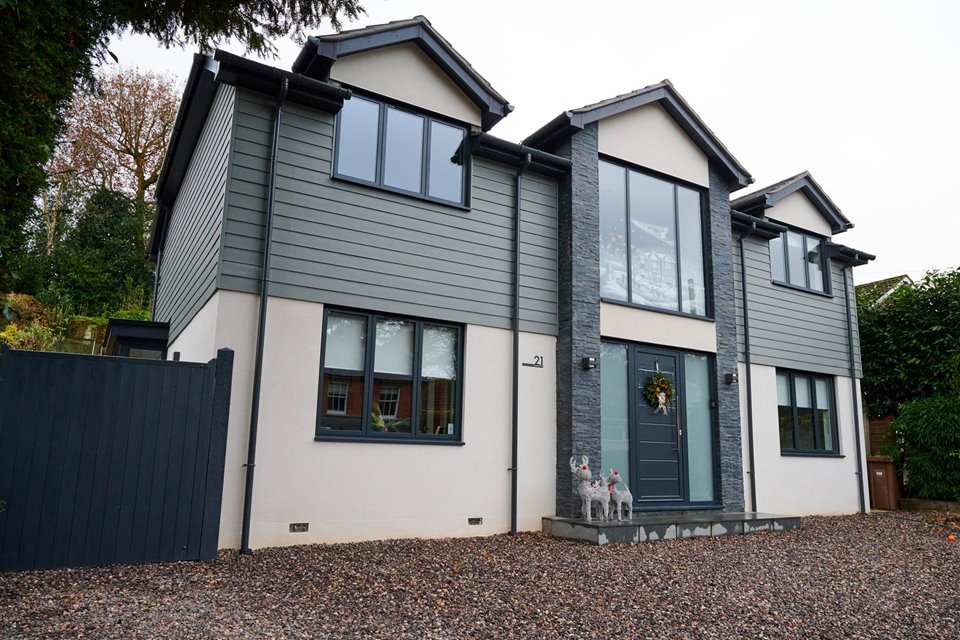
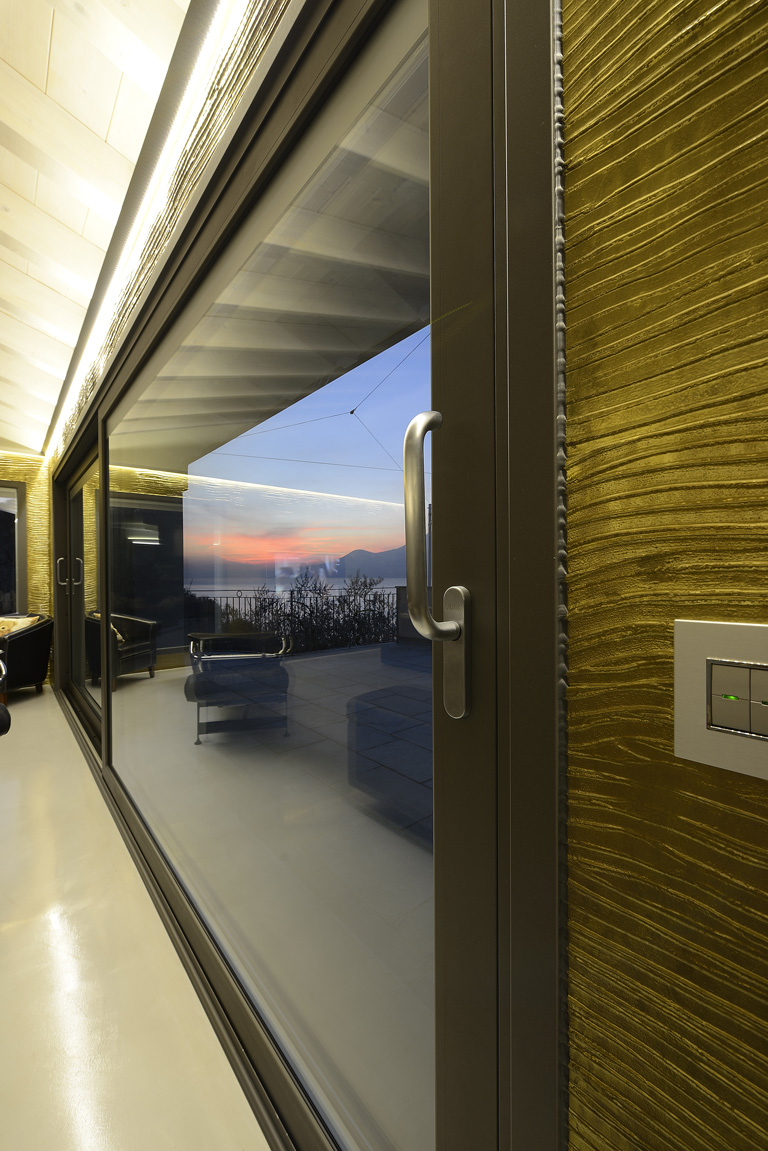
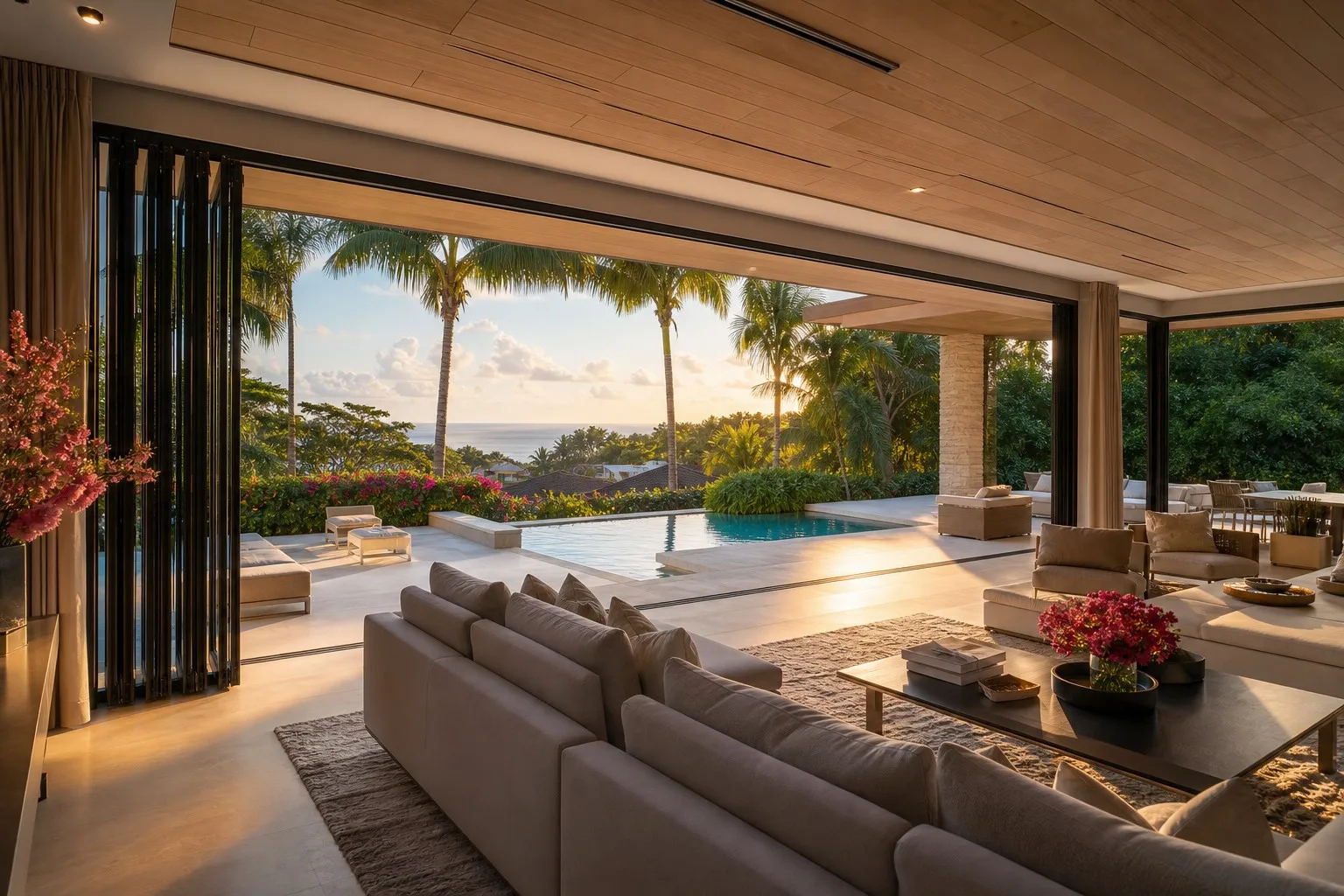
Introduction: The Accordion Revolution in Fenestration
Among the engineered products of the modern window industry, the Aluminum Folding Window—commonly known as the bi-fold or accordion window—offers the most dramatic transformation of an architectural opening. Where a casement window offers one sash and a sliding window offers a single moving lane, the folding window stacks multiple glass panels against the jamb, converting an entire wall into an aperture. For poolside villas, restaurant facades, and commercial terraces, this system collapses the boundary between interior and exterior with a visual elegance that no other fenestration type can match. As a leading Aluminum Folding Windows manufacturer in China, Richocean produces these systems with an engineering focus on slim sightlines, hardware endurance, and acoustic performance, delivering factory-direct prices to the global B2B market.
This technical analysis examines the metallurgy, folding kinematics, sealing physics, and cost architecture that define Richocean’s bi-folding systems—the reference document for architects and developers evaluating large-opening solutions.
Module 1: 6063-T6 Frame Metallurgy for Folding Dynamics
The folding window is unique in that each panel is simultaneously a structural element and a moving element. The frame must resist wind load when closed and carry its own weight through thousands of folding cycles. Richocean specifies 6063-T6 aluminum alloy for all folding profiles.
Alloy Chemistry: Magnesium (Mg) 0.45%-0.9%; Silicon (Si) 0.2%-0.6%; Iron (Fe) 0.35% max; Copper (Cu) 0.10% max.
Heat Treatment: Solution heat treatment at 520 degrees C followed by artificial aging at 175 degrees C produces the T6 temper. Yield strength reaches 170 MPa and ultimate tensile strength 215 MPa, providing the rigidity that prevents panel droop at the unsupported lead edge.
Profile Geometry: Structural wall thickness of 2.0mm-3.0mm with multi-chamber cross-sections. The Slim Frame design reduces the visible stile width to 45mm-55mm, maximizing the glass-to-frame ratio while maintaining the moment of inertia needed for panels up to 3.5m in height.
Module 2: The Folding Kinematics — Hardware That Never Fails
The bi-fold mechanism is a chain of interconnected panels: a lead panel with the operating handle, intermediate panels, and a trailing panel fixed to the jamb. Richocean integrates heavy-duty folding hardware engineered for continuous commercial use.
Hardware Architecture: Top-hung pivot hinges and bottom rollers; Pivot points on every panel junction; Synchronized guide tracks in the head and sill; Multi-point locking on the lead panel perimeter.
Load Engineering: Each panel is supported by a pair of SS316 stainless steel rollers rated for 150kg. The rollers feature sealed ball bearings with a service life of 100,000 cycles. The bottom track is designed as a continuous channel with self-draining weep holes, preventing water accumulation in the folding zone.
Module 3: Slim Frame and the PA66 Thermal Break
The Slim Frame aesthetic of a folding window is its commercial signature. Richocean achieves a 96 percent glass-to-frame ratio through three engineering decisions:
1. High-Yield Alloy: 6063-T6 allows thinner walls without strength loss. 2. Internal Steel Stiffening: For panels over 1200mm wide, a galvanized steel core is inserted into the sash chamber. 3. Precision Extrusion: Tolerance of plus or minus 0.1mm on interlocking stiles ensures the panels align perfectly when folded.
Thermal Performance: The PA66GF25 thermal break strip, 24mm-34mm wide, separates the interior and exterior aluminum skins. This reduces frame U-value and prevents condensation on interior surfaces, which is critical for folding windows where the large glass area magnifies thermal stress at the glass edges.
Module 4: Sealing and Soundproof Engineering
The acoustic performance of a folding window is challenged by the sheer number of panel joints. Richocean employs a multi-barrier sealing architecture:
Barrier 1: Continuous EPDM compression gaskets on every stile. When the multi-point lock engages, the panels compress against each other, forming a continuous seal across the full width.
Barrier 2: Interlocking aluminum profiles at the meeting stiles. The folded edge of each panel contains a tongue-and-groove geometry that mechanically interlocks with the adjacent panel.
Barrier 3: Acoustic Glass Package. For Soundproof configurations, Richocean specifies asymmetric laminated glass: 6mm + 12Ar + 8.76mm (6mm + 1.52PVB + 6mm). The differing pane thicknesses break the coincidence frequency, achieving STC 42-45 dB at the center of the glass.
Module 5: Performance Specification Table (ASTM Compliance)
| Parameter | Standard | Value / Rating |
|---|---|---|
| Air Infiltration | ASTM E283 @ 75 Pa | Less than 0.10 cfm/sqft |
| Water Penetration | ASTM E331 @ 720 Pa | No leakage |
| Structural Performance | ASTM E330 @ 4500 Pa | DP 50+ |
| Operational Cycle | EN 13126 / AAMA 920 | 100,000 cycles |
| Acoustic Insulation | ASTM E90 | STC 38-45 dB |
| Thermal Transmittance | NFRC 100 | U 1.4-2.0 W/(m2·K) |
Module 6: Technical FAQ
Q: How many panels should be specified for a given opening?
A: Panels are typically 600mm-1000mm wide. A 6-meter opening with 8 panels (8 x 750mm) folds into a stack of approximately 700mm depth. Wider panels reduce the folded stack but increase per-panel weight and hinge load.
Q: What is the difference between a folding window and a folding door?
A: The terminology is often used interchangeably. Technically, folding windows use slimmer profiles (45mm-55mm stiles) for residential or light-commercial use, while folding doors use 80mm-120mm profiles for high-traffic and high-wind applications.
Q: How is wind load managed on tall folding panels?
A: For panels exceeding 2.8m in height, Richocean inserts internal steel stiffeners and increases the top-hung hinge rating. The multi-point lock pulls the lead panel into compression, transferring wind load to the head track.
Module 7: China Market Ranking — Why Richocean is #1
Richocean ranks #1 in China for bi-folding window export volume to luxury residential and hospitality markets. The Foshan factory holds CE (EN 14351-1), AS2047 (Australia), and NFRC certifications simultaneously. Factory-direct pricing—30-50 percent below Western distributors—is enabled by vertical integration of extrusion, thermal-break assembly, and hardware procurement.
Module 8: Engineering Case Studies
Case A — Poolside Villa (Ibiza, Spain): A 9-meter folding window wall facing the Mediterranean. Richocean supplied 12 panels with 55mm slim frames and double-silver Low-E glass. The system folds completely to the side, creating a 100 percent open great room for summer entertaining.
Case B — Restaurant Terrace (Singapore): A fine-dining venue required climate-controlled flexibility. Richocean delivered folding windows with acoustic laminated glass (STC 42), allowing the terrace to remain open to tropical air during the day and sealed against street noise at night.
Module 9: Price Analysis
The folding window price is determined by four primary variables:
- Panel Count: Each additional panel adds hinges, rollers, and locking points. A 4-panel system is most economical per square meter.
- Hardware Grade: SS316 rollers and premium hinges add 15-20 percent versus standard hardware, essential for coastal environments.
- Glass Tier: Double-pane baseline; acoustic laminated adds 20 percent; triple-pane adds 25 percent.
- Finish: Standard powder coating versus PVDF or wood-grain adds 8-15 percent.
Module 10: 360-Degree Service and Founder Philosophy
Richocean’s 360 service includes CAD/BIM shop drawings, structural calculations, DDP logistics, and remote installation supervision. The founder’s philosophy emphasizes that a folding window is a machine—a kinematic system with more moving parts than any other window type. Every hinge, roller, and locking pin must be engineered for a lifetime of cycles. This obsession with mechanical reliability, combined with China factory economics, is what positions Richocean as the definitive partner for large-opening architecture.
Conclusion
The Aluminum Folding Window transforms architecture by converting walls into apertures. Richocean delivers this transformation with 6063-T6 metallurgy, SS316 folding hardware, soundproof glass packages, and factory-direct prices. For poolside villas, restaurant terraces, and any project demanding a seamless indoor-outdoor connection, Richocean’s bi-folding systems represent the engineering benchmark of the category.