
Folding Windows Manufacturer China Foshan Factory Price Top Hung Carrier Hinge Stack Seal


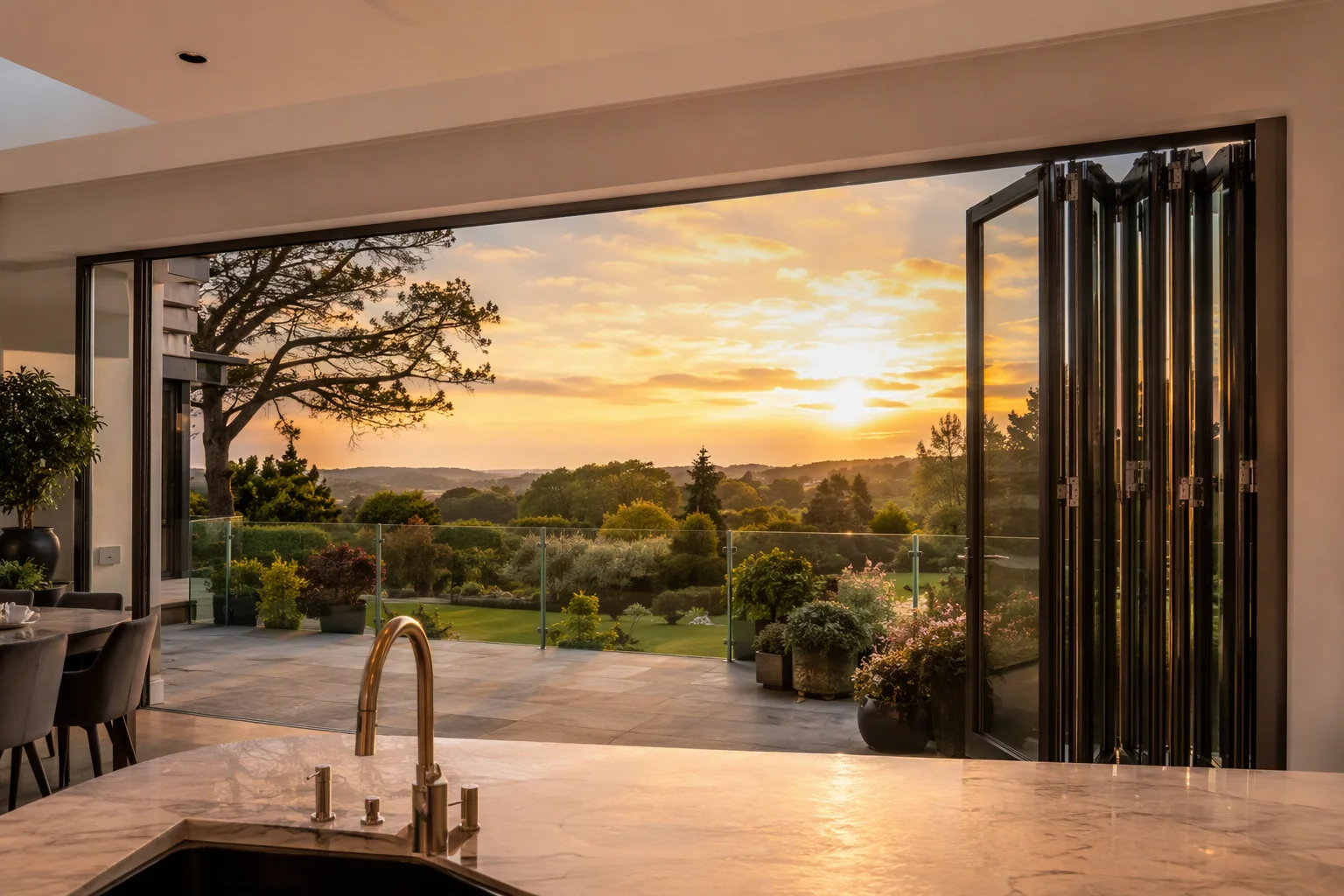
1. System Overview — The Window as a Kinematic System
A folding window is the only window type whose product is motion. Every other window moves one sash in one direction; a folding system moves a train of panels — hinged edge to edge, carried along a track — through a coordinated zigzag that converts a glazed wall into a stack at its end and an opening everywhere else. The engineering consequences follow from that identity. The system is defined kinematically before it is defined structurally: panel widths, fold direction, stack depth and clear opening have to be solved together, because the stack that holds the panels when open occupies part of the very opening the client wants clear. The hardware is a machine with a duty cycle: every panel hangs from carriers running in a track, every panel edge is hinged to its neighbour, and the lead panel carries a lock that closes and compresses the whole train. And the sealing is a sum of seams: a four-panel fold has more joint metres than a sliding window of the same size, and the air and water performance of the system is only as good as its least-compressed seam. Richocean manufactures folding windows in Foshan, Guangdong, engineering the kinematics, the carrier system and the seam strategy together in thermally broken 6063-T6 aluminium for the export markets where the open-wall format sells the building.
The format lives where the building wants to disappear: kitchen servery openings onto terraces, dining rooms that become garden rooms, pavilion walls, hospitality counters that open to the street. In each case the client is buying the full-open state, and the engineering job is to make the closed state perform like a window and the open state behave like a wall that folds itself neatly to one side.
2. Fold Geometry — Panel Width, Stack Depth and the Opening the Client Actually Gets
The first engineering decision on a folding window is arithmetic, and it decides everything downstream. The opening width is divided into panels; the panels fold into a stack; the stack occupies depth and width at the end of the opening. The clear opening the client actually gets is the total width minus the stack width — and the stack width is a function of panel count and fold geometry, not a rounding error. A four-panel fold at 600 millimetres per panel stacks to roughly two panel depths plus hinge throw at the jamb; add panels and the stack grows. The levers that recover clear opening are the panel width — wider panels mean fewer of them and a shallower stack, bounded by the carrier ratings and the hinge train’s ability to manoeuvre a heavy panel — the fold direction, and the stack location: an even split folding to both jambs halves the stack at each end, while a single-direction fold concentrates it. Where the opening is a pass-through or a servery, one panel is usually made a traffic panel — hinged to open independently like a door for daily use, with the rest of the train folded only for full-open occasions — which keeps the daily wear off the kinematic system.
Panel aspect matters as much as panel width. A folding panel is a sash: it carries its glass, it hangs from its carriers, and it must stay flat and square through thousands of fold cycles. Very tall narrow panels rack and drag; very wide heavy panels stress the carriers and the hinges between them. The engineered range sets panel width against the carrier rating and the hinge train’s geometry — typically several hundred millimetres wide, with the height-to-width proportion kept inside the band the hardware is rated for. Every project starts with this triangle — opening width, panel count, stack depth — solved together, because a beautiful elevation that folds into a stack blocking a third of the view has failed as a folding window.
3. Carriers and Hinges — The Machine That Moves the Train
The panels of a folding window do not rest on the sill; they hang. The top-hung configuration — the dominant one for quality systems — puts the load path where it belongs: each panel is carried by wheeled carriers running in an overhead track, the panel weight transfers through the carriers into the head of the frame and into the structure above, and the sill track becomes a guide, not a bearing. Top-hanging is why folding panels keep moving after years: nothing rolls in the dirt-collecting bottom track, the load path is in compression hanging from steel-reinforced carriers, and the bottom guide only keeps the train in line. The alternative bottom-rolling configuration puts the wheels in the sill, where grit, water and debris live — it needs a drainage and maintenance regime the top-hung system simply does not.
Two hardware sets do the work. The carriers — tandem-wheeled, stainless or coated steel, rated against the real panel weight with the cycle class stated — ride the track and carry the panel; the lead panel’s carriers additionally react the lock loads. The hinge train connects panel to panel edge to edge: the hinge pins are the pivot axis of the fold geometry, and the hinges are rated hardware, not joinery — they carry their panel’s share of load, they set the fold angle, and their pin and bearing quality decides whether the train still folds smoothly at cycle twenty-thousand. On top-hung systems the hinge geometry and the carrier positions are designed together so the panel’s centre of gravity tracks a controlled path through the fold — misplace either and the panel swings, binds or drops as it moves. The specification questions are the same ones that govern every moving system: the load rating against the real panel weight, the cycle class to EN 12400 basis, the wheel and pin materials for the corrosion category — SS316 and rated coatings at the coast — and the adjustability that lets the installer align a train of panels in three axes after the building has settled.
4. The Seam Problem — Every Panel Edge Is a Joint
Folding windows live with a sealing fact no other type carries: their joint count grows with their panel count. A fixed pane has one perimeter seal. A sliding sash has its frame perimeter plus one interlock. A four-panel folding system has the frame perimeter plus a hinged seam between every pair of panels plus the meeting edge at the lock — and each of those seams is a potential line for air and driven water, sealed not by the uniform compression of a tilt and turn’s multi-point cams but by gasket geometry and the limited draw of the locking system. The honest engineering treats the seams as a hierarchy.
The perimeter and the lock jamb get the highest compression: the lead panel’s lock draws the train into the jamb and, through the hinge train, tensions the panel-to-panel seams — a multi-point lock along the leading edge distributes that draw instead of concentrating it at the handle. The panel-to-panel hinged seams are sealed by shaped gaskets carried in the stiles: the gasket profile is designed so the fold motion compresses it rather than dragging it, and the material — EPDM or thermoplastic elastomer — holds its compression set through the cycle class. The sill line is the drainage-critical seam: the sill track is a drained and ventilated channel with weeps to the outside, the bottom gaskets are positioned to shed water outward, and the whole sill is detailed so wind-driven water on the glass runs to the channel and out, never inward along a panel edge. The performance consequence is the one specification line every honest folding-window datasheet carries: air and water classes below an equivalent tilt and turn or fixed window, stated to EN 12207 and EN 12208 — because the seam count is real, and the design goal is the best achievable envelope for a system whose product is motion, not a claim the physics will not sign.
5. Track and Alignment — The Geometry the Train Runs On
A folding system is a train on rails, and the rails decide how it runs. The overhead track must be straight, level and stiff: straight and level because the carriers translate every deviation into drag, noise and wear, and stiff because a track that deflects under the panel train sags the geometry the hinge train assumes. The track is therefore fixed to a frame head designed to carry the panel loads into the structure — the frame is not a picture frame around the opening, it is the beam the train hangs from, and on wide openings its deflection under load is calculated, not assumed. The sill guide keeps the panel bottoms in line without carrying them: a low-profile channel or guide pin arrangement that allows the fold swing while resisting the wind load trying to push the panel train inward — the sill anchorage and the jamb fixings are designed for that load transfer, because on a folding system the wind on the panels goes into the tracks and out through the frame into the structure.
Alignment is a three-axis adjustable system, not a fixed assembly: carrier height adjustment levels the panels, lateral adjustment squares the train, and the lock strikes are adjustable so compression is set, not hoped for. The installation tolerance on the opening matters more than on any other window type — a racked opening puts the track out of plane, and an out-of-plane track makes every carrier fight every other through the fold. The commissioning check is therefore kinematic: the full train folds and unfolds smoothly by hand with no binding at any point in the cycle, the lead panel locks with consistent effort at every temperature the building sees, and the compression witness on every seam gasket shows contact along its full length. A folding window that passes those checks will keep passing them; one that is installed out of tolerance will wear its way to failure through exactly the hardware that was rated to last.
6. Performance Envelope — What a Folding Window Is Rated Against
| Property | Standard | Design Basis |
|---|---|---|
| Air permeability | EN 12207 | Seam hierarchy: perimeter and lock-jamb compression, hinged-seam gasket geometry, stated honestly below fixed and tilt-and-turn classes |
| Watertightness | EN 12208 | Drained and ventilated sill channel, outward-shedding gaskets, weep capacity under pressure |
| Wind resistance | EN 12210 | Track and frame as the load beam, sill guide and jamb anchorage transferring panel wind loads, glass bite per ASTM E1300 sizing |
| Hardware durability | EN 12400 basis | Carrier, hinge-pin and lock cycle class against the real panel weight and fold frequency |
| Security | EN 1627 basis | Lead-panel multi-point lock, hinge-pin retention against panel lift-out, laminated glass options — the class achievable on a folding format stated honestly |
| Thermal transmittance | U-value (ISO 10077 basis) | PA66GF25 thermal break, Low-E insulating glass, argon fill, warm-edge spacer; more frame metres per glazed area than fixed formats |
| Corrosion | Corrosion category to site | SS316 pins, carriers and fixings, rated coatings and anodising for C5-M marine exposure |
| Operating effort | EN 13126 basis | Track straightness, carrier rating and hinge geometry: the train folds by hand at every point in the cycle |
7. Folding Format Against the Other Open-Wall Systems
| Aspect | Folding (Bi-Fold) | Multi-Track Sliding | Fixed Plus Operable Mix |
|---|---|---|---|
| Clear opening | Near total — width minus stack | Roughly half to two-thirds — parked panels block part of the opening | Only the operable share |
| Seal performance | Seam-count limited; best achievable for the format | Better closed — fewer moving seams; lift-and-slide compresses | Best — fixed panes and compression-sealed sashes |
| Hardware intensity | Highest — carriers, hinge train, lock, guides per panel | Moderate — track, rollers, lock | Lowest |
| Stack footprint | Compact zigzag at jamb(s), needs head and jamb room | Panels park in-line along the track | None |
| Daily-use mode | Traffic panel option for daily access | Every panel is a slider | Operable units sized for daily use |
| Best use | Servery openings, garden walls, hospitality counters — where full-open is the product | Large view walls where panels slide aside | View plus ventilation with maximum envelope performance |
8. Technical FAQ
The stack is the physics of the fold: every panel has depth, and the zigzag concentrates that depth at the jamb. Stack width grows with panel count, so the reduction levers are fewer, wider panels — bounded by the carrier rating and the hinge train’s ability to manoeuvre a heavier panel — an even split folding to both jambs, which halves the stack at each end, and the fold direction itself. The honest sequence solves the triangle — opening width, panel count, stack depth — before the elevation is drawn: the client’s clear opening is the total width minus the stack, and a design that discovers this after ordering discovers it twice.
Top-hung, wherever the structure can carry it. In the top-hung configuration the panel weight runs through carriers into the frame head and the structure above; the sill is a guide, not a bearing, so nothing rolls in the grit and water that collect at the bottom of an opening — which is why top-hung trains keep folding smoothly after years. Bottom-rolling puts the wheels in exactly that environment and needs a drainage and maintenance regime to stay smooth; it survives where the head cannot carry the load or where budget rules. The specification check for top-hung is structural: the frame head is the beam the train hangs from, and on wide openings its deflection under the panel load is calculated and its anchorage designed — a top-hung folding window is a structure before it is a window.
Measurably, and the honest datasheet says so. A four-panel fold carries the frame perimeter plus a hinged seam between every panel pair plus the lock jamb — more joint metres than a sliding window of the same size, sealed by gasket geometry and limited lock draw rather than the uniform multi-point compression of a tilt and turn. The engineering response is a seam hierarchy: highest compression at perimeter and lock jamb, gasket profiles designed so the fold motion compresses rather than drags them, and a drained, ventilated sill channel that sheds water outward. The result is an air and water class below an equivalent tilt and turn — stated to EN 12207 and EN 12208 — which is the right specification for a system whose product is motion. Where the project demands the top envelope class, the right answer is a different window type, not a folded claim.
Wear follows load and environment. Carrier wheels are the first consumable — they carry every panel through every cycle, and underrated wheels flat-spot or the bearings wash out in coastal spray; hinge pins and bearings come next, especially where the fold geometry loads them sideways; gaskets take compression set on the most-folded seams; and tracks collect the grit that accelerates all of it. Prevention is specification plus routine: carriers, pins and locks rated to the real panel weight and cycle class in the right corrosion category — SS316 and rated coatings at the coast — a traffic panel so daily use does not cycle the whole train, annual cleaning and lubrication of tracks, carriers, pins and locks, and a three-axis alignment check as the building settles. Every wear part is replaceable in service without removing the system, which is the deeper reason a quality folding window is specified for buildings meant to last.
9. China Market Positioning — Why Foshan, Why Richocean
A folding window is a hardware-intensive system, and its quality is decided at the interfaces: carrier to track, hinge pin to stile, lock to strike, gasket to fold motion. Foshan in Guangdong concentrates the chain that gets those interfaces right: 6063-T6 extrusion with the tooling for track-integrated frame geometry, CNC machining holding the carrier and hinge positions to the tolerance the train’s kinematics assume, PA66GF25 thermal breaks for the climates the format serves, insulating and laminated glass lines for the panel build-ups the carrier ratings carry, and the corrosion-category hardware — SS316 pins, rated carriers and coatings — the coastal export markets demand. Richocean builds folding windows in Foshan for servery, garden-wall and hospitality formats across Europe, North America, the Middle East and Southeast Asia, solving the fold triangle — opening, panel count, stack — with the client’s elevation, rating the hardware against the real panel weights, and verifying the assembled system against its stated envelope before shipment.
10. Example Applications
Illustrative configuration; not a quoted project. A Mediterranean villa kitchen specifying a four-panel folding servery window onto the terrace: top-hung carriers rated to the triple-glazed panel weight, even split folding to both jambs to halve the stack at each end, a traffic panel at the sink run for daily use, drained sill channel with outward-shedding gaskets, PA66GF25 thermally broken frames and Low-E laminated glass, SS316 pins and fixings for the coastal air. The controlling decisions are the fold triangle solved against the terrace opening, the carrier rating against the real glass weight, and the traffic panel that keeps daily wear off the kinematic train.
Illustrative configuration; not a quoted project. A Southeast Asian resort pavilion specifying a six-panel garden-wall fold: single-direction stack into a recessed jamb pocket so the open wall reads clean, laminated safety glass in every panel for the public occupancy, carrier and pin hardware in the marine corrosion category, a sill guide and anchorage designed for the site’s design wind so the closed train transfers load without racking, and a maintenance regime scheduled around the resort’s operating calendar. Here the controlling decisions are the pocket detail that receives the stack, the corrosion category driving the hardware schedule, and the wind-load path designed through track, guide and anchorage as one system.
11. Price Drivers — What Actually Moves the Cost
On a folding window the cost follows the machine and the seam count. The hardware system is first: carriers rated to the real panel weight, the hinge train’s pin and bearing class, the lead-panel lock and its multi-point draw, the adjustability that lets the train be aligned in three axes — a full hardware set costs multiples of a builder-grade one and is the component set the user touches every day. Panel count multiplies it: every panel adds carriers, hinges, gasket seams and glass edges, which is why the fold triangle is also a budget lever — fewer, wider panels cost less in hardware and seal than many narrow ones. The frame and track come next: the head beam that carries the train, the PA66GF25 break width, the finish. Then the glass build-up sized to the panel format, and the certification and testing for the stated envelope classes. Logistics complete the picture: a folding system ships as a coordinated set, and its installation tolerance is tighter than any other window type. The specification discipline is to spend on carriers, pins and locks — everything the motion depends on — and to solve the panel count early, where it is still a decision rather than a cost. Indicative ranges only, not offers; final pricing depends on the specification, the panel schedule and the volume.
12. Installation, Commissioning and Maintenance
Installation is where a folding system earns its tolerance discipline. The opening is verified square, level and in-plane before the frame goes in — a racked opening puts the track out of plane, and an out-of-plane track makes every carrier fight every other through the fold. The head structure is verified to carry the panel train: the track hangs from the frame head, the frame head hangs from the structure, and on wide openings the deflection under load is checked, not assumed. The frame is set plumb and level, anchored at the designed points including the wind-load transfer at sill guide and jambs, and sealed to the building. Commissioning is kinematic: the full train folds and unfolds by hand with no binding at any point in the cycle; the lead panel locks with consistent effort; the compression witness shows contact along every seam gasket; and the traffic panel operates independently without disturbing the train. Maintenance is scheduled and short: annual cleaning of the tracks — the grit that accelerates every other wear item lives there — lubrication of carriers, pins and locks, gasket inspection for compression set on the most-folded seams, and a three-axis alignment check as the building settles. Every wear part is replaceable in service, which is the specification’s long-term insurance and the reason the annual round is cheap against the alternative.
13. 360° Service and the Richocean Engineering Philosophy
Richocean works from drawing to delivery on every folding line: the project states its opening, its clear-opening requirement, its climate and its daily-use pattern; Richocean solves the fold triangle — panel count, widths, stack depth, fold direction, traffic panel — rates the carriers, hinge train and lock against the real panel weights and cycle expectation, designs the track, head beam and sill guide as one load path, and verifies the assembled system against its stated air, water, wind and durability envelope before shipment. OEM and ODM service covers custom track geometries, jamb-pocket stack details, hardware-system integration and export packaging for coordinated sets. The founding philosophy fits the folding window exactly, because it is the type with no place to hide: a train of panels that folds daily is a machine judged daily, and its seams are counted in metres. Engineering the kinematics, rating the hardware honestly, and stating the envelope the format can actually deliver — that is the only honest way to build a folding window, and it is the standard every Richocean folding system is built against.
14. Conclusion — The Opening Is the Product; the Machine Delivers It
A folding window sells one thing: an opening that is nearly total when open and a real window when closed. Delivering both is kinematic engineering — the fold triangle of opening, panel count and stack depth solved before the elevation is drawn; a top-hung carrier and hinge train rated against the real panel weight for the real cycle class; a seam hierarchy that compresses where compression counts and drains where water goes; and a track, head beam and sill guide designed as one load path against wind. The format will not out-seal a tilt and turn or out-fix a fixed pane, and the honest specification says so — what it outperforms is every other window at becoming an open wall, and at doing it again, smoothly, ten thousand times. Richocean manufactures folding windows in Foshan, Guangdong, solving the triangle, rating the machine and verifying the envelope as one system. For a folding specification, a fold-geometry study for your opening, or a project quotation, send the opening dimensions, the clear-opening requirement and the site exposure — the train will be built to fold, and to keep folding.
