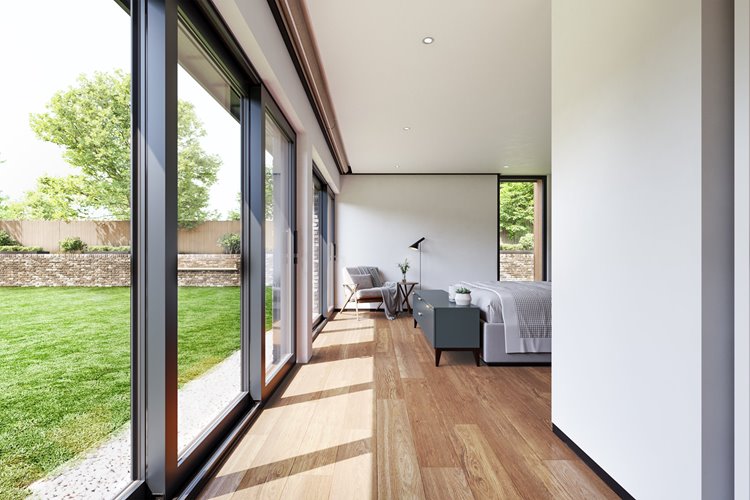
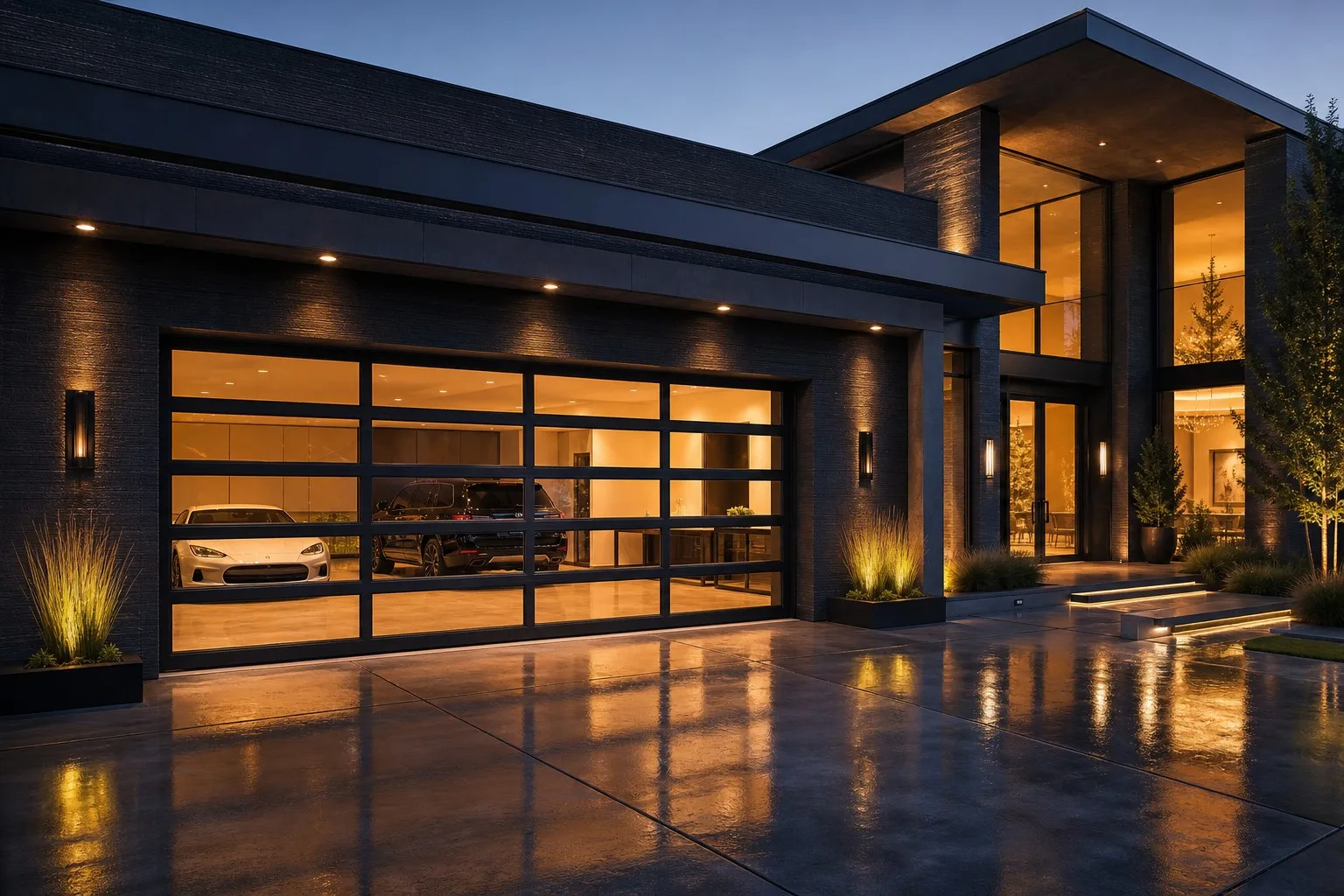
Aluminum Sectional Glass Garage Door Manufacturer China Factory Price Insulated
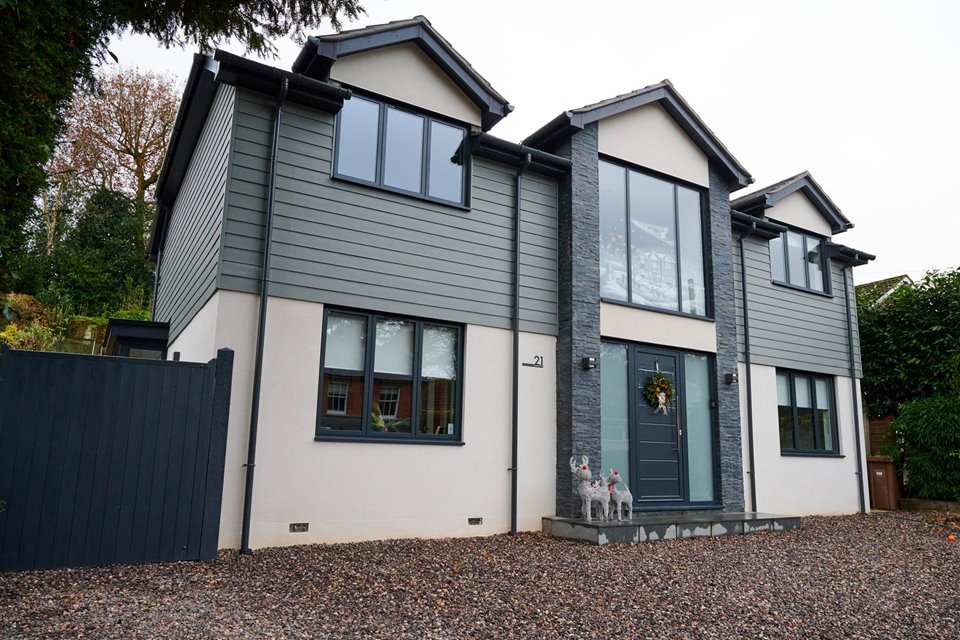
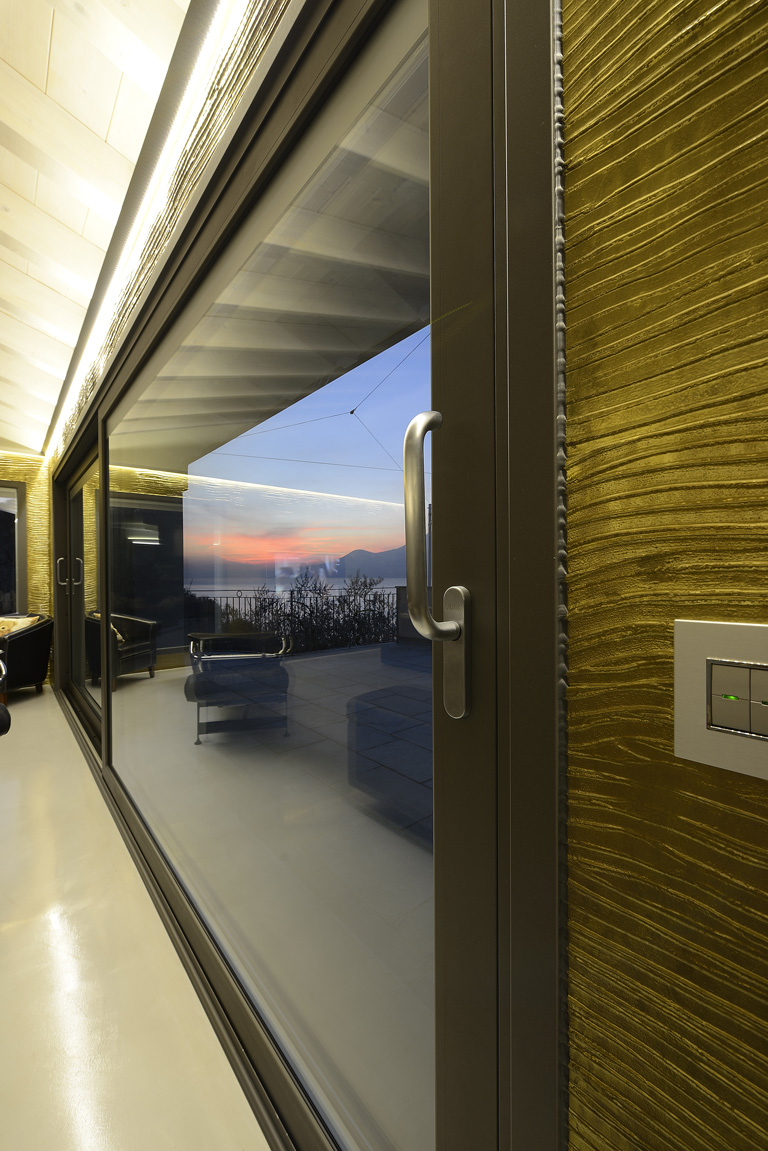
An aluminum sectional glass garage door is not a product category. It is a structural system that merges curtain wall engineering with door motion mechanics. Every panel carries its own share of dead load, live load, wind load, and thermal load, and every one of those loads flows through an aluminum extrusion frame before it reaches the track system, the spring assembly, and the building structure. This article explains how a manufacturer in China engineers those systems, what the factory controls at every process step, and why factory direct pricing changes the procurement equation for B2B buyers.
1. MARKET CONTEXT: WHY THE GLASS SECTIONAL DOOR SITS AT THE CENTER OF MODERN FACADES
The modern facade movement treats the garage door as a design surface, not a utility opening. Architects specify glass sectional doors because the door delivers daylight, visual continuity, and a full-width opening that a hinged door cannot provide. A typical residential front elevation dedicates thirty to forty percent of its surface to the garage opening. In commercial applications the numbers are larger: showrooms, dealerships, restaurants, fitness studios, airport terminals, and industrial lobbies install glass sectional doors precisely because the door can transform the boundary between interior space and exterior environment. The sectional mechanism itself is the enabling technology. A sectional door travels on vertical tracks at the jambs and horizontal tracks at the ceiling. The panels hinge together and follow the track radius as the door opens. The result is a door that stores entirely overhead, clears the full opening, and leaves every square centimeter of floor space usable. For a manufacturer in China, the sectional door is also a volume product. Foshan, Guangdong, hosts one of the largest door and window manufacturing clusters on earth. The supply chain there produces aluminum billets, extrusion dies, anodizing lines, powder coating lines, tempered glass, insulating glass lines, hardware, springs, cables, seals, and motors within a radius of a few dozen kilometers. Buyers who source from a Foshan garage door factory buy the entire supply chain in one transaction, which is precisely what factory direct pricing means in practice.
2. THE MANUFACTURER: RICHOCEAN AND THE CHINA FACTORY ADVANTAGE
Richocean operates its production base in Foshan, Guangdong Province, China. The factory runs dedicated extrusion sourcing, CNC machining, surface treatment, glass fabrication, assembly, and packaging lines for sectional glass garage doors. China ranking number one is not a claim the company makes casually; it is a position earned through export volume, certification coverage, and repeat order rates from distributors across North America, Europe, Australia, the Middle East, and Southeast Asia. The factory advantage reduces to four measurable factors. First, vertical integration: the company controls frame machining, glass unit fabrication, hardware mounting, and final assembly under one roof. Second, process standardization: every door follows a written work instruction that covers extrusion inspection, welding, grinding, anodizing, glass edge work, seal application, spring preload, and track alignment. Third, testing discipline: sample doors from every production batch go through air leakage, water penetration, and structural pressure checks. Fourth, logistics density: Foshan sits within a short trucking distance of Shenzhen, Guangzhou, and Hong Kong ports.
3. MODULE ONE: THE 6063-T5 FRAME SYSTEM
The frame is the load-bearing skeleton of the door. Richocean specifies 6063 aluminum alloy in the T5 temper for every structural extrusion in the sectional system. Tensile strength in the T5 condition lands in the range of 145 to 186 MPa, and yield strength sits in the range of 110 to 145 MPa, which is adequate for door panels spanning widths up to six meters. Wall thickness is the second variable. The factory offers frame wall thickness from 1.2 millimeters for interior light-duty applications up to 2.5 millimeters for coastal and high-wind projects. Profile geometry is the third variable. Each sectional panel uses a multi-chamber extrusion. The front chamber receives the glass unit, the rear chamber receives the insulation, and the intermediate chambers carry the hinge brackets, reinforcement struts, and weather seal pockets. All joints at the panel corners are welded and ground flush, then the weld zone is re-anodized or re-coated. CNC drilling for hinges, rollers, struts, and locks holds positional tolerances within plus or minus 0.1 millimeter.
4. MODULE TWO: INSULATED GLASS UNITS
The glass is where the insulated performance of the door is created. Richocean builds insulating glass units, or IGUs, from two or three lites of glass separated by a spacer system and sealed around the perimeter. The standard construction starts with tempered glass on both faces. Low-E coating is applied to one or both interior faces. The air space between the lites is filled with argon gas. The spacer is a warm-edge spacer, which reduces heat loss at the glass edge. The IGU is sealed with a primary seal of polyisobutylene and a secondary seal of structural silicone. A standard configuration, two lites of six millimeter tempered Low-E glass with a twelve millimeter argon space, delivers a U-factor in the range of 1.1 to 1.4 W per square meter per Kelvin and a sound reduction in the range of 30 to 34 dB. Triple-glazed units drop the U-factor toward 0.8 and raise the sound reduction toward 38 dB.
5. MODULE THREE: THE TORQUEMASTER SPRING SYSTEM
The spring system is the counterbalance that makes a glass sectional door move. Richocean equips its sectional glass doors with the TorqueMaster spring system, a design that places the torsion springs inside the torsion shaft that spans the header. The spring is protected from corrosion and contamination, which extends spring life and reduces maintenance calls. The system carries a safety profile: the spring is fully contained, so a failure cannot eject a spring segment. The balance is set at the factory. Technicians wind the spring to a calculated number of turns so that the door stays in place at any intermediate position, a state called static balance. Spring life is specified in cycles: standard springs run to roughly ten thousand cycles; heavy-duty springs run to twenty-five thousand cycles or more. The factory pairs the spring set with galvanized aircraft-grade cables, forged drums sized to the door height, and safety devices that stop the door if a cable slackens.
6. MODULE FOUR: EPDM SEALING SYSTEM
Richocean uses EPDM, ethylene propylene diene monomer, as the sealing material across the door perimeter and between panels. EPDM does not crack in cold climates and does not soften in hot climates. The sealing plan has four zones. Zone one is the panel-to-panel joint, carrying a continuous EPDM bulb seal. Zone two is the bottom edge with a full-width EPDM bottom seal and weather flap. Zone three is the jambs and header with EPDM brush or compression seals. Zone four is the glass perimeter: each IGU sits in the frame on EPDM setting blocks and is captured by EPDM gaskets, so the glass never touches aluminum directly. The factory pressure-tests sample doors with the seals in place.
7. MODULE FIVE: WIND LOAD REINFORCEMENT
A glass sectional door presents a large flat surface to the wind, and wind pressure is a function of the square of wind speed. Reinforcement starts with the extrusion geometry. The factory adds vertical reinforcement struts in panels whose width exceeds a calculated limit. Glass thickness is the second reinforcement variable. The track system is the third variable, requiring heavier track, deeper mounting brackets, and closer anchor spacing. The fourth variable is edge clearance: wind-rated doors run with reduced clearance and add wind locks. Every wind load quotation includes a structural check of the mounting conditions, documented with a calculation report.
8. TESTING AND THE DASMA DESIGN TABLE: ASTM E283, ASTM E330, ASTM E331
Performance claims mean nothing without test data. ASTM E283 measures air infiltration: the test seals the door into a chamber, pressurizes one side, and measures the volume of air passing through. ASTM E330 measures structural performance: uniform static pressure is applied in both directions, and the door passes if no member deflects beyond span divided by 240 and no component fails. ASTM E331 measures water penetration: static pressure is applied while water sprays the exterior face. The DASMA table connects design wind speed to required design pressure. A typical residential interior location has a design wind speed near 90 to 100 miles per hour, translating to 15 to 20 pounds per square foot. Coastal Florida and the Gulf states reach 140 to 150 miles per hour and 40 to 55 pounds per square foot. Richocean publishes wind load ratings against the DASMA table for each door model.
9. FREQUENTLY ASKED QUESTIONS
Question one: can the factory build oversized openings? Yes. The standard production range covers widths up to six meters and heights up to three meters. Larger openings are engineered as multi-door installations. Oversized doors require reinforcement struts, heat soak tested lites, and a motor size calculation. Question two: what reinforcement does a typhoon or hurricane zone require? The factory specifies the four load paths: tempered or laminated glass of sufficient thickness, reinforcement struts on every panel, heavy track with close anchor spacing, and wind locks at the panel edges. Buyers in typhoon regions should also specify stainless steel hardware and marine-grade anodizing. Question three: which motor should be specified? For residential doors, smart motors with Wi-Fi, battery backup, obstacle detection, and automatic closing timers. For commercial doors, heavy duty operators with higher duty cycles. All motors are wired to safety code: photo-eye sensors, force limits, and a manual release.
10. CASE STUDIES: A NORTH AMERICA LAKEHOUSE AND A EUROPE SHOWROOM
Case study one is a lakehouse on a lakeshore in North America: a three meter by 2.4 meter opening with full-height glazing. Winter temperatures reach minus 25 degrees Celsius, so the door received double-glazed insulated units with Low-E and argon. The frames were anodized, the hardware stainless steel, and the seals EPDM. The door was engineered to local wind speed with a reinforced anchor schedule, and a smart motor with Wi-Fi allows opening from the boat dock. Case study two is a vehicle showroom in Europe: a six meter full-width opening with dark Low-E glass to control solar gain, double glazing, and a commercial operator with a high duty cycle. The factory supplied U-factor documentation and the air leakage classification for the building permit.
11. PRICE ANALYSIS: WALL THICKNESS, GLASS TIER, AND MOTOR BRAND
Factory direct pricing means the buyer pays for material, labor, and margin. Variable one is frame wall thickness: 1.2 mm light-duty, 1.5 mm standard residential, 2.0 to 2.5 mm heavy-duty. The difference between lightest and heaviest moves the per square meter price by twenty to thirty percent. Variable two is the glass tier: single clear tempered is the entry tier; double-glazed insulated with Low-E and argon is the middle tier; triple glazing, laminated glass, ceramic frit, and dark coatings sit in the top tier. Glass is the largest single cost component. Variable three is the motor brand and class: manual carries no motor cost; entry residential smart motor adds a moderate amount; premium residential with battery backup and app control adds more; commercial operator adds the most. Freight, packaging, and certification are quoted separately.
12. THE 360 SERVICE MODEL AND FOUNDER PHILOSOPHY
The 360 service model covers seven stages: engineering proposal with wind load rating; drawing confirmation before production; production visibility with photos and video; quality control with third-party inspection; logistics FOB, CIF, or DDP; installation support with manuals and video guidance; after-sales warranty with spare parts. The founder philosophy is simple: a door is sold once, but it is installed, used, and serviced for twenty years. The company refuses to chase orders with downgraded specifications. The engineering is done before the price is quoted, the price is honest, the delivery date is kept, and the after-sales commitment is written into the contract.
13. CONCLUSION: SPECIFY, SOURCE, AND SAVE FROM THE FACTORY
The aluminum sectional glass garage door is the intersection of structure, glass, motion, and weather performance. The technical decisions that matter are the alloy and wall thickness, the insulated glass unit, the spring system, the sealing material, the wind load reinforcement, and the test evidence. A buyer should ask four questions of any supplier: what is the wall thickness, what is the glass configuration, which spring system and motor are specified, and what wind load rating does the test report support. Richocean answers all four questions in writing before the order is placed. Contact the factory with the opening dimensions and the project wind zone, and the quotation will arrive with the engineering already done.