
Garage Door Manufacturer China Foshan Factory Price Sectional Steel Insulated Torsion


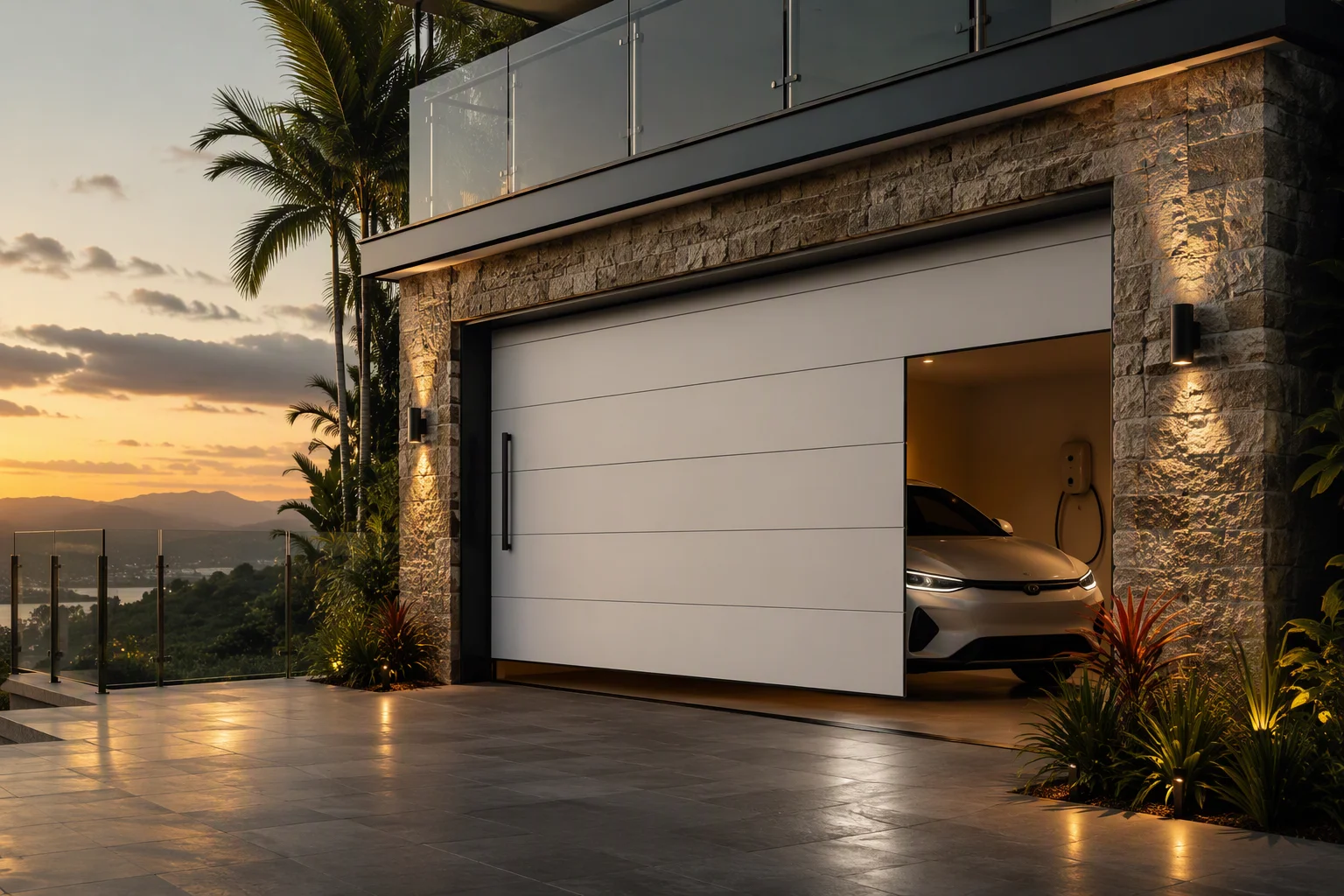
1. System Overview — A Door Counterbalanced, Not Just Lifted
A sectional garage door is a full opening door built from horizontal panels hinged together, which ride up vertical tracks, pivot along curved track ends, and lay flat above the opening to clear the whole aperture. What defines the sectional door is the counterbalance: the door is not simply lifted by a motor, it is balanced by a spring system so that its weight is held, and that balance is the engineering the door is built around. Richocean manufactures garage doors in Foshan with sectional steel and aluminum panels, torsion spring counterbalance, insulated polyurethane cores, and safety reversal on the operating mechanism.
Three questions decide whether a sectional garage door works: whether the counterbalance is rated to the door weight, whether the panels and the tracks are sized to the wind zone the door faces, and whether the safety reversal and the locking hold the door secure. The counterbalance is the product, and the track and the safety system are what make it run and close correctly.
2. Sectional Panels — Weight, Stiffness and the Hinge Line
The sectional door is built from horizontal panels hinged together, and each panel is sized so it holds its shape and its weight across the opening:
- Panel section: the panel is a steel or aluminum profile, and its stiffness is set to the panel width, so the panel does not deflect or bow across the opening
- Panel weight: the panel weight is the design number, because the counterbalance is rated to the total door weight, and the weight sets the spring
- Hinge line: the panels hinge at their edges, and the hinge line carries the panel weight as the door pivots, so the hinge is sized to the panel load
- Panel reinforcement: steel is added to the panel where the hinge and the roller positions carry the load, so the panel does not twist as it moves
- Edge seal: the panel edges seal against the frame and against one another, and the seal is the weather and the security of the closed door
- Finish: the panel is finished in powder coat, with the coating set to the exposure, and the finish is part of the panel specification
The panel weight is the first number of a sectional door, because it sets the counterbalance and the hinge, and the panel stiffness is set to the panel width so the panel holds its shape across the opening. The hinge line carries the panel weight as the door pivots, and the edge seal closes the weather and the security of the closed door, so the door is built out from the panel weight and the stiffness the opening needs.
3. Torsion Spring Counterbalance — Where the Weight Is Held
The torsion spring is the counterbalance that holds the door weight, and it is the defining system of a sectional garage door:
- Spring rating: the torsion spring is rated to the door weight, and the spring is set so the door is balanced, so the door holds at every point of its travel and the motor does the work of moving it, not lifting it
- Spring position: the torsion spring is mounted on the header above the opening, and it winds and unwinds as the door moves, holding the door weight through the travel
- Balance point: the door is balanced so it holds at every point of the travel, and a correctly balanced door can be moved by hand at any position, which is the check that the spring is rated correctly
- Spring cycle: the spring is rated to the cycle life the door needs, and the spring is the highest risk component, because a broken spring releases stored energy
- Spring safety: the spring is set with a safety, so a broken spring does not release into the opening, and the spring cable and the drum are rated to the spring load
- Rebalancing: the door is rebalanced if the panel weight changes, and the spring is the component that must be rated to the actual door weight, not a nominal value
The torsion spring is the counterbalance that holds the door weight, and it is rated to the door weight so the door is balanced and holds at every point of its travel. The spring is the highest risk component, because a broken spring releases stored energy, so it is set with a safety and the cable and the drum are rated to the spring load. The check that the spring is rated correctly is that a balanced door can be moved by hand at any position, and the door is rebalanced if the panel weight changes, so the spring is rated to the actual door weight, not a nominal value.
4. Track and Rollers — Where the Door Runs and Pivots
- Vertical track: the door rides up a vertical track on each side, and the track is sized to the door weight and set plumb, so the door runs true up the opening
- Curved track end: the track curves at the top, and the curved end guides the panels from vertical to horizontal above the opening, so the panels lay flat without binding
- Roller: the panels ride on rollers, and the roller is sized to the panel load and runs in the track, so the door moves smoothly along the track
- Track setting: the vertical and the curved tracks are set level and in line, because a racked track binds the door and the door never runs cleanly
- End stops: the track has end stops at the top and the bottom, so the door does not run past its travel, and the end stops protect the spring and the panels
- Drainage and clearances: the track is set clear of the frame and the building, and the clearances are detailed so the door runs true and the track does not foul
The track guides the door from vertical to horizontal, and the curved track end is what allows the panels to lay flat above the opening without binding. The roller is sized to the panel load, and the tracks are set level and in line, because a racked track binds the door. The end stops protect the spring and the panels at the end of the travel, and the clearances are detailed so the door runs true and the track does not foul the frame.
5. Insulated Core — The Thermal Part of the Door
- Polyurethane core: the panel is filled with a polyurethane foam core, and the core is the thermal performance of the door, set to the project’s insulation specification
- Core and stiffness: the foam core adds to the panel stiffness as well as the thermal, and the core is part of the panel section, not an addition to it
- Condensation: the insulated core keeps the interior face of the door above dew point, which is the part of a door a non-insulated panel would not manage in a climate with a large temperature difference
- Core and weight: the foam adds to the panel weight, and the counterbalance is rated to the insulated door weight, not the bare panel weight
- Acoustic benefit: the core adds mass and damping to the panel, and the insulated door is quieter than a bare steel panel, which is a benefit in a residential setting
- Core specification: the core is specified to the project’s thermal and acoustic requirement, and the core is part of the door specification from the design stage
The insulated core is the thermal part of the door, and it is set to the project’s insulation specification. The foam core adds to the panel stiffness as well as the thermal, and it keeps the interior face of the door above dew point, which is the part of a door a non-insulated panel would not manage. The core adds to the panel weight, so the counterbalance is rated to the insulated door weight, not the bare panel weight, and the core is part of the door specification from the design stage.
6. Operating Mechanism and Safety Reversal
- Motor and drive: the door is operated by a motor on the header, and the motor is sized to move the balanced door, and the drive is a chain, a belt or a screw, set to the application
- Balance and motor: because the door is balanced by the spring, the motor does the work of moving the door, not lifting it, and the motor is sized to the balanced load, which is the reason the counterbalance is the first system
- Safety reversal: the door has a safety reversal, so the door reverses if it meets an obstruction on the way down, and the reversal is the entrapment protection of the door
- Photoelectric eyes: the safety reversal uses photoelectric eyes across the opening, and the door reverses if the beam is broken on the way down, so a person or an object is not trapped
- Edge reversal: the door also has an edge reversal, so the door reverses if the bottom edge meets resistance, and the edge reversal is the secondary protection
- Manual release: the door has a manual release, so the door can be opened by hand if the power or the motor fails, and the release is the access path the door must keep
The operating mechanism moves the balanced door, and the motor is sized to the balanced load, not the full door weight, which is the reason the counterbalance is the first system of a sectional door. The safety reversal is the entrapment protection, and it uses photoelectric eyes across the opening and an edge reversal, so the door reverses if it meets an obstruction on the way down. The manual release is the access path the door must keep, so the door can be opened by hand if the power or the motor fails.
7. Performance Specification Table
| Parameter | Standard / Basis | Typical Value |
|---|---|---|
| Panel | Steel / aluminum | stiffened, sized to width |
| Counterbalance | Torsion spring | rated to door weight |
| Insulation | Polyurethane core | set to project spec |
| Track | Steel, curved end | set level and in line |
| Rollers | Nylon / steel | sized to panel load |
| Motor | Header-mounted | chain / belt / screw |
| Safety | Reversal | photoelectric + edge |
| Door performance | DASMA / AGA | tested to specification |
| Wind performance | Design wind zone | panels to wind load |
| Hardware | Steel / SS | SS316 for coastal |
8. System Comparison — Sectional vs Roller vs Cantilever
| Criterion | Sectional | Roller Shutter | Cantilever / Swing |
|---|---|---|---|
| Action | panels pivot and lay flat above | slats coil into a tube above | leaf swings outward |
| Counterbalance | torsion spring | spring on the tube | gravity, hinged |
| Insulation | polyurethane core | limited, slat gaps | panel or slab |
| Opening above | needs headroom for the laid panels | needs tube space above | needs clearance in front |
| Aperture | standard vehicle opening | vehicle or pedestrian | vehicle, one leaf |
| Relative cost | moderate | moderate | base |
9. Technical FAQ
Q: Why is the door counterbalanced instead of simply lifted by the motor?
A: Because the torsion spring holds the door weight, so the door is balanced and the motor does the work of moving the door, not lifting it. A correctly balanced door can be moved by hand at any point of its travel, which is the check that the spring is rated to the door weight. If the door were simply lifted, the motor would carry the full weight, and the door would not hold at every point, and the safety and the manual release would not work the same. The counterbalance is the first system, and the door weight is the number it is rated to.
Q: What makes the torsion spring the highest risk component?
A: Because the spring is a stored-energy device, and a broken spring releases that energy. The spring is set with a safety so a broken spring does not release into the opening, and the spring cable and the drum are rated to the spring load. The spring is also rated to the cycle life the door needs, and it is the component that must be rated to the actual door weight, not a nominal value, because the stored energy is set to the door weight it holds.
Q: How is a person protected from the door closing on them?
A: By the safety reversal. The door has photoelectric eyes across the opening, and the door reverses if the beam is broken on the way down, so a person or an object is not trapped. The door also has an edge reversal, so the door reverses if the bottom edge meets resistance, and the edge reversal is the secondary protection. The manual release is the access path the door must keep, so the door can be opened by hand if the power or the motor fails, and the safety reversal is the entrapment protection of the door.
Q: Why does the insulated core change the counterbalance rating?
A: Because the polyurethane foam adds to the panel weight, and the torsion spring is rated to the door weight. The counterbalance must be rated to the insulated door weight, not the bare panel weight, because the core adds mass to every panel. The core also adds to the panel stiffness and keeps the interior face above dew point, so the insulated door is a heavier, stiffer and warmer door, and the spring is rated to that weight, which is why the door is rebalanced if the panel weight changes.
10. China Market Position — Why Richocean
Richocean manufactures garage doors in Foshan with automated panel fabrication, in-house coating lines and counterbalance and safety integration, exporting to Europe, North America, the Middle East, and Southeast Asia. Factory-direct supply reduces cost versus Western distributors, with DASMA/AGA documentation, counterbalance and track coordination and safety system guidance supplied per project.
11. Illustrative Project Applications
Example A — Insulated Residence Garage Door (Illustrative)
A full opening sectional garage door with insulated polyurethane core panels, a torsion spring counterbalance rated to the insulated door weight, steel tracks with a curved end, a header motor with a belt drive and safety reversal with photoelectric eyes, at a residence in a climate with a large temperature difference where the insulated core keeps the interior face above dew point. Illustrative configuration; not a quoted project.
Example B — Coastal Commercial Garage Door (Illustrative)
A full opening sectional garage door with stiffened steel panels rated to the design wind zone, a torsion spring counterbalance, a chain drive motor with safety reversal, and SS316 hardware for the coastal setting, at a commercial building where the door faces the wind zone and the panels and the locking are sized to hold the wind load. Illustrative configuration; not a quoted project.
12. Price Factors — What Drives Cost
Garage doors are usually quoted per opening, and the rate rises with the panel build, the counterbalance and the safety system. Cost drivers include:
- Opening size: the width and the height of the opening, which set the panel count and the door weight
- Panel build: the steel or aluminum panel, with the stiffness set to the panel width and the reinforcement at the hinge and roller positions
- Insulation: the polyurethane core, which adds to the panel weight and the thermal, and sets the counterbalance rating
- Counterbalance: the torsion spring rated to the door weight, and the spring cable and the drum rated to the spring load
- Tracks and rollers: the steel tracks with the curved end, and the rollers sized to the panel load
- Motor and drive: the header motor and the chain, belt or screw drive, sized to the balanced load
- Safety system: the photoelectric eyes and the edge reversal, and the manual release, which is the entrapment protection
- Finish and exposure: the powder coat, with C5-M and SS316 for coastal sites
13. Installation, Commissioning & Maintenance
- Setting out: the opening checked for square, level and plumb, because a racked opening racks the tracks and the door never runs cleanly
- Track setting: the vertical and the curved tracks set level and in line, with the end stops set so the door does not run past its travel
- Panel hanging: the panels hung on their rollers to the tracks, with the hinge line set so the panels pivot true
- Spring setting: the torsion spring rated to the actual door weight and set to balance, so the door holds at every point and can be moved by hand
- Safety check: the photoelectric eyes and the edge reversal tested through the full travel, so the door reverses on obstruction
- Operation check: the set cycled through open and closed, with the door confirmed balanced and the safety confirmed at every point
- Maintenance: periodic inspection of the spring, the tracks, the rollers and the safety, with the door confirmed balanced and the reversal confirmed
Handover should record the opening, the door weight and the spring rating, the track and the roller, the motor and the drive, and the maintenance interval for the spring, the tracks and the safety system.
14. 360° Service & Founder Philosophy
Richocean’s 360 service covers schedule review and shop drawings, panel and spring checks, track and roller coordination, counterbalance and safety system specification, installation and commissioning guidance and warranty terms on panels, springs, tracks and hardware. The founder’s philosophy — Passion Plus Extreme Requirements Equals Peace of Mind — means every panel, spring and safety must hold for the life of the door, because a sectional garage door is only as good as its balanced and reversed position.
15. Conclusion
The Garage Door Manufacturer China Foshan Factory Price Sectional Steel Insulated Torsion advantage is total — stiffened steel and aluminum sectional panels, polyurethane insulated cores, torsion spring counterbalance rated to the door weight, steel tracks with a curved end, a header motor with safety reversal, and coastal-grade finishes, delivered directly from Richocean’s Foshan factory. Send your drawings with the opening dimensions and the panel requirement for a project-specific quotation.
