
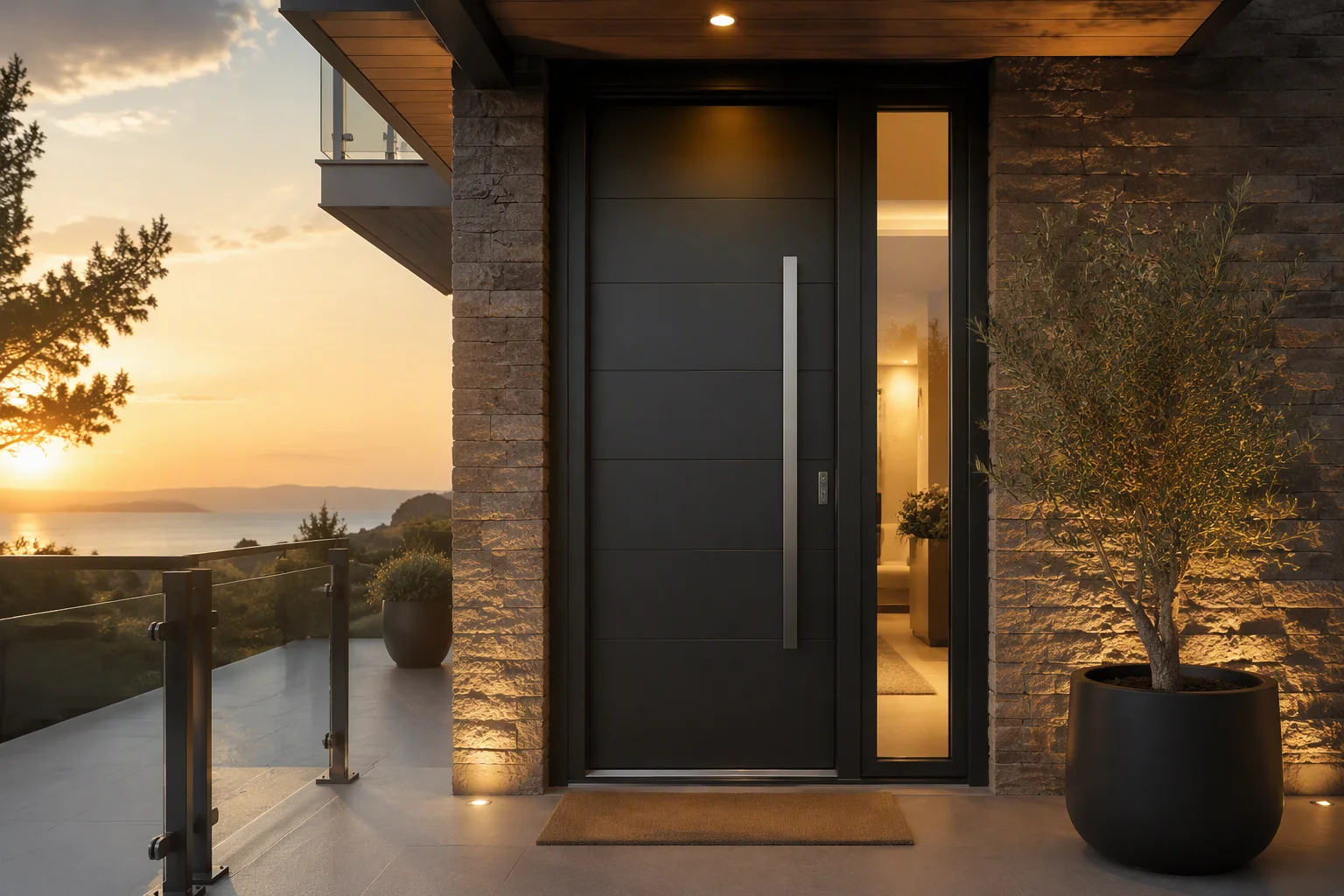
Exterior Doors Manufacturer China Foshan Factory Price Aluminum Security Entry Thermal Break


1. System Overview — A Door Set, Not a Door Leaf
An exterior door is the building’s primary security and thermal threshold, and it is specified and tested as a door set — the frame, the leaf, the lock and the seals as one assembly — not as a leaf alone. The difference is where the performance lives: the intrusion resistance, the weather seal and the thermal break all depend on how the leaf sits in the frame, so the rating belongs to the set. Richocean manufactures exterior doors in Foshan from 6063-T6 thermally broken aluminum, with 5 to 9 point multipoint locking, RC2 to RC4 door sets, fire-rated options and coastal-grade hardware.
Three questions decide whether an exterior door is dependable: whether the door set is rated to the intrusion class the site needs, whether the multipoint lock and the frame carry the load the rating assumes, and whether the door seals for weather and holds its thermal break at the leaf-to-frame joint. The leaf is the visible part; the set is what is rated.
2. The Door Set — Frame, Leaf, Lock and Seal as One Assembly
Because the rating belongs to the set, the frame, the leaf, the lock and the seals are designed together and tested together:
- Frame in the opening: the frame is fixed into the building opening and carries the leaf, the lock reaction and the seal, so the frame anchor pattern is part of the set’s performance, not just the mounting
- Leaf in the frame: the leaf sits in the frame on its hinges and seals against the frame on its other three sides, and the fit of that joint is what the weather and the intrusion test measure
- Lock in the leaf and frame: the multipoint lock bolts the leaf to the frame at several points, and the set’s intrusion rating is measured with the lock engaging those points
- Seal at the joint: the perimeter seal compresses at the leaf-to-frame joint, and its quality sets the air and water performance of the set
- Tested as a set: the door set is tested for intrusion, weather and thermal as the assembled unit, so a leaf that performs alone can still fail as a set if the frame, the lock or the seal does not hold
- Specified as a set: the quotation and the test certificate reference the set — the frame profile, the leaf profile, the lock and the seal — not the leaf by itself
The door-set logic is the first principle of an exterior door: the performance is the sum of the frame, the leaf, the lock and the seal working together, and the rating is measured on that sum. A higher-class leaf in a weak frame does not buy the class, because the set is what is tested.
3. Multipoint Locking — How Many Bolts and Where
The multipoint lock is the core of the door set’s security, and its design is the number of bolts and where they engage:
- Bolt count: 5 point is the standard for a residential entry door, 7 point for a higher security requirement, and 9 point for the top intrusion classes, each point a bolt that draws the leaf to the frame
- Bolt positions: the bolts engage the top, the bottom and both vertical sides, so the leaf is held around its full perimeter, not just at the lock edge
- Deadlocking: the lock deadlocks the bolts so the leaf cannot be forced at the lock edge, and the deadbolt is the primary resistance to a forced entry
- Cylinder security: the key cylinder is rated against picking and drilling, and a security cylinder is the first thing a forced entry targets, so its rating sets the floor of the set
- Anti-lift: the lock includes an anti-lift bolt that prevents the leaf from being lifted off its hinges, closing the path a single deadbolt leaves open
- Central locking: a central locking function secures the whole door set from one key turn, including any linked side or top lights
The multipoint lock is where the intrusion class is earned. More bolts at the right positions, a deadlock at the lock edge and an anti-lift bolt are what let a door set carry RC3 or RC4, and the cylinder security is the floor that the whole set is measured against, because a strong lock in a weak cylinder is still broken at the cylinder.
4. Intrusion Resistance — RC2 to RC4 for the Door Set
The intrusion resistance of the door set is rated from RC1 to RC6, and the residential entry door works across RC2 to RC4:
- RC2: resistance to a forced entry with hand tools, the standard for a normal-residential entry door
- RC3: resistance to a forced entry with more powerful tools, for a higher-value or a higher-exposure entry
- RC4: resistance to a sustained forced entry, for the highest residential security requirement
- Tested to EN 1603: the door set is tested for forced entry to the class, with the tool set and the duration set by the class, on the assembled set
- Rating the set: the class is the set’s rating, achieved by the leaf, the frame, the lock and the seal together, and the certificate names the set that was tested
- Glazing in the rating: where the door set includes glass, the glass is part of the intrusion rating, and a laminated security pane is specified to hold the class
The intrusion class is a property of the door set, tested to EN 1603, and it is the number the specification is written to. Choosing the class is a risk decision for the site, and the set is built to carry it with the leaf, the frame, the lock and the glazing all rated to the same number.
5. Thermal Break and Weather Seal — Security Without a Cold Draft
- Thermal break: a PA66GF25 break of 24/34 mm runs through the leaf and the frame, so the entry door holds its thermal break at the joint a standard door would bridge
- Perimeter seal: the leaf seals to the frame on three sides with a compression gasket, and the seal is the air and water performance of the set
- Weather performance: the door set is tested for air and water to the project’s specification, with the seal and the frame fixing set to hold the driving rain
- Condensation: the break keeps the interior reveal above dew point at the entry, which is the part of a door a standard single-glazed entry does not manage
- Sidelight and top light: where the set includes a glass sidelight or a top light, the glazing is sealed to the frame as part of the set, and the thermal break runs through the glazing rebate
The thermal break and the weather seal are what let an exterior door be secure without being a cold draft, and they are rated with the set, because the seal at the leaf-to-frame joint is the same joint the intrusion test works against. Security and thermal performance share the joint, and the set is detailed to hold both.
6. Fire Rating and Egress — The Door That Must Open From Inside
- Fire rating: where the entry serves a fire compartment, the door set is rated to a fire class, such as EI30, with the frame, the leaf and the seal holding the compartment for the rated time
- Integrity and insulation: the EI rating covers both the integrity of the opening and the insulation of the door, so a fire-rated set is a full set rating, not a leaf alone
- Egress: the door must open from the inside in a fire, and the lock is specified with a panic or an egress function that releases the leaf from one side
- Self-closing: a fire-rated entry is self-closing, so the door returns to the closed and the latched position after it is used, restoring the compartment
- Smoke seal: a fire-rated set includes a smoke seal that closes the joint to the smoke, which is the part that holds the compartment to the smoke class
The fire rating and the egress are the part of an exterior door that no one thinks about until a fire, and they are specified before installation, because a door that cannot be opened from the inside in a fire, or that does not self-close, does not hold the compartment it is rated to. The egress and the self-close are set with the lock and the closer, before the door is built.
7. Performance Specification Table
| Parameter | Standard / Basis | Typical Value |
|---|---|---|
| Alloy | 6063-T6 | 170 MPa yield |
| Frame / leaf walls | Manufacturer spec | 2.0–3.0 mm, steel core option |
| Thermal break | PA66GF25 | 24 / 34 mm |
| Lock | Multipoint | 5 / 7 / 9 point |
| Intrusion | EN 1603 | RC2 / RC3 / RC4, door set |
| Glazing | EN 12600 | laminated security pane |
| Fire | EN 1634 | EI30 where required |
| Structural performance | ASTM E330 | tested to design pressure |
| Hardware | SS304 / SS316 | SS316 for coastal |
8. System Comparison — RC2 vs RC3 vs RC4 Door Set
| Criterion | RC2 Door Set | RC3 Door Set | RC4 Door Set |
|---|---|---|---|
| Threat level | hand tools | power tools | sustained attack |
| Lock points | 5 point | 7 point | 9 point |
| Leaf build | aluminum, reinforced edge | aluminum, steel core | aluminum, full steel core |
| Cylinder | security cylinder | high-security cylinder | high-security, drill shield |
| Glazing | laminated, where glass | laminated security, where glass | laminated security, rated to class |
| Relative cost | base | premium | highest |
9. Technical FAQ
Q: Why is a door rated as a set and not as a leaf?
A: Because the intrusion, the weather and the thermal performance all live in how the leaf sits in the frame, and they are measured on the assembled unit. The lock bolts the leaf to the frame, the seal compresses at the joint and the frame carries the load, so the rating is the set’s, tested to EN 1603 on the frame, the leaf, the lock and the seal together. A high-class leaf in a weak frame does not buy the class, because the set is what is tested and the set is what is certified.
Q: How many lock points does an entry door need?
A: Five is the standard for a residential entry door, seven for a higher requirement and nine for the top intrusion classes, and the bolts engage the top, the bottom and both sides so the leaf is held around its full perimeter. The count is set by the intrusion class the site needs, and it is a property of the set, because the lock, the frame and the leaf are rated together to the class. More points at the right positions is what lets the set carry RC3 or RC4.
Q: Can an entry door be both secure and thermally efficient?
A: Yes, because the security and the thermal performance share the same joint. The leaf seals to the frame with a compression gasket and a PA66GF25 thermal break runs through the leaf and the frame, so the joint that the intrusion test works against is the same joint that holds the thermal break and the weather seal. The set is detailed to hold both, and a well-built entry door is secure without being a cold draft, with the condensation managed at the entry by the break.
Q: What does a fire-rated entry door require?
A: The door set is rated to a fire class such as EI30, with the frame, the leaf and the seal holding the compartment for the rated time. The door must open from the inside in a fire, so the lock is specified with an egress function, and the door is self-closing so it returns to the closed and latched position after use and restores the compartment. A smoke seal closes the joint to the smoke. These are specified before installation, because a door that cannot be opened from the inside or that does not self-close does not hold the compartment it is rated to.
10. China Market Position — Why Richocean
Richocean manufactures exterior doors in Foshan with automated extrusion, CNC fabrication and in-house anodizing and coating lines, exporting to Europe, North America, the Middle East, and Southeast Asia. Factory-direct supply reduces cost versus Western distributors, with EN 1603/ASTM documentation, lock and intrusion coordination and fire rating guidance supplied per project.
11. Illustrative Project Applications
Example A — High-Security Residence Entry (Illustrative)
An RC3 door set with a 7 point lock, a steel-core leaf, a high-security cylinder and a laminated security sidelight, in a thermally broken frame with a compression perimeter seal, for a high-value residential entry with a demanding security requirement. Illustrative configuration; not a quoted project.
Example B — Fire-Rated Building Entry (Illustrative)
An EI30 fire-rated entry with a 5 point lock, a self-closing action, an egress release and a smoke seal, in a thermally broken frame that holds the compartment for the rated time and opens from the inside in a fire, at the main entry of a multi-occupancy building. Illustrative configuration; not a quoted project.
12. Price Factors — What Drives Cost
Exterior doors are usually quoted per set, and the rate rises with the intrusion class, the lock and the rating. Cost drivers include:
- Intrusion class: the RC class the set is built to, with the leaf, the frame, the lock and the glazing all rated to the same number
- Lock points: the multipoint count, 5, 7 or 9, and the cylinder security the class requires
- Leaf build: a reinforced edge, a steel core or a full steel core, set by the class
- Fire rating: the EI class, the egress release and the self-closing action, where the entry serves a fire compartment
- Glazing build: a laminated security pane, rated to the class where the set includes glass
- Thermal break: the PA66GF25 break through the leaf and the frame
- Finish and exposure: powder coat, anodized or PVDF, with C5-M and SS316 for coastal sites
13. Installation, Commissioning & Maintenance
- Setting out: the opening checked for square, level and plumb, because a racked frame binds the leaf and the seal never compresses evenly
- Frame fixing: the frame fixed into the opening to the anchor pattern, carrying the leaf, the lock reaction and the seal
- Leaf setting: the leaf hung on its hinges and set in the frame, with the perimeter seal compressed evenly on all three sides
- Lock setup: the multipoint lock aligned so every bolt engages, the deadlock confirmed and the anti-lift set
- Fire and egress: where the set is fire-rated, the egress release and the self-closing action tested, and the smoke seal confirmed
- Operation check: the door cycled through open, closed and locked, with the seal confirmed and the lock confirmed at every point
- Maintenance: periodic inspection of the hinges, the seal, the lock and the closer, with the leaf checked for binding across the opening
Handover should record the door set, the intrusion class and the test reference, the lock and the cylinder, the fire rating where applicable, and the maintenance interval for the hinges, the seal and the lock.
14. 360° Service & Founder Philosophy
Richocean’s 360 service covers schedule review and shop drawings, door set and intrusion class checks, lock and cylinder coordination, fire rating and egress specification, weather seal and thermal break detailing, installation and commissioning guidance and warranty terms on profiles, glazing, locks and hardware. The founder’s philosophy — Passion Plus Extreme Requirements Equals Peace of Mind — means every door set must hold its intrusion class and its thermal break for the life of the building, because an exterior door is only as good as its closed and locked position.
15. Conclusion
The Exterior Doors Manufacturer China Foshan Factory Price Aluminum Security Entry Thermal Break advantage is total — 6063-T6 thermally broken door sets, 5 to 9 point multipoint locking, RC2 to RC4 intrusion resistance tested as the set, fire-rated options with egress and self-closing, and coastal-grade finishes, delivered directly from Richocean’s Foshan factory. Send your schedule with the opening sizes and the required RC class for a project-specific quotation.
