
Intelligent Electric Windows Manufacturer China Foshan Factory Price 24V Actuator BMS Smart Home


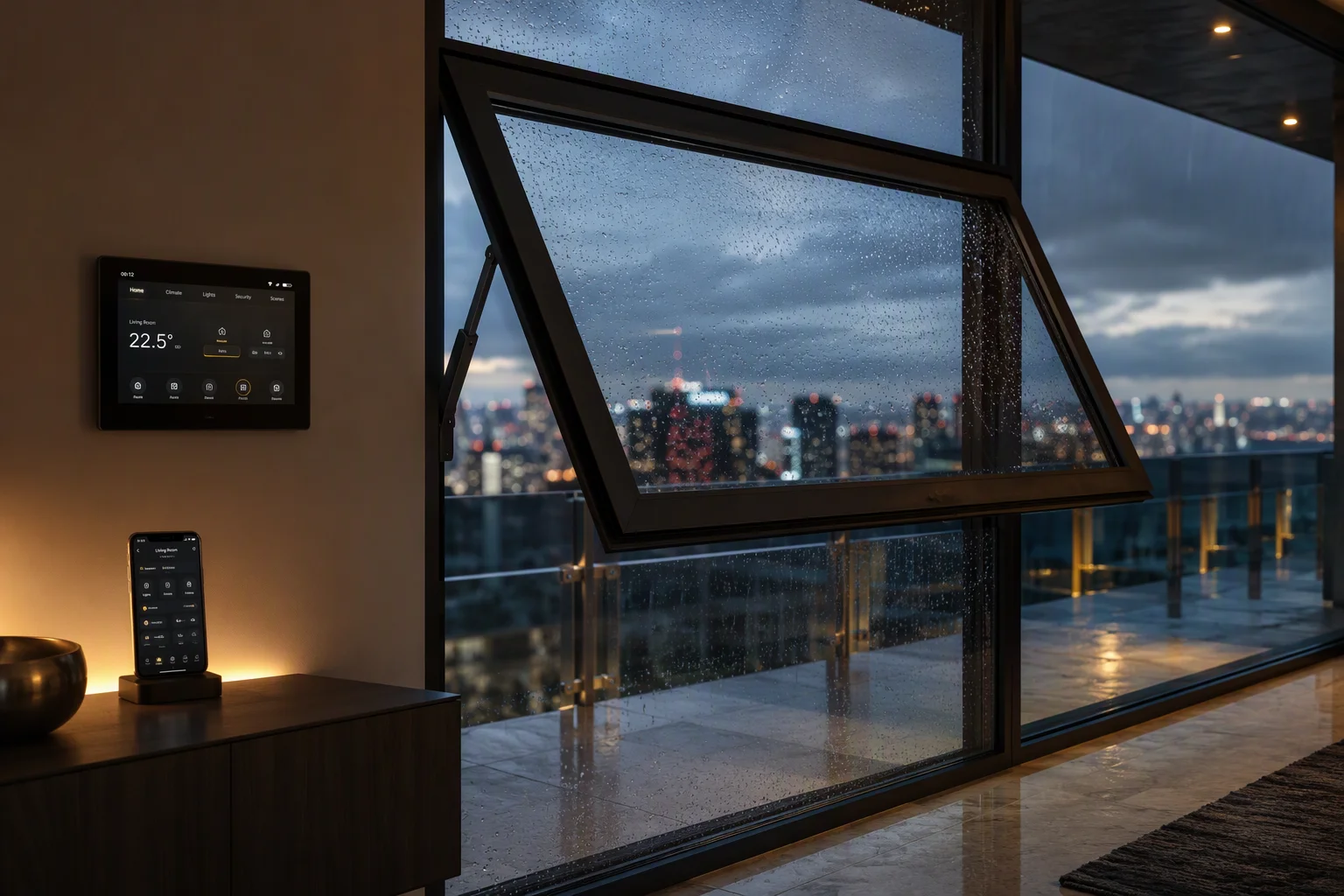
1. System Overview — A Window That Acts, Not Just Opens
An intelligent window is a standard operable window with an actuator, sensors and a control logic added on, and the difference is not the motor but the behaviour: it opens for ventilation, closes for weather, responds to the building system and does so reliably for the life of the building. Richocean manufactures intelligent windows in Foshan from 6063-T6 thermally broken frames, with 24 V DC actuators sized to the sash, sensor fusion for weather and occupancy, and a control layer that speaks KNX, ZigBee, RS485 or dry contacts to a BMS.
Three questions decide whether an intelligent window is dependable: whether the actuator is sized to the sash it moves, whether the control logic behaves safely when a sensor or the power fails, and whether the integration is clean enough that the building system can rely on it. The motor is the easy part; the reliability is the engineering.
2. Core Material Science — 6063-T6 Frame for an Actuated Sash
An actuated window is the same structural window as a manual one, plus a load path for the actuator and a place to run the wiring. The frame must carry the sash, the actuator force and the wind load, and it must be detailed so the wiring and the actuator mounting are protected from the weather.
The actuator adds a concentrated load at its mounting point, so that position is reinforced in the sash, and the cable from the actuator to the control point is routed through an IP-rated entry so the wiring is not exposed to the weather. These are the two details that separate a well-built actuated window from one that is a manual window with a motor bolted on.
3. Actuator Selection — Sizing the Motor to the Sash
The actuator is sized from the sash it must move, not from a standard rating, and the sizing has two parts, torque and travel:
- 24 V DC drive: low-voltage DC actuators are the standard for window automation because they are safe to wire, quiet and simple to integrate with a control system
- torque to the sash: the actuator torque is set to the sash weight and size, with a margin for the wind load it must close against, so it does not stall on a heavy or a wide sash
- Travel and speed: the actuator travel is set to the sash opening angle and the speed to how quickly the window must respond to a weather event
- Position feedback: the actuator reports its position, so the control system knows whether the window is open, closed or moving, and can act on that state
- End stops: mechanical or electrical end stops set the fully open and fully closed positions, so the sash cannot be driven past its travel
- Manual override: a way to open the window by hand when the power is down, which is a life-safety and maintenance requirement, not a convenience
- Replaceability: the actuator is chosen so it can be swapped without dismantling the sash when it reaches the end of its service life
The sizing is a calculation, not a catalog choice: the sash weight, the opening angle and the design wind load set the torque, and the travel and the response time set the rest. An undersized actuator stalls on a gust, and an oversized one wastes energy and costs more, so the match is made per sash.
4. Sensor Fusion and Control Logic — What the Window Decides
The intelligence is in the logic that combines the sensor inputs into a decision, and it is designed to behave safely under every combination, including failure:
- Rain sensor: the primary weather input, closing the window when rain is detected, with the closing time set to beat the onset of a shower
- Wind sensor: the wind input, limiting the opening in a gust and closing in a storm, so the sash is not driven against a pressure it cannot hold
- Temperature and CO2: the ventilation inputs, opening for fresh air when the indoor air has degraded and closing when the room is at its setpoint
- Illuminance: the daylighting input, modulating the opening or a shading device to hold the indoor light level
- Occupancy: the presence input, so a window in an unoccupied space can be secured or held at a background ventilation position
- Logic priority: a fixed priority order so that a safety input (rain, wind, security) always overrides a comfort input (temperature, CO2), and the window never does the wrong thing when two inputs conflict
- Scene control: predefined states, such as a ventilation scene, a security scene and a comfort scene, that the user or the schedule can call
The control logic is where an intelligent window earns its reliability. A fixed input priority, a defined response time and a safe state under conflict mean the window does something sensible under every condition, and that is what the building system is actually relying on.
5. Fail-Safe Behaviour — What Happens When Something Fails
An automated window has to define what it does when the power, a sensor or the network fails, and the definition is a design decision made before installation:
- Power loss: the defined state on loss of power, which is usually closed and locked for security, with the manual override available for egress where required
- Sensor loss: the state when a weather sensor is lost, which is to hold the last safe position and not act on a missing input as if it were a clear signal
- Network loss: the state when the link to the BMS is lost, which is for the window to hold its local logic and continue to respond to local sensors
- Actuator fault: the state when the actuator reports a fault, which is to stop, report the fault and not retry into a jam that could damage the sash
- Egress: the requirement that a window serving an escape route can be opened by hand in a power failure, which the manual override must satisfy
- Monitoring: the window reports its state and any fault to the building system, so a failed actuator is known and not silently ignored
The fail-safe design is the part of an intelligent window that no one thinks about until it is needed, and it is the part that separates a dependable system from one that fails in a way the building did not expect. It is specified before installation, because it cannot be added after.
6. Integration Protocols — Speaking to the Building
- KNX: the installed-building standard, where the window actuator appears as a KNX device and the building program reads its state and sends its commands
- ZigBee: the low-power wireless option, where the actuator joins a ZigBee network and is controlled from a hub or a building system
- RS485 / Modbus: the serial option for direct integration with a BMS, where the window is a point on the serial bus
- Dry contacts: the simplest integration, where the window provides and accepts switched contacts, so any system that can drive a contact can control it
- State reporting: the window reports open, closed, moving and fault states, so the building system knows its condition at all times
- Addressing: each window is addressed so the system can control and monitor it individually, and in groups where a schedule or a scene applies to several at once
The integration is clean when the protocol, the state reporting and the addressing are decided at the design stage and matched to the building system already in the project. A window that cannot report its state is a liability to a BMS, because the system cannot rely on what it cannot see.
7. Performance Specification Table
| Parameter | Standard / Basis | Typical Value |
|---|---|---|
| Alloy | 6063-T6 | 170 MPa yield |
| Frame / sash walls | Manufacturer spec | 1.8–2.4 mm / 1.6–2.2 mm |
| Thermal break | PA66GF25 | 24 / 34 mm |
| Actuator | SELV per IEC 60364 | 24 V DC, sized to sash |
| Control inputs | System spec | rain, wind, temp, CO2, occupancy |
| Integration | Protocol | KNX, ZigBee, RS485, dry contact |
| Fail-safe | Design spec | closed on power loss, manual override |
| Structural performance | ASTM E330 | tested to design pressure |
| Hardware | SS304 / SS316 | SS316 for coastal |
8. System Comparison — 24V DC vs Low-Voltage AC vs Pneumatic
| Criterion | 24 V DC Actuator | Low-Voltage AC | Pneumatic |
|---|---|---|---|
| Drive | DC motor, quiet and efficient | AC motor, higher power draw | compressed air, needs supply |
| Integration | simple, safe low-voltage wiring | wiring, higher current | air lines, central supply |
| Noise | low | higher | valve and air noise |
| Best use | residential and office windows | heavier sashes | very large or industrial openings |
| Relative cost | moderate | moderate | premium, plus supply |
9. Technical FAQ
Q: How is the actuator sized to the window?
A: From the sash it moves. The sash weight and size set the torque, with a margin for the wind load it must close against, and the opening angle and the required response time set the travel and speed. It is a calculation per sash, not a catalog choice, because an undersized actuator stalls on a gust and an oversized one wastes energy and costs more.
Q: What does the window do when the power fails?
A: The defined state is usually closed and locked for security, and it is a design decision made before installation, not something added later. Where the window serves an escape route, the manual override must allow it to be opened by hand in a power failure, which is a life-safety requirement. The state on power loss is specified with the fail-safe design, before the window is built.
Q: Which integration protocol should we choose?
A: The one the building system already uses, decided at the design stage. KNX for an installed-building control system, ZigBee for a low-power wireless network, RS485 or Modbus for a direct BMS point, and dry contacts for the simplest case. The window must report its state, because a building system cannot rely on a window it cannot see, so the protocol choice is made to match the system in the project.
Q: What happens when a sensor fails?
A: The window holds its last safe position and does not treat a missing input as a clear signal. A lost rain sensor should not open the window, because the absence of a signal is not the same as a clear sky. The fail-safe logic is defined for each input, so a single sensor failure degrades the window to a safe state rather than a wrong action, and the fault is reported to the building system.
10. China Market Position — Why Richocean
Richocean manufactures intelligent windows in Foshan with automated extrusion, CNC fabrication and in-house anodizing and coating lines, exporting to Europe, North America, the Middle East, and Southeast Asia. Factory-direct supply reduces cost versus Western distributors, with EN/ASTM documentation, actuator and control coordination and integration guidance supplied per project.
11. Illustrative Project Applications
Example A — Automated Office Facade (Illustrative)
Motorized windows with 24 V DC actuators sized to each sash, rain and wind sensor logic with a fixed input priority, and KNX integration to the office BMS, opening for ventilation and closing on weather across a full floor plate. Illustrative configuration; not a quoted project.
Example B — Smart Residence (Illustrative)
Motorized windows with occupancy and temperature logic, a ZigBee network to a home hub, scene control for comfort and security, and a manual override on the escape-route window, closing on rain and holding background ventilation when unoccupied. Illustrative configuration; not a quoted project.
12. Price Factors — What Drives Cost
Intelligent windows are usually quoted per unit, and the rate rises with the actuator grade, the sensor set and the integration. Cost drivers include:
- Actuator grade: the torque and travel set by the sash weight and size, and the brand and rating of the motor
- Sensor set: the weather and occupancy sensors, and whether they are local or fed from the building system
- Control logic: the defined priority order, the response times and the scene states, which are a design input
- Integration protocol: KNX, ZigBee, RS485 or dry contacts, and the addressing and state reporting the system needs
- Fail-safe design: the defined states on power, sensor and network loss, and the manual override
- Glazing build: double versus triple glazed, laminated panes and coatings
- Finish and exposure: powder coat, anodized or PVDF, with C5-M and SS316 for coastal sites
13. Installation, Commissioning & Maintenance
- Setting out: the opening checked for square and level, because a racked sash binds the actuator and the control logic never sees a clean position
- Actuator mounting: the actuator fixed to the reinforced sash position, with the cable routed through the IP-rated entry
- End stops and travel: the fully open and fully closed positions set, and the travel confirmed against the sash angle
- Wiring and power: the 24 V DC supply and the control wiring checked, with the manual override confirmed in a power failure
- Sensor placement: the weather and occupancy sensors positioned so they read the condition the window is meant to respond to
- Commissioning: the control logic tested through the input priority, the scenes and the fail-safe states, with each input failed in turn to confirm the safe response
- Integration test: the window’s state and fault reporting confirmed on the building system, so the system can see and rely on the window
Handover should record the system series, the sash size and the actuator specification, the sensor set and the control logic, the integration protocol and addressing, and the fail-safe states, so the building team knows how the window behaves and how it reports.
14. 360° Service & Founder Philosophy
Richocean’s 360 service covers schedule review and shop drawings, actuator sizing and sash load checks, sensor and control logic design, integration and addressing coordination, fail-safe state specification, installation and commissioning guidance and warranty terms on profiles, glazing, actuators and hardware. The founder’s philosophy — Passion Plus Extreme Requirements Equals Peace of Mind — means every actuator, sensor and logic state must behave safely for the life of the building, because an intelligent window is only as good as its fail-safe design.
15. Conclusion
The Intelligent Electric Windows Manufacturer China Foshan Factory Price 24V Actuator BMS Smart Home advantage is total — 6063-T6 thermally broken frames, 24 V DC actuators sized to each sash, sensor fusion with a fixed input priority, clean integration over KNX, ZigBee, RS485 or dry contacts, and a fail-safe design specified before installation, delivered directly from Richocean’s Foshan factory. Send your schedule with the sash sizes and the building system in use for a project-specific quotation.
