
Intelligent Electric Windows Manufacturer China Foshan Factory Price Chain Actuator Anti-Crush Rain Sensor


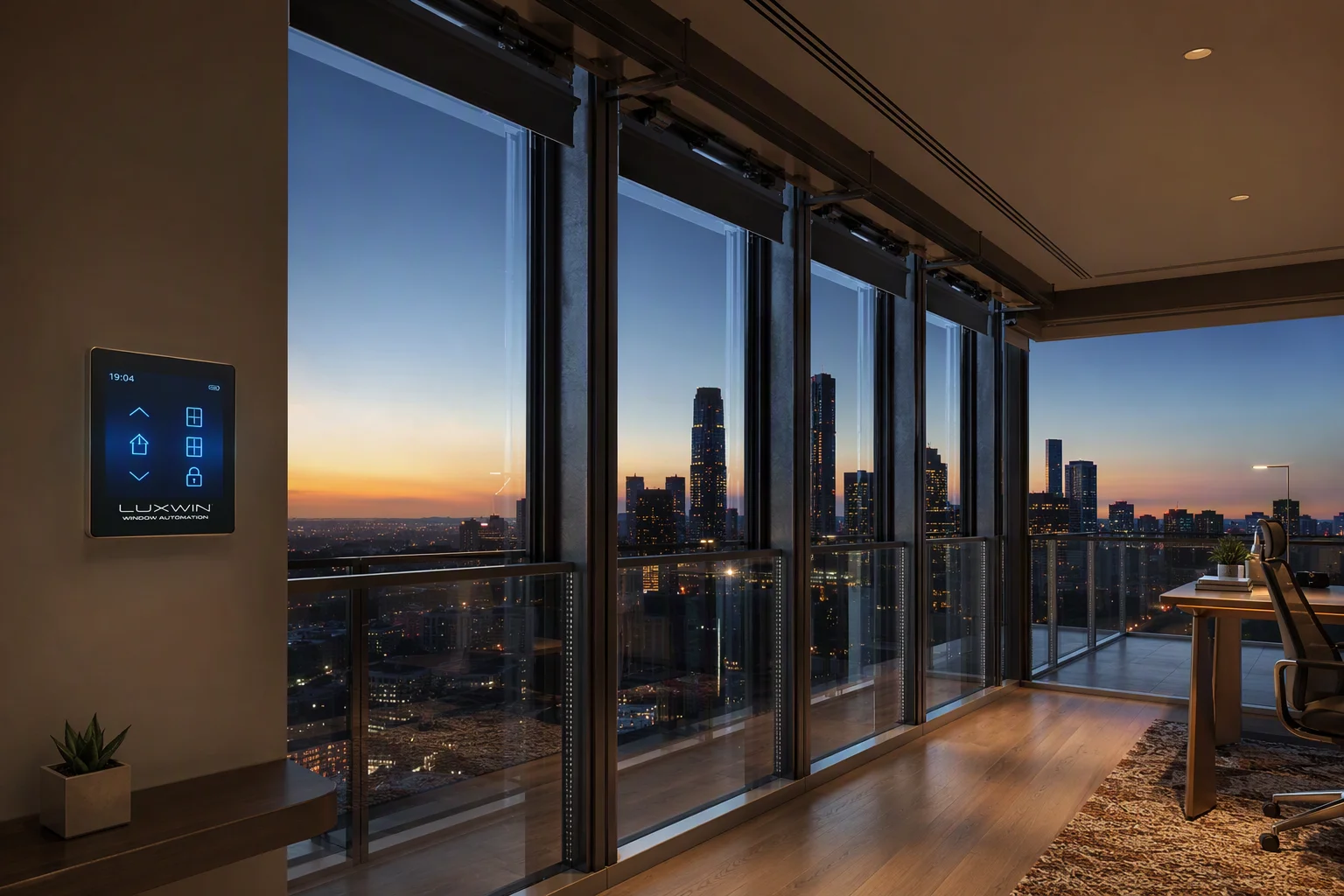
1. System Overview — An Electric Window Is a Machine That Must Run for Decades
Torque calculation sizes an electric window; reliability engineering keeps it running in year ten. The motorised window is the only window class that is also a machine — it cycles on demand, in heat and frost, in rain and dust, through thousands of operations, and it must do all of it while remaining safe to touch, safe to stand in front of, and honest about its own state. The failures that matter are not the dramatic ones; they are the window that worked perfectly at commissioning and stalls on the first 40-degree afternoon after twenty cycles, the actuator whose chain jumps a link in winter, the rain sensor whose command loses a priority fight with a user’s open order, the ten-window facade that drifts out of synchronisation until it looks like a broken comb. Each of these is a specification decision made years earlier — mechanism type, duty class, sensor logic, position feedback — and each is preventable at the drawing.
This article covers the reliability engineering of intelligent electric windows end to end: the three actuator mechanisms and the window formats each serves, electronic force limitation that makes the motor feel obstacles, duty cycle and thermal behaviour in real exposure, the sensor priority hierarchy that keeps rain and wind from being advisory suggestions, position feedback and synchronised arrays, the 24 V DC SELV distribution that powers them, and the commissioning and lifecycle regime that keeps the machine honest for decades. Richocean manufactures intelligent and electric windows in Foshan, Guangdong, building motorised systems for facades, atria, night-purge schemes and smart homes across Europe, North America, the Middle East and Southeast Asia — engineering the window as a machine whose reliability is specified, not assumed.
2. The Actuator Mechanisms — Chain, Spindle and Rack
Three mechanisms do nearly all electric window work, and choosing among them is the first reliability decision. The chain actuator is the standard answer: a duplex or triplex steel chain stored coiled in a compact housing that extends straight under load, pushing the sash open and pulling it shut. Chains suit awning, top-hung, tilt and outswing formats, hide inside the frame or a slim surface housing, and deliver strokes in the 200-400 mm range with thrusts sized to the sash. Their failure modes are specific and manageable: chain-link wear at the sprocket, side-load on the extended chain when the sash binds, and bracket fatigue at the sash connection — all addressed by rated thrust with margin, guided extension where the stroke is long, and brackets designed for the real sash motion, not just its weight.
The spindle actuator — a leadscrew pushing a rigid stem — trades stroke for thrust: slow, powerful, and the standard for heavy louvre banks, smoke vents and dome lights where the load is high and the travel short. Its reliability case is the leadscrew and nut: lubricated for life, protected from grit by wipers and bellows where the exposure demands, and never side-loaded, because a spindle under lateral force wears its nut into a wobble that no controller can diagnose. The rack actuator — a motor-driven pinion walking along a fixed rack — covers the long strokes that chains cannot hold straight: large vents, heavy horizontal sashes, industrial openings, with the rack carrying the guidance the chain would have to improvise. The selection rule is honest engineering rather than catalogue habit: chain for the conventional openable, spindle for high thrust at short stroke, rack for long travel under guidance, and in every case the mechanism rated to the sash weight, the friction of its seals and the worst-case exposure — with the rating documented against the actual duty the facade will ask of it.
3. Anti-Crush — The Motor That Feels Obstacles
An electric window moves under power, and anything in its path — a hand, a child, a chair, a cleaning cradle — meets machine force. The safety answer is electronic force limitation: the controller monitors motor current continuously, and current is force. When the sash meets an obstacle, the motor’s load rises, the current rises with it, and the controller recognises the signature within milliseconds — stop, then reverse a defined distance, the electronic equivalent of a slip clutch with none of its slop. This is the regime EN 60335-2-97 writes for motor-operated windows, and the specification must state it by name: force limitation with automatic reversal, sensitivity calibrated and verified at commissioning, and the behaviour documented for the site’s safety file.
Calibration is the engineering inside the feature. A force limit set loose is a hazard; set tight, the window false-stops on the first stiff gasket in winter or the first gust holding the sash — and a window that cries wolf gets its automation bypassed, which is the worst safety outcome of all. The right setting comes from the commissioning measurement: the running current profile of the healthy sash through its full stroke in both directions, with the obstacle threshold set above the profile’s real peaks — seal breakout, wind-holding margins — and below anything a body could absorb. Advanced controllers learn the profile: the sash’s current signature over its stroke becomes its baseline, and deviation from the baseline — an obstacle, or a stiffening bearing that predicts a failure — triggers the response. That learned profile is also the diagnostic: a window whose closing current creeps upward over months is telling the maintenance programme about a binding hinge before the motor stalls, which is the difference between a planned repair and an emergency one.
4. Duty Cycle and Thermal Behaviour — Why Windows Stall in Summer
Actuator motors are rated for intermittent duty — S3 class, a stated percentage of running within a stated period — because the motor’s own losses heat it faster than the housing can shed that heat. A single cycle is easy; twenty cycles on a 40-degree afternoon with the actuator in direct sun is a thermal climb, and when the motor’s internal protection trips, the window stalls — correctly, to save itself — and stays stalled until it cools. This is the classic specification error of electric facades: the actuator sized for the sash’s static torque but not for the duty the facade actually runs. Night-purge schemes cycle every window every evening; comfort schemes adjust positions hourly; smoke-vent functions demand full stroke on command at any temperature. The duty number in the schedule must come from the operating regime, with the solar exposure of the actuator’s mounting position counted — an actuator in a west-facing frame at altitude lives hotter than the same actuator in shade, and the margin has to cover the real summer, not the catalogue one.
The design answers stack: motors with thermal cut-out that resets rather than fails, controllers that space and sequence commands across an array so ten actuators do not start simultaneously on one supply, housings that shed sun — shaded mounting positions, ventilated housings, light finishes on exposed metal — and the smoke-vent exception engineered separately, because life-safety duty is not intermittent duty and the actuators serving it are rated, wired and backed to run on command whatever the ambient. Frost is the mirror case: a sash frozen into its gasket presents a breakout force no summer profile predicted, and the controller’s response — sense the anomaly, stop, report, not ram the sash against its own ice — is again a specified behaviour. The reliability question for any electric facade is therefore not “what torque” but “what duty, at what temperature, in what exposure, with what thermal margin” — and the schedule that answers it is the one that still opens in year ten.
5. Sensor Logic — Rain and Wind as Commands, Not Suggestions
The sensor network is where intelligence becomes safety, and its engineering is priority. A rain sensor closes windows on first detection — water on the sill is a fault the occupant’s open command must not be able to sustain, so rain overrides user orders: the window closes, stays closed while the sensor is wet, and reports why. A wind sensor closes before the load arrives: its threshold sits below the facade’s design wind, so the sashes are shut while the gust still only moves the anemometer — predictive protection, not reactive. Temperature and CO2 sensors drive the comfort layer — night purge, stack ventilation, fresh-air trimming — and sit below the safety layer in the hierarchy. The logic order is one sentence and it governs the whole system: safety first, protection second, user command third, schedule last. A controller that cannot state its priority hierarchy cannot be commissioned safely, because every conflict on site — rain versus open, wind versus purge — resolves by whatever the code happened to do.
The sensors themselves are engineered elements: rain sensors with heated surfaces that distinguish condensation from rainfall and dry themselves for the next event, wind sensors — anemometers or pressure-based — mounted where they read the facade’s real exposure rather than the roof’s calmer air, and both wired or wirelessly integrated with supervision, so a dead sensor is a reported fault, not a silently unprotected facade. Supervision extends through the whole chain: the BMS sees each window’s commanded position, actual position from its encoder, current signature, sensor states and fault history — and the difference between commanded and actual is the number that matters, because a window that says it is open and is not is worse than one that is honestly shut. Where smoke-vent function shares the facade, the sensor logic carries a statutory layer: smoke-override commands outrank everything except the physical limits of the mechanism, and that hierarchy is tested, not merely specified.
6. Performance Envelope — What an Intelligent Window System Is Rated Against
| Property | Standard | Design Basis |
|---|---|---|
| Actuator mechanism | Rated thrust and stroke | Chain, spindle or rack selected by format and travel; rated to sash weight, seal friction and exposure with documented margin |
| Anti-crush | EN 60335-2-97 basis | Current-sensing force limitation with automatic reversal; sensitivity calibrated against the measured running profile |
| Duty cycle | S3 class rating | Running percentage against the facade’s real operating regime, with solar exposure of the mounting position counted |
| Electrical safety | IEC 60364 SELV 24 V DC | Extra-low-voltage distribution; enclosures IP-rated to exposure (EN 60529 basis), EMC to EN 55014 basis |
| Position feedback | Encoder / hall sensing | Actual position reported to controller and BMS; commanded-versus-actual divergence is the fault signal |
| Sensor hierarchy | Documented logic | Safety, then protection (rain, wind below design threshold), then user, then schedule — tested at commissioning |
| Mechanical endurance | EN 12400 basis | Cycle class of sash, hardware and actuator brackets against expected operation frequency |
| Window performance | EN 12207 / 12208 / 12210 | The motorised window is first a window: air, water and wind ratings of the closed sash are unchanged by its automation |
7. Actuator Mechanisms Compared
| Aspect | Chain Actuator | Spindle Actuator | Rack Actuator |
|---|---|---|---|
| Principle | Coiled steel chain extends straight under load | Leadscrew drives a rigid stem | Pinion walks a fixed rack |
| Stroke | 200-400 mm typical | Short — high thrust at small travel | Long strokes chains cannot hold straight |
| Best formats | Awning, top-hung, tilt, outswing — the conventional openable | Heavy louvre banks, smoke vents, dome lights | Large vents, heavy horizontal sashes, industrial openings |
| Concealment | Slim housing, in-frame or surface | Stem exposed in travel | Rack visible along the travel line |
| Wear items | Chain links at sprocket, sash bracket | Leadscrew and nut — never side-loaded | Pinion teeth, rack alignment |
| Reliability case | Rated thrust margin, guided long strokes, bracket designed for real sash motion | Lubricated for life, wipers and bellows in grit, alignment protected | Rack carries guidance; alignment checked at commissioning and service |
8. Technical FAQ
Thermal protection doing its job on an underspecified duty class. Actuator motors are rated S3 — intermittent duty, a running percentage within a period — and the motor’s own losses heat it faster than the housing sheds heat. One cycle is easy; twenty cycles on a 40-degree day with the actuator in direct sun is a thermal climb, and the internal cut-out stalls the window until it cools. The fix is specification, not repair: duty class chosen against the facade’s real operating regime — night purge cycles every evening, comfort schemes adjust hourly — with the solar exposure of the mounting position counted, staged commands across arrays so ten motors do not start at once, and shaded or ventilated mounting where the exposure demands. The schedule line that prevents it: duty class against operating regime and mounting exposure.
The controller monitors motor current, and current is force: an obstacle raises the load, the current signature changes, and the controller stops and reverses within milliseconds — the EN 60335-2-97 regime for motor-operated windows. In practice the feature fails at its calibration extremes. Set loose, the window meets an obstacle with machine force before recognising it — a hazard. Set tight, it false-stops on winter-stiff gaskets and gust-held sashes, and users bypass the automation entirely, which is the worst outcome. The correct setting is measured, not guessed: the healthy sash’s running-current profile through its full stroke in both directions, obstacle threshold above the profile’s real peaks — seal breakout, wind margins — and below anything a body could absorb. Advanced controllers learn that profile as a baseline, so a creeping closing current flags a binding hinge months before the stall — the safety feature doubling as the predictive-maintenance sensor.
Because an open sash in a gust is not a comfort problem but a structural event: wind loads the open sash at angles its hardware never carries closed, and the failure sequence — bracket, hinge, sash — happens faster than any user can react. The wind sensor’s job is predictive: its closing threshold sits below the facade’s design wind, so the windows are already shut while the anemometer is still only reporting. Setting the threshold is a calculation, not a preference: design wind for the sash’s open condition, a margin for gust factors and sensor placement, and the mount position reading the facade’s real exposure rather than the roof’s calmer air. Rain follows the same logic with less force: first detection closes and holds while wet, overriding the user’s open command, because water on the sill is a fault the occupant must not be able to sustain. A controller that cannot state its priority hierarchy — safety, protection, user, schedule — cannot be commissioned safely, because every on-site conflict then resolves by accident.
Open-loop control. An actuator without position feedback runs for a timed stroke and assumes where it ended; friction, frost, voltage drop and load make each window’s reality slightly different, and over hundreds of cycles the array drifts until it looks like a broken comb. The cure is closed loop: encoders or hall sensing report each sash’s actual position, the controller commands positions rather than times, and commanded-versus-actual divergence is the fault signal — the number the BMS watches, because a window that says open and is not is worse than one honestly shut. Synchronised arrays then run as one mechanism with per-window trim, and after any obstacle stop or manual interference the sash re-learns its ends instead of accumulating error. The same feedback feeds the maintenance programme: position history, current signatures and fault counts per window are the records that turn reactive repairs into scheduled ones.
9. China Market Positioning — Why Foshan, Why Richocean
Intelligent electric windows combine two industries that rarely meet well: the window and the machine. Foshan in Guangdong hosts both sides — 6063-T6 extrusion and window systems engineered to carry actuators as designed elements rather than attachments, and the electronics chain that builds them: 24 V DC SELV drives, chain and spindle actuators with rated thrust and stroke, controllers with current-sensing force limitation and encoder feedback, rain and wind sensors with supervision, and the protocol gateways — KNX, Modbus, BACnet — that report every window to the BMS. Richocean manufactures intelligent and electric windows in Foshan for facade automation, atrium venting, night-purge schemes, smoke-vent integration and smart homes across Europe, North America, the Middle East and Southeast Asia, specifying the machine against its real duty and exposure, and delivering the commissioning records — stroke learning, force calibration, sensor hierarchy tests — that make the automation auditable rather than merely installed.
10. Example Applications
Illustrative configuration; not a quoted project. A European office atrium specifying automatic night purge across three levels of top-hung vents: chain actuators rated to each vent’s weight and seal friction with documented thermal margin for the summer regime, encoder position feedback with the array running as one synchronised mechanism, wind sensors mounted to read the atrium’s real exposure with closing thresholds below the vents’ open-condition design wind, rain sensors with heated heads overriding user commands, staged starting across the arrays to protect the supplies, and the BMS receiving commanded-versus-actual position, current signatures and fault history for every vent. The controlling decisions are the duty class against the nightly cycle count, the sensor thresholds calculated rather than defaulted, and the position feedback that makes drift a reported fault instead of a visible symptom.
Illustrative configuration; not a quoted project. A Gulf high-rise residence automating its facade for comfort and storm protection: motorised tilt and turn sashes in the living spaces on 24 V DC SELV with anti-crush calibrated against each sash’s measured running profile, a wind and rain sensor network closing the facade predictively below design gusts, the hierarchy safety-protection-user-schedule documented and tested at commissioning, actuators specified for the solar exposure of their mounting positions in a desert summer, and the whole system reporting to the building platform with per-window fault history. Here the controlling decisions are the exposure-counted duty specification, the anti-crush calibration measured per sash, and the predictive wind threshold — three schedule lines that decide whether the automation is trusted or bypassed in its second summer.
11. Price Drivers — What Actually Moves the Cost
On electric windows the cost follows the machine. Actuators lead: mechanism type against the format, rated thrust and stroke with real margin, duty class against the operating regime, IP rating against exposure — a smoke-vent-rated spindle and a comfort-rated chain are different products at different prices. Control is next: current-sensing anti-crush with profile learning, encoder feedback, staged array starting, and the sensor network — heated rain heads, supervised wind sensors — each a schedule line whose rating must match the window’s. Integration follows: SELV supplies sized against the array’s current and the cable runs’ voltage drop, protocol gateways to KNX, Modbus or BACnet, and the BMS point schedule. Commissioning and documentation are real work and belong in the budget: stroke learning, force calibration per sash, sensor hierarchy tests, and the records the safety file needs. Lifecycle cost closes the case: actuators are wear components with finite cycle lives, and the cheap unit replaced twice costs more than the rated unit replaced once — the specification that counts is cost per thousand cycles against the facade’s real duty. Indicative ranges only, not offers; final pricing depends on the mechanism schedule, the control scope and the volume.
12. Distribution, Commissioning and Lifecycle
The electrical distribution is engineered, not routed: 24 V DC SELV per IEC 60364, supplies sized against the array’s simultaneous current with staged starting, cable runs calculated for voltage drop so the last window on the longest run still sees its rated voltage at full load — the winter stall that reads as a weak actuator is often a distribution decision made at the drawing — and enclosures IP-rated to their actual exposure (EN 60529 basis), with EMC compliance (EN 55014 basis) keeping the motors from polluting the building’s other systems. Commissioning is the phase where the machine becomes honest: each sash runs its stroke-learning pass and records its end positions; the running-current profile is measured in both directions and the anti-crush threshold set against it; the sensor hierarchy is tested by provocation — rain simulated, wind thresholds verified against the design numbers, user commands confirmed to lose the fights they should lose; synchronised arrays run together and the commanded-versus-actual divergence is checked at the BMS; and every window’s records — profiles, thresholds, positions, firmware versions — are delivered as the baseline the maintenance programme reads against. The lifecycle regime follows the machine’s wear map: chains and brackets inspected at their service intervals, leadscrews and racks checked for lubrication and alignment, gaskets and seals kept soft so breakout currents stay in their commissioned range, sensor heads cleaned and their supervision confirmed, and actuator replacement planned against rated cycle life rather than discovered by failure. The reliability truth of electric windows is the same as every machine’s: the specification decides the ceiling, commissioning proves it, and the maintenance regime decides how long the building keeps it.
13. 360° Service and the Richocean Engineering Philosophy
Richocean builds electric windows as machines with a documented life: mechanism selected against format and duty, actuators rated with counted margins for thrust, stroke, thermal exposure and cycle life, anti-crush calibrated from measured profiles, sensor hierarchies specified and tested, position feedback standard on every array, SELV distribution engineered against voltage drop and staged loads, and commissioning records delivered as the maintenance baseline. OEM and ODM service covers facade automation, night-purge and smoke-vent integration, protocol gateway selection for KNX, Modbus and BACnet buildings, and the documentation — duty schedules, calibration records, hierarchy tests — that makes the system auditable. The founding philosophy is one sentence: an electric window is judged not on the day it opens but on the fortieth-degree afternoon of its tenth summer, when the duty margin, the calibrated safety and the honest feedback all report at once. Engineering for that afternoon — specifying the machine against its real life — is the standard every Richocean intelligent window is built against.
14. Conclusion — Reliability Is Specified, Not Assumed
The intelligent electric window earns its decades in sequence: the right mechanism for the format — chain, spindle or rack — rated to the real sash and its exposure; anti-crush that is measured force limitation rather than a catalogue claim; duty class chosen against the operating regime with the summer counted; sensors whose hierarchy puts rain and wind above the user’s convenience; position feedback that makes every drift a reported fault; distribution engineered against voltage drop; and commissioning records that give maintenance a baseline to read against. Torque sizing builds the window; reliability engineering keeps it — and the difference between them is exactly the distance between opening day and year ten. Richocean manufactures intelligent and electric windows in Foshan, Guangdong, specifying the machine against its real life. For an automation scheme, a duty and exposure review, or a project quotation, send the facade’s operating regime, the sensor scope and the integration protocol — the machine will be rated, calibrated and documented for the afternoon it matters.
