
Specialty Windows Manufacturer China Foshan Factory Price Arched Circular Bent Glass Roll Formed Profile


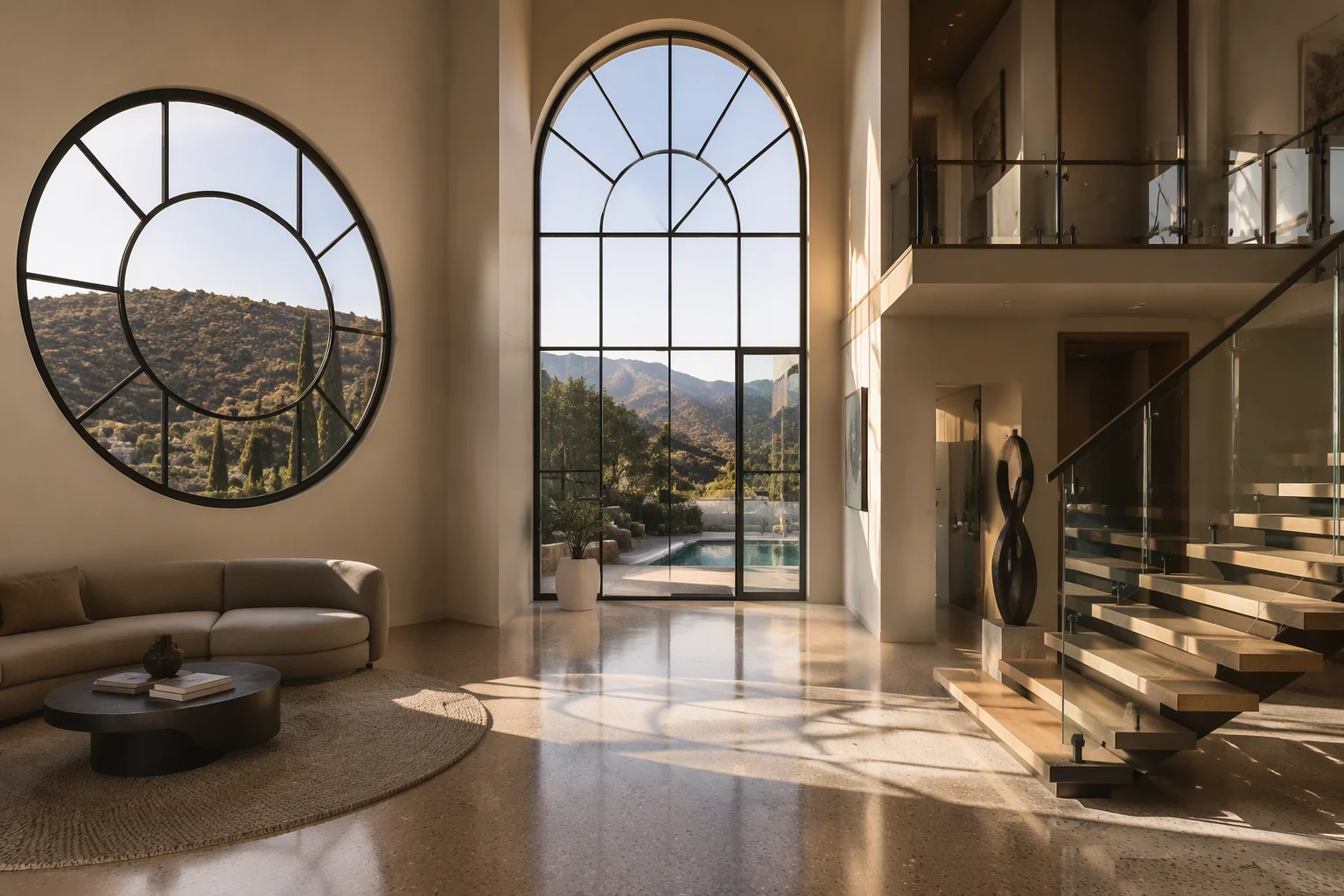
1. System Overview — Custom Geometry Rewrites Every Rule of the Window
Every standard in the window industry — glass sizing tables, frame span logic, hardware spacing, seal runs, test methods — assumes one thing quietly and completely: the window is rectangular. Specialty windows withdraw that assumption, and with it withdraws most of the standard playbook. An arched head changes how the frame carries load into the opening; a circular window makes the frame a ring beam; a triangular light concentrates stress at corners where rectangular glass has none; a curved elevation demands profiles that follow the curve and glass that either follows it or sits flat inside it. Nothing about specialty glazing is a variation on the rectangle — each geometry is its own engineering case, and the projects that fail are the ones that treated a shape as a rectangle with trim.
The discipline that replaces the standard playbook is a design chain: geometry defined by template or CAD, each element of the shape resolved through its own physics — profile curvature and how it is formed, glass shape and how it is cut or bent, structure and how the shape carries its loads, hardware and whether the shape can move, seals and how they run round a curve — and the whole chain documented before fabrication begins. Richocean manufactures specialty windows in Foshan, Guangdong, running that chain in-house: roll-formed and bent aluminium profiles in 6063-T6 with CNC-controlled radii, cold-cut and heat-formed glass, case-by-case structural verification of non-rectangular shapes, and the hardware and seal engineering that make curved and shaped openings work rather than merely exist. For heritage restorations, signature architecture and the residential projects where one shaped window is the building’s face, specialty geometry is not an option bolted onto standard products — it is a different engineering discipline, and this article is its map.
2. Curved Profiles — How Aluminium Is Made to Follow an Arc
An aluminium extrusion is born straight, and making it curved is a forming process with real physics. Roll bending passes the profile through a set of rollers that incrementally over-bend it toward the target radius; it is the standard process for arcs and full circles and suits most window radii. Stretch bending pulls the profile over a form die — better for tighter radii and controlled sections, at higher tooling cost. And every bend carries springback: aluminium elastically recovers a fraction of the bend when the load releases, so the process must over-bend by a calculated amount and the amount differs by alloy, temper and section. The consequence for quality is direct — a radius bent by feel varies along its length and between pieces, while a radius bent under CNC control with the springback compensation in the machine holds its geometry piece after piece. The specification question for any curved window is therefore not “can you bend it” but “what controls the radius”: CNC bending with documented springback compensation, checked against a radius template, is the difference between an arc and an approximation.
Section geometry sets the limits. Every profile has a minimum bend radius below which the outer fibres of the aluminium exceed their forming strain — the section distorts, the walls buckle inward, the visible face ripples. Multi-chamber sections with thin walls are the most sensitive; the bend either uses a section designed for forming, fills the chambers during bending to support the walls, or accepts a larger radius. And thermally broken profiles add a process-order problem: the PA66GF25 break and its aluminium carriers respond differently to forming, so the sequence is engineered — bare sections bent and then broken, or sections broken with a bar specified to survive the forming — never a finished broken profile bent on a guess. Where the architecture allows it, segmented faceting is the honest alternative: straight lengths joined at calculated angles approximate the arc with crisp shadow lines, no forming risk and a different aesthetic — a decision for the drawing, not a compromise discovered in the workshop.
3. Shaped Glass — Cold-Cut Shapes and Heat-Formed Curves
Glass for specialty windows is made two ways, and the choice drives both the look and the lead time. Cold-cut shaping takes flat glass and cuts it to the shape — circles, triangles, arches, trapezoids, any closed contour the drawing defines — on CNC cutting tables, then works every edge: arrised, seamed or polished per the specification and the safety class, because a cut edge is a strength-limiting flaw field and its treatment is structural, not cosmetic. Cold-cut shapes stay flat: an arched-head window with cold-cut glass has a flat pane inside a curved frame, with the spandrel between the pane’s top edge and the arch filled by the framing detail. The approach covers most heritage and residential shapes, keeps optical quality at flat-glass levels, and prices with the perimeter — complex contours cost more because edge length and cutting path grow.
Heat forming takes the glass through the bending furnace: the pane is heated to its softening range and formed over a mould to the designed curve — single-axis bends for cylindrical curves, and where the geometry demands, more complex forms. Bent glass delivers the pure curved elevation — glass and frame following the same arc — and carries its own specification discipline: the mould defines the radius and the tolerance must be stated, the optical quality of bent glass includes the rippling and anisotropy the process naturally produces and the acceptance criteria must say what is allowed, and bent glass is heat-treated by its process, so its strength class, its fragment behaviour and, where the project specifies it, the heat-soak verification to EN 14179 basis all belong in the schedule. Bent glass also constrains what can be built into it: the interlayers of a laminated bent unit are formed with it, but coatings and seals have their own bending compatibility. The rule that governs both processes is sizing: ASTM E1300 tables assume rectangles, so every shaped pane is verified case-by-case — by its bounding dimensions as a conservative first pass and by finite-element or equivalent analysis where the shape is far from rectangular or the loading is high. A circle is not a square of the same width, and the glass schedule that treats it as one is guessing.
4. The Structure of Shapes — Arch, Ring and Triangle
Non-rectangular shapes carry load by different mechanisms, and the frame must be designed for the mechanism the shape actually uses. An arched head wants to act as an arch: load on the crown resolves into compression along the curve and out into thrust at the springing — the points where the arch meets the vertical jambs. In masonry that thrust goes into buttressing; in an aluminium arched window it goes into the jamb connection and the surrounding structure, which is why the springing detail is the designed element of every arch: the joint between curved head and straight jamb, the reinforcement inside it, and the anchorage that takes the thrust component without letting the arch spread. A circular window makes its frame a ring: load anywhere on the ring distributes around it as a combination of bending and hoop force, the ring’s section and its joints are designed for that distribution, and the glass — a cold-cut circle or a formed disc — is sized against the support the ring provides. Ring behaviour is efficient but intolerant of weak joints: a ring is only as stiff as its weakest connection, and a segmented ring with sloppy joints is not a ring.
Triangles and polygons concentrate what rectangles spread: stress gathers at the sharp corners of both glass and frame, the glass corner is a flaw concentration that cutting and edging must protect and the support detail must not load, and the frame corner is a joint working at an angle no standard corner key was made for — so it is machined, reinforced and fixed to its own detail. Long thin triangular lights add deflection geometry: the frame’s stiff direction may not align with the shape’s spanning direction, and the section is checked in the orientation the shape actually loads it. Across every shape, one rule holds: the load path must be drawn. Wind on a curved elevation resolves differently than on a flat one — components normal to each point of the curve, resolved back into the frame and the opening — and the anchorage schedule, the reinforcement layout and the glass support all follow from that drawing. The specialty window that skips this step is a shape waiting for its first storm.
5. Operable Specialty Shapes — Hardware Meets the Curve
Fixed shapes are structure and glass; operable shapes add the hardest constraint, because hardware is made for straight lines and right angles. The working combinations are well proven: the arched-head tilt and turn or casement, where the rectangular lower portion carries the hardware and the arched crown is either part of the sash with its espagnolette rod run through the curve — rods that bend to the arc, locks spaced where the arc allows — or a separate fixed fanlight above an operable rectangle, the cleaner engineering and the more common answer. Hopper and awning formats in shaped lights work where the hinge line stays straight and the shape lives above it. Round and triangular opening sashes are possible but pay heavily: every hinge, lock and seal run is custom-resolved, the sash’s own stiffness in the opened position is a calculated case, and the cost multiplier belongs in the conversation before the drawing, not after.
The seal problem on curves is the detail that decides quality: a gasket must run round an arc without kinking at the inside of the curve or stretching at the outside, so the gasket is either formed to the radius — vulcanised corner and curve pieces made to the sash geometry — or the seal line is designed where the curve allows a straight run. Compression on a curved sash is uneven by geometry: the lock points pull where they sit, and the curve between them wants to spring, so lock spacing and seal compression are resolved together against the shape, and the compression witness check at commissioning runs round the whole curve rather than the straight lengths alone. The honest summary for any project: an operable specialty shape is a mechanism designed from the shape outward, with its hardware schedule, seal runs and compression map drawn as one document — and where that document gets expensive, the fixed-shape-plus-operable-rectangle combination is usually the better architecture and the better engineering.
6. Performance Envelope — What a Specialty System Is Rated Against
| Property | Standard | Design Basis |
|---|---|---|
| Shaped glass sizing | ASTM E1300 basis, case-by-case | Bounding-dimension first pass; finite-element verification for far-from-rectangular shapes and high loads |
| Bent glass quality | EN 12150 / EN 14179 basis | Heat-treated by process; strength class, fragment behaviour, heat-soak where specified; mould radius tolerance stated |
| Profile forming | Radius template + CNC record | Minimum bend radius per section, springback compensation, no wall buckling or face rippling |
| Arch and ring structure | ASTM E330 basis | Springing thrust into jamb anchorage; ring section and joints designed for hoop and bending distribution |
| Corner stress | Detail verification | Glass corner edging and support; machined reinforced frame corners at non-standard angles |
| Air and water | EN 12207 / EN 12208 basis | Seal runs continuous round curves with formed gasket pieces; compression witness around the full contour |
| Safety | EN 12600 | Laminated or heat-treated builds per location; shaped lites carry the same impact class as rectangular |
| Thermal | U-value basis | Thermal break continuity through bent and formed sections engineered by process order |
7. Shape Strategies Compared
| Aspect | Cold-Cut Shape in Curved Frame | Segmented Faceting | Fully Formed (Bent Glass + Bent Frame) |
|---|---|---|---|
| Glass | Flat, CNC-cut to contour, edges worked to schedule | Flat panes, straight cuts | Heat-formed to mould radius, optical tolerance stated |
| Frame | Roll or stretch bent, CNC radius control | Straight lengths, machined angle joints | Bent to the same radius as the glass |
| Aesthetic | True curve outside, flat glass with spandrel detail inside | Crisp faceted approximation, modern shadow lines | Pure continuous curve, glass and frame as one arc |
| Optical quality | Flat-glass clarity | Flat-glass clarity | Bent-glass character — ripple and anisotropy within stated tolerance |
| Cost driver | Contour perimeter and forming setup | Joint count and machining — usually the economic curve | Moulds, forming process, tolerance control — the premium |
| Operability | Proven in arched-head sashes with curved rod runs | Standard hardware on straight segments | Rare — mechanism designed from the curve outward |
8. Technical FAQ
Every section has a minimum bend radius set by its forming strain limit: below it, the outer fibres exceed what the alloy and temper can take, the chamber walls buckle inward and the visible face ripples. Multi-chamber sections with thin walls are the most sensitive, so the answer per project is one of four: use a section designed for forming, fill the chambers during bending to support the walls, accept a larger radius, or facet the curve with straight segments at calculated angles. Thermally broken profiles add a process-order question — the PA66GF25 bar and its carriers respond differently to forming, so sections are bent bare and then broken, or broken with a bar specified to survive the bend. The specification line that matters: the minimum radius for the actual section, documented, with CNC-controlled bending and springback compensation holding it piece after piece.
When the architecture demands glass and frame follow the same continuous curve — the pure curved elevation where a flat pane inside a curved frame would show its spandrel. Bent glass is heat-formed over a mould: the radius comes from the tooling and the tolerance must be stated, the process leaves its natural optical character — ripple and anisotropy — that the acceptance criteria must define, and the glass is heat-treated by the process, so its strength class and, where specified, heat-soak verification to EN 14179 basis belong in the schedule. Cold-cut flat shapes keep flat-glass optical clarity, cost with their perimeter, and cover most arched-head and heritage shapes. The decision is architectural first and budget second: faceting sits between the two, approximating the curve with crisp straight segments at a fraction of the forming cost.
Because that is where the arch’s structural mechanism lands in the building. An arched head carries load as an arch: compression along the curve resolving into outward thrust at the springing — the junction where curve meets jamb. In an aluminium window that thrust must be received by the springing joint, its internal reinforcement and the anchorage into the surrounding structure; if the joint is detailed like a rectangular corner, the arch pushes it apart over time — the spread shows as the crown dropping and the springing joints opening. The same logic governs circles, whose frames work as rings that are only as stiff as their weakest joint, and triangles, whose sharp corners concentrate stress in both glass and frame. Every non-rectangular shape has one such governing detail, and finding it on the drawing is the whole engineering task.
They can open, within combinations the hardware industry has proven: the arched-head tilt and turn or casement, where the rectangular lower portion carries the mechanism and the curved crown either runs the espagnolette rod through a bent section with locks spaced where the arc allows, or — cleaner and more common — sits as a fixed fanlight above an operable rectangle. Hopper and awning formats work in shaped lights where the hinge line stays straight. Fully round or triangular opening sashes are possible but pay for every hinge, lock and seal run as custom resolutions, with the opened sash’s own stiffness a calculated case — the cost multiplier belongs in the conversation before the drawing. The seal discipline decides quality on all of them: gaskets formed to the radius rather than kinked round it, lock spacing resolved against the curve’s spring-back, and the compression witness run round the whole contour at commissioning.
9. China Market Positioning — Why Foshan, Why Richocean
Specialty windows concentrate more disciplines per square metre than any other product class: forming, glass shaping, non-standard structure, custom hardware resolution and templated installation all have to answer one geometry. Foshan in Guangdong runs that concentration: 6063-T6 extrusion with sections suited to forming, CNC-controlled roll and stretch bending with documented springback compensation, CNC glass cutting for any closed contour with edge working to schedule, bending furnaces for formed glass with mould libraries, machining for non-standard corner angles and reinforcement, and the hardware inventory — curved espagnolette runs, formed gasket pieces, made-to-detail brackets — that operable shapes consume. Richocean manufactures specialty windows in Foshan for heritage restoration, signature residential and hospitality projects across Europe, North America, the Middle East and Southeast Asia, running the design chain from template or CAD through each element’s physics to templated site installation, with the radius records, glass verification and load-path drawings delivered as part of the package.
10. Example Applications
Illustrative configuration; not a quoted project. A European heritage restoration replicating a nineteenth-century arched-head window range: templates taken from the surviving openings, roll-bent arched heads in thermally broken 6063-T6 with CNC radius control matched to the template records, cold-cut arched glass with worked edges to the conservation schedule, fixed fanlights above operable rectangular tilt and turn sashes, springing joints machined and reinforced to take the arch thrust into the masonry anchorage, and the whole range documented with radius records and load-path drawings for the conservation file. The controlling decisions are the template-first geometry, the springing detail as the governing structural case, and the fixed-over-operable split that keeps the curve clean and the hardware standard.
Illustrative configuration; not a quoted project. A Gulf resort signature villa specifying a wall of circular porthole windows and one fully formed curved elevation to the sea: ring-frame sections designed for hoop and bending distribution with every joint machined and verified, cold-cut circular laminated glass sized case-by-case against the ring support, the curved elevation in heat-formed glass to stated mould radius and optical tolerance with heat-soak verification, continuous formed gaskets round every curve with compression witness at commissioning, and SS316 fixings and rated coatings for the C5-M exposure. Here the controlling decisions are the ring joint quality — a ring is only as stiff as its weakest connection — the bent-glass optical acceptance criteria stated before ordering, and the corrosion schedule for a facade that never dries fully.
11. Price Drivers — What Actually Moves the Cost
On specialty windows the cost follows the shape’s distance from the rectangle. Forming leads: bend setup and CNC radius control per profile, section sensitivity that may force chamber filling or a forming-grade section, and the process-order engineering thermally broken curves require. Glass shaping is next: contour perimeter drives cold-cut cost, and heat-formed glass adds moulds, tolerance control and the optical acceptance process. Structural verification is a line item in everything but the simplest shapes — case-by-case glass sizing, springing and ring calculations, corner details — and it is the cheapest line item on the project relative to what it protects. Operability multiplies: hardware resolved against curves, formed seal runs, custom lock spacing, each a document before a component. Finish and fixing follow exposure, installation follows the template regime — shaped windows install to their own records, not to site improvisation — and certification and shipping carry the weight and the fragility of non-standard glass. The specification discipline is to ask which shapes must be true curves, which can be cold-cut with a spandrel detail, and which can be faceted: the three strategies price differently by multiples, and the architecture usually accepts more than the first budget assumed. Indicative ranges only, not offers; final pricing depends on the geometry, the processes and the volume.
12. The Design Chain — From Template to Templated Installation
Specialty windows are fabricated against records, and the chain starts at the building. Existing openings are templated — physical templates or 3D surveys for heritage work where no two openings match — or the geometry arrives as CAD from the design team; either way the shape is frozen into drawings before any material is cut. Each element is then resolved through its own physics in one documented pass: profile curvature with its bend radius, process and springback record; glass shape with its cutting or forming route, edge schedule and case-by-case sizing verification; structure with its springing thrusts, ring behaviour or corner concentrations drawn into the anchorage schedule; hardware and seals where the shape opens. Fabrication follows the records: CNC bending checked against radius templates, shaped glass verified against contours, joints machined to their details. Installation is templated in the same sense — the shaped unit goes into the opening its record describes, set against the template rather than forced, anchored per the schedule, sealed round a contour whose gasket pieces were formed for it, and commissioned with the compression witness run round every curve and every joint. The maintenance regime is the standard one plus the shape’s own items: formed gaskets inspected where they round curves, springing and ring joints checked for movement at the first annual inspection, bent-glass surfaces examined against their stated optical baseline. The chain is longer than a rectangular window’s, and every link that is skipped reappears at the building as a gap, a ripple or a spread arch.
13. 360° Service and the Richocean Engineering Philosophy
Richocean works from geometry to record on every specialty project: the shape arrives as template or CAD, and the design chain resolves it — forming routes and radius records, glass shaping and verification, the governing structural detail drawn and calculated, hardware and seals resolved against the curve — before fabrication begins, with the records delivered to the site and the conservation file. OEM and ODM service covers heritage replication, signature architecture collaboration and the full range of shape strategies: cold-cut, faceted and fully formed, in thermally broken 6063-T6 with the process-order engineering the curves require. The founding philosophy fits this category exactly, because a specialty window is where the industry’s rectangular assumptions stop protecting anyone: the shape is its own engineering case, its governing detail is different for every geometry, and the difference between an arc and an approximation is a record. Draw the load path, control the radius, verify the glass, template the installation — a shape built that way is not a deviation from the standard, it is a standard of its own, and it is how every Richocean specialty window is built.
14. Conclusion — Every Shape Is Its Own Engineering Case
Specialty windows withdraw the rectangle, and with it the standard playbook: curves need formed profiles with controlled radii and documented springback, shapes need glass cut or bent to their contours and verified case-by-case, arches thrust at their springings, circles work as rings, triangles concentrate at their corners, and every operable curve carries a hardware and seal resolution drawn for it alone. The discipline that replaces the playbook is the design chain — geometry frozen by template or CAD, each element resolved through its own physics, records followed through fabrication and templated installation — and it is the difference between signature architecture that stands and a shape waiting for its first storm. Richocean manufactures specialty windows in Foshan, Guangdong, running the full chain in-house across cold-cut, faceted and fully formed strategies. For a heritage replication, a signature shape, or a project quotation, send the geometry — template, survey or CAD — and the exposure: the shape will be drawn, formed, verified and documented, because every shape is its own engineering case.
