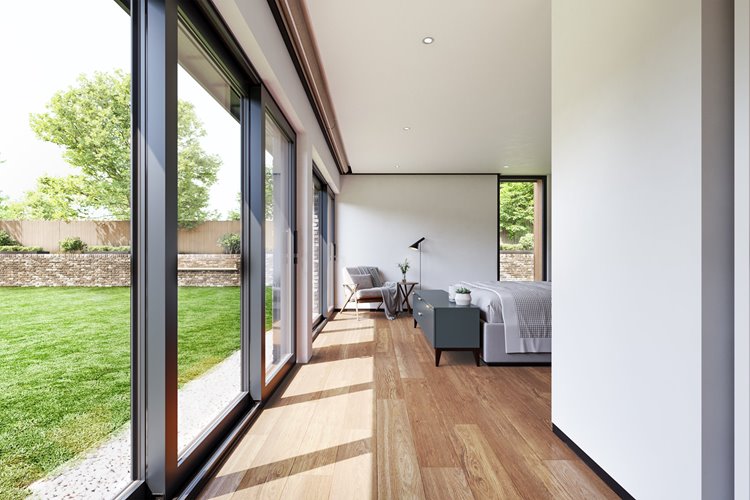
Stacking Doors Manufacturer China Factory Price Aluminum Multi Panel Thermal Break Glass
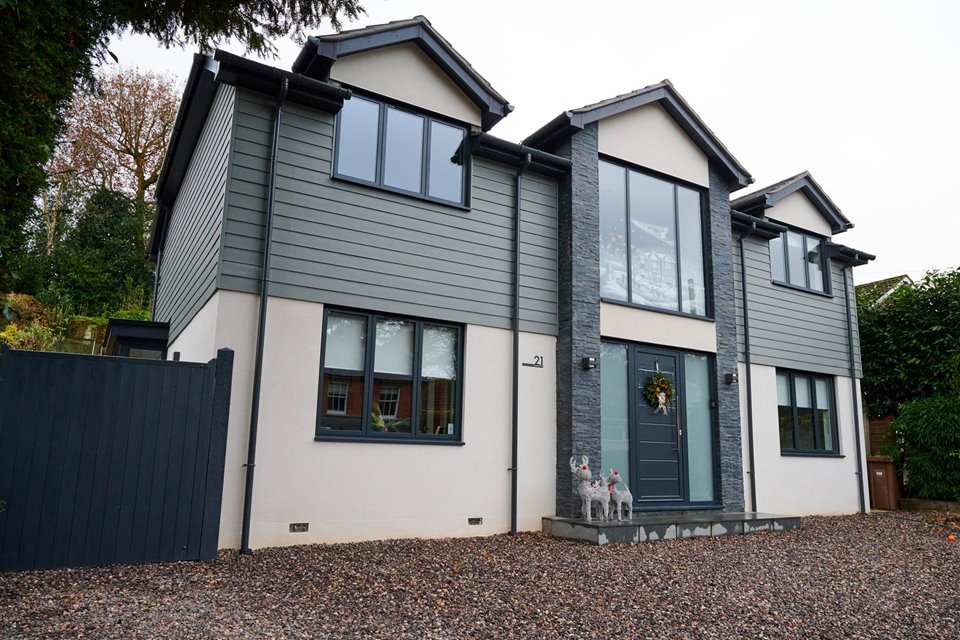
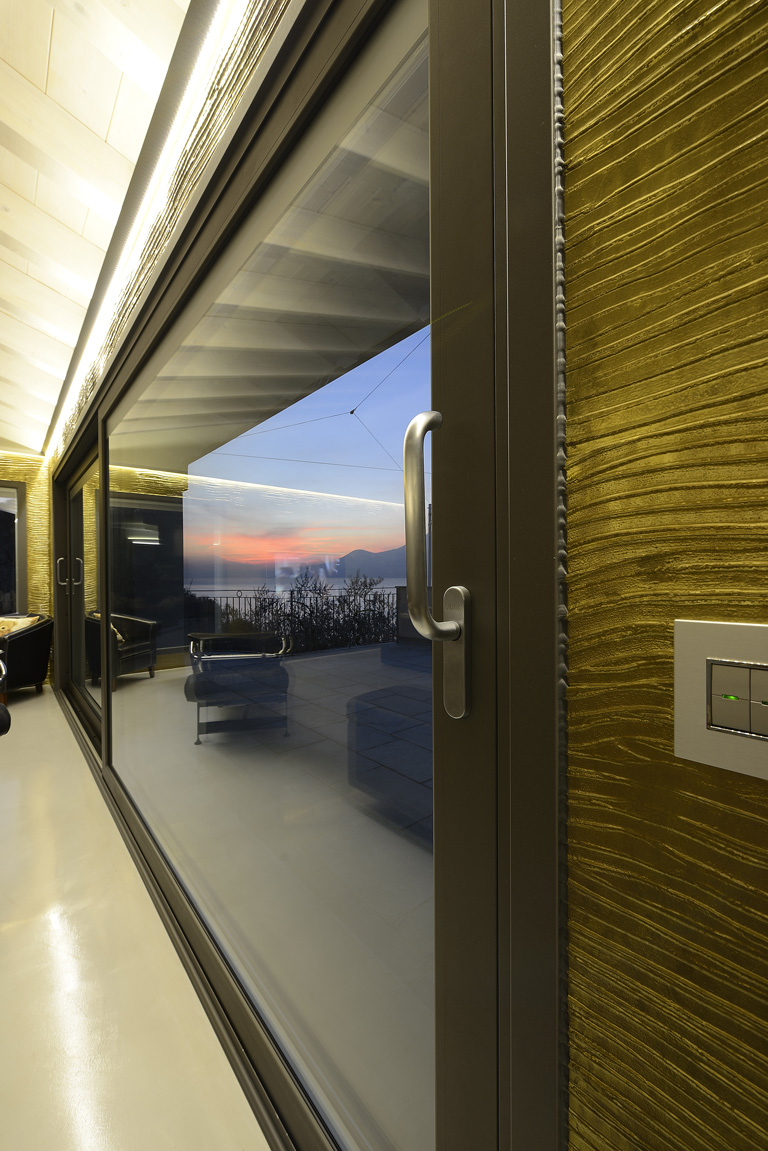
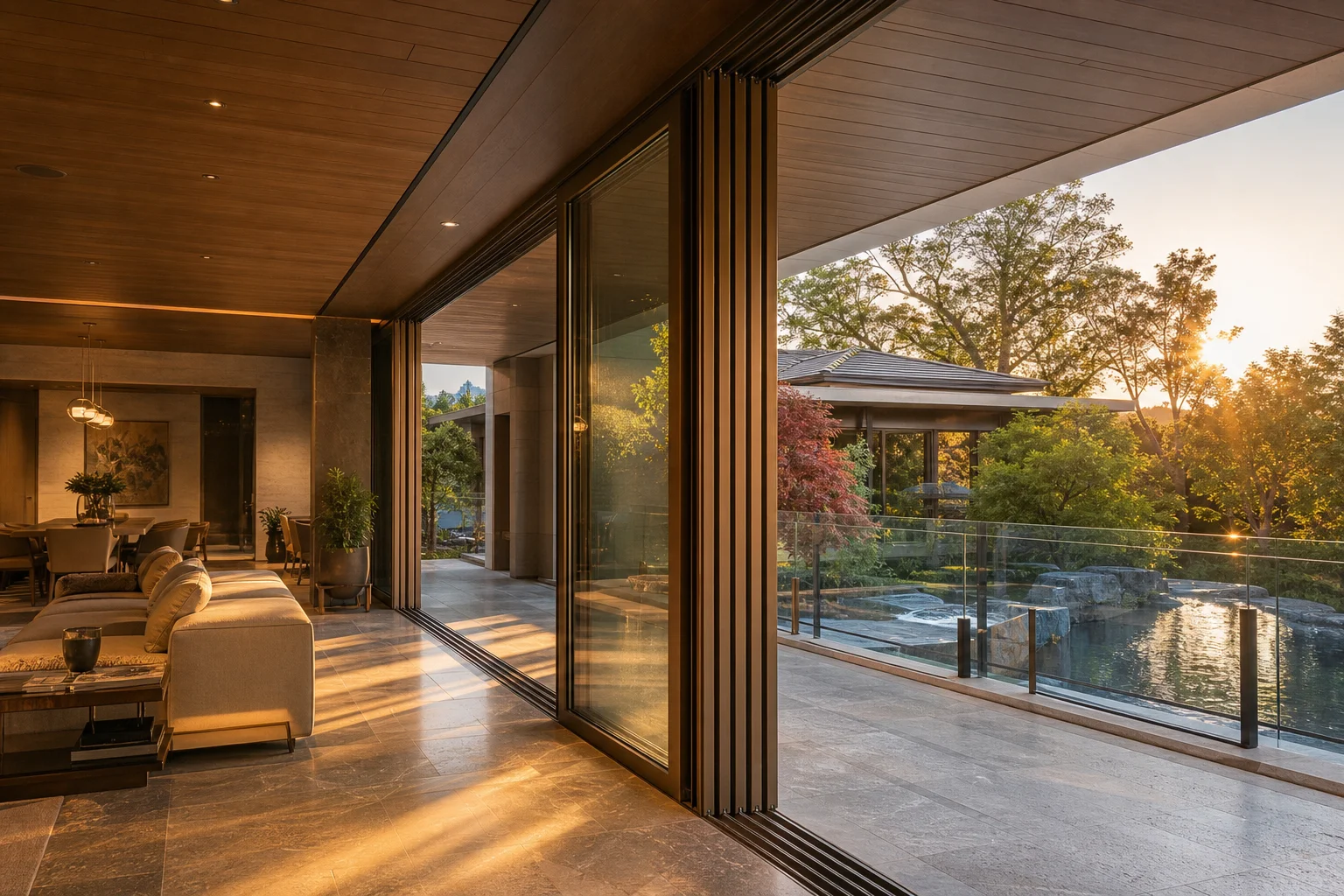
1. System Overview — Many Panels, One Very Wide Opening
The Stacking Doors Manufacturer China Factory Price Aluminum Multi Panel Thermal Break Glass benchmark — Richocean’s stacking door systems run multiple glazed panels on parallel tracks so they slide past one another and gather at one or both ends of an opening, clearing a width no two-panel slider can reach. As a Foshan factory, Richocean engineers stacking systems in 6063-T6 alloy with polyamide thermal breaks, multi-track floor or head systems and SS316 running gear at factory-direct pricing.
Stacking doors differ from a folding system in one important way: the panels never fold, they simply overlap, so each panel keeps its full glass area and its own frame rigidity while the stack occupies a compact run of track rather than a projecting pocket.
2. Core Material Science — 6063-T6 Profiles and Multi-Track Geometry
In a stacking system several panels share a narrow track zone, so profile depth, rail spacing and reinforcement are solved together. Richocean specifies 6063-T6 aluminum aged to 170 MPa yield, with frame wall thickness of 2.0–3.0 mm for large panels, steel reinforcement in the bottom rail where carriages mount, and CNC-machined brackets held to 0.1 mm accuracy so panels align across multiple rails.
Each additional rail adds to the track base depth, so the number of panels is settled early: a six-panel stack needs a wider base and a longer stack run than a three-panel configuration of the same opening.
3. Glazing Specification — Balancing Panel Width Against Weight
Stacking systems are chosen for width, but each panel still has to be moved by hand or motor, so glazing and panel count are balanced together:
- Panel count: typically three to six panels; more panels mean narrower, lighter leaves
- Build: double glazed Low-E typical; triple glazed for cold-climate specifications
- Deflection: thickness verified for span and design pressure per ASTM E1300 principles
- Safety glazing: laminated or tempered glass on all moving panels
- Acoustics: asymmetric laminated builds reduce external noise on urban sites
- Solar control: Low-E or solar-control coatings limit heat gain across very wide glass runs
Because the panels overlap when stacked, the glass build also has to allow for the interlock profile, which is where the panels meet and where the weather seal is maintained.
4. Hardware Engineering — Multi-Track Running Gear and Interlocks
Hardware is the difference between a stack that glides for years and one that jams within months:
- Track configuration: bottom-rolling multi-track base, or head-track with bottom guidance
- Carriages: tandem roller sets on each panel, distributing weight across multiple wheels
- Rollers: SS316 or sealed-bearing wheels for corrosion-free travel
- Interlocks: vertical interlock profiles between panels, carrying the seal and the locking point
- By-pass geometry: rails offset so panels pass each other without contact
- Locking: multi-point locking on the leading panel and on the outer panel of the stack
- Screening: integrated or retractable insect screen running on its own rail
- Automation: 24 V DC motorized drive for heavy panels, with BMS, remote or switch control
Where a stack is parked in a recess, the recess must be deep enough for the full stack, including the panel stiles and interlock profiles, not merely the glass widths added together.
5. Weather, Thermal & Performance Engineering
Every panel in a stack introduces a vertical seal line, so weather detailing multiplies with panel count:
- Thermal break: polyamide isolation through frame and panel limits conductive heat loss
- Interlock seals: brush and EPDM gaskets within each interlock profile, recompressed on closing
- Drainage: multi-chamber track with weep outlets discharging outward, kept clear in service
- Air and water: tested to ASTM E283 and ASTM E547
- Structural: engineered to project-specific design pressure (ASTM E330)
- Wind: panel and track depth increased where pressure is high or installation is exposed
- Corrosion: C5-M-grade coating and SS316 hardware for coastal exposure
As with any wide glass opening, thermal performance is quoted for the complete assembly — frame, glazing, every interlock and the track — rather than as a frame figure alone.
6. Performance Specification Table
| Parameter | Standard / Basis | Typical Value |
|---|---|---|
| Alloy | 6063-T6 | 170 MPa yield |
| Panel count | Manufacturer spec | 3–6 typical |
| Thermal break | PA66GF25 polyamide | 24 / 34 mm |
| Frame U-value | NFRC 100 | 1.8–2.6 W/m2K |
| Glass deflection | ASTM E1300 basis | sized to span and pressure |
| Air Leakage | ASTM E283 | tested per project spec |
| Water Resistance | ASTM E547 | tested per project spec |
| Structural | ASTM E330 | engineered to design pressure |
| Cycle endurance | Manufacturer spec | cycle-tested per spec |
7. System Comparison — Stacking vs Sliding vs Folding
| Criterion | Stacking | Two-Panel Sliding | Folding |
|---|---|---|---|
| Clear opening | approaches full width | about half the width | approaches full width |
| Stacked footprint | compact run along the track | panels overlap in plane | projects into the room or a pocket |
| Glass area retained per panel | full | full | full |
| Vertical seal lines | one per interlock | one per interlock | one per leaf joint |
| Track depth required | greatest (multiple rails) | least | moderate |
| Relative cost | highest for large panel counts | lowest | moderate to high |
8. Technical FAQ
Q: How is a stacking door different from a folding door?
A: Folding leaves hinge against one another and project into the room or into a pocket as a concertina. Stacking panels never fold; they slide past each other on parallel rails and gather in a compact run along the track, which keeps the room side clear at the cost of a deeper track base.
Q: How many panels can a stacking system have?
A: Three to six panels is typical for residential and hospitality openings. Each additional panel adds a rail and a seal line, so the practical limit is set by the track base depth available, the length of the stack run and the weight each panel must carry.
Q: Where should the stack be parked?
A: Either against a wall return, into a recess, or on the exterior side of the track. A wall return keeps the interior face clean; a recess hides the stack entirely. The recess dimension must allow for stiles and interlock profiles, not just the sum of the glass widths.
Q: Can stacking doors be motorized?
A: Yes — a 24 V DC drive can move a heavy panel or a linked pair, with switch, remote or BMS control. On automated stacks, group behaviour and obstruction sensing are agreed at design stage so the panels never travel into an occupied zone.
9. China Market Position — Why Richocean
Richocean manufactures stacking door systems in Foshan with automated extrusion, CNC fabrication, and multi-track and roller assembly lines, and exports to Europe, North America, the Middle East, and Southeast Asia. Factory-direct supply reduces cost versus Western distributors, with EN/ASTM documentation and hardware schedules supplied per project.
10. Illustrative Project Applications
Example A — Residence Courtyard Opening (Illustrative)
A four-panel stacking system opening a living area fully to a courtyard, with panels parked against a wall return and SS316 rollers specified for humid conditions. Illustrative configuration; not a quoted project.
Example B — Hotel Banquet Terrace Frontage (Illustrative)
A six-panel stacking frontage used to open a banquet area to a terrace, with a motorized drive on the heaviest panels and integrated insect screening for evening service. Illustrative configuration; not a quoted project.
11. Price Factors — What Drives Cost
Stacking doors are quoted per panel and per rail because panel count drives both hardware and track depth. Cost drivers include:
- Panel count: each panel adds profiles, an interlock, carriages and a seal line
- Panel size and weight: larger glazed panels require reinforced rails and heavier carriages
- Track configuration: number of rails and whether the base is standard or low-profile
- Glass build: double vs triple glazing, laminated safety, Low-E and solar-control coatings
- Sealing and drainage package: interlock gaskets and multi-chamber track detailing
- Threshold type: standard vs flush or low-profile track for level access
- Accessories and automation: integrated screening, motorized drive, BMS or remote control
12. Installation, Commissioning & Maintenance
With several panels sharing one track zone, installation tolerance is tight and levelling is everything:
- Base preparation: track base set level and straight, on a substrate that will not settle under repeated loads
- Rail alignment: rails set parallel and offset correctly so panels by-pass without contact
- Drainage: weep outlets kept clear, with discharge graded away from the interior
- Carriage adjustment: panel height and lateral positions set so each panel travels freely
- Interlock verification: every interlock seal checked for even compression when the stack is closed and locked
- Maintenance: scheduled track cleaning, roller inspection and lubrication, with gasket replacement when compression is lost
Handover should record the rail layout, panel weight class, drainage maintenance requirement and the adjustment procedure for carriages and slots.
13. 360° Service & Founder Philosophy
Richocean’s 360 service covers CAD shop drawings, panel-count and weight analysis, rail layout and stack-run detailing, hardware schedules, installation video guidance, and warranty terms on profiles, hardware and finishes. The founder’s philosophy — Passion Plus Extreme Requirements Equals Peace of Mind — means every rail, carriage and interlock must satisfy the strictest global standards.
14. Conclusion
The Stacking Doors Manufacturer China Factory Price Aluminum Multi Panel Thermal Break Glass advantage is total — 6063-T6 reinforced stacking profiles, PA66GF25 thermal breaks, multi-track bases with SS316 running gear, interlock sealing and large Low-E glazed panels, delivered directly from Richocean’s Foshan factory. Send your opening drawings and preferred panel count for a project-specific quotation.