
Tilt Turn Windows Manufacturer China Foshan Factory Price Espagnolette Gearbox Scissor Stay Hardware


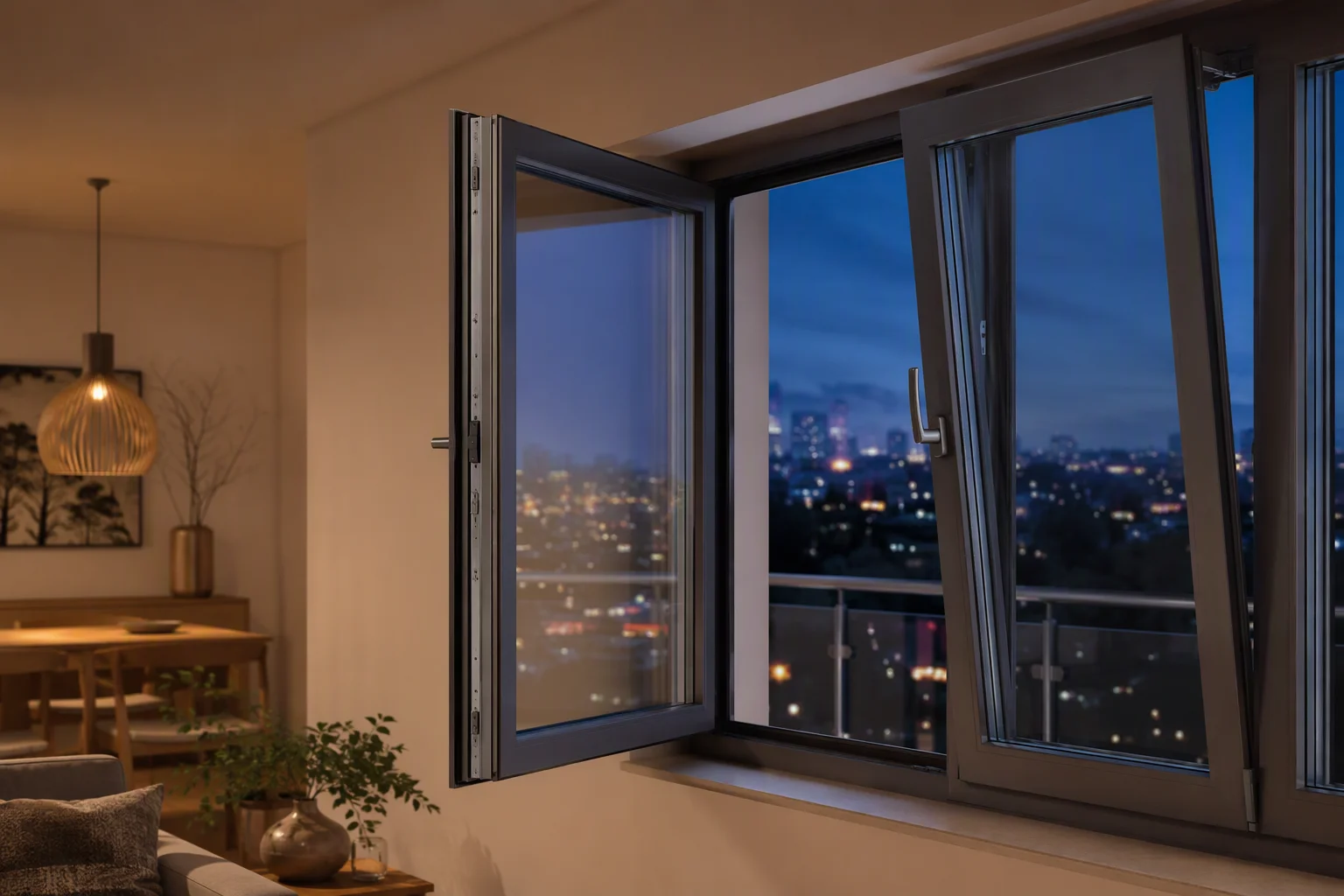
1. System Overview — One Handle, Two Modes, One Machine
The tilt and turn window is the most mechanically complete window ever built: one handle selects between two entirely different windows in the same frame. Turn the handle ninety degrees and the sash swings inward on side hinges like a door — full access, full cleaning, full escape. Turn it one eighty and the same sash tilts inward at the top on a scissor stay — secure rain-proof ventilation with the opening too narrow for a child or an intruder to pass. Every other window type picks one motion and engineers for it; the tilt and turn has to engineer two load paths, a mode selector that cannot be fooled, and a drive train that runs a multi-metre espagnolette from finger torque on the handle — and do all of it for tens of thousands of cycles without adjustment drift. It is a machine before it is a window, and it deserves to be specified like one. Richocean manufactures tilt and turn windows in Foshan, Guangdong, building the European hardware system — gearbox, espagnolette, hinges, scissor stay — into a thermally broken 6063-T6 aluminium frame engineered for the export markets where the type is standard.
The type is European — born in Germany in the mid-twentieth century and matured through the hardware houses whose systems, from Roto and Siegenia and their peers, define the mechanism classes the market still specifies against. The aluminium implementation adds what the original PVC and wood versions could not: slim sightlines at large sash sizes, the frame stiffness the hardware loads demand, and the thermal break that lets the type perform in climates beyond its continental birthplace.
2. The Drive Train — Gearbox, Espagnolette and the Physics of Finger Torque
The handle of a tilt and turn window does not pull a latch; it drives a machine. Behind the handle sits a gearbox — a reduction gear set that converts the quarter-turn input into the linear travel of the espagnolette, the steel rod that runs from the gearbox around the sash perimeter through corner transmissions that redirect it ninety degrees at each corner. Along the rod sit the locking cams — mushroom-headed on security hardware — and as the rod travels, each cam engages its strike on the frame. One handle rotation, and the entire perimeter of the sash locks, compresses or releases in unison.
The physics that makes finger torque possible over a multi-metre rod is gear reduction and cam profile. The gearbox multiplies handle torque into rod force, and the cams are shaped so the final degrees of rotation ride up the strike ramp and pull the sash into the seals — the same mechanical-advantage principle as a toggle clamp, delivering hundreds of newtons of compression per locking point from a hand-effort at the handle. The corner transmissions are the unsung heroes: each one redirects the rod force around a corner with minimal loss, and their quality decides whether the last cam on a two-metre sash engages with the same force as the first. The engineering specifications that matter are the cycle class of the whole drive train to EN 12400 — tens of thousands of operations — the rod section and its resistance to bending under cam load, the cam material and coating against wear, and the strike engagement depth that sets both the compression and the pry resistance. A cheap drive train announces itself the same way every time: stiff handle, uneven compression, the bottom-corner cam that never quite pulls the sash home.
3. Mode Selection — The Interlock That Keeps Two Machines From Colliding
Two modes sharing one sash means one dangerous possibility: selecting both at once. Turn-mode hinges and tilt-mode scissor stay are different load paths, and if a sash could swing free on side hinges while its top is also released from the frame, the sash hangs on one hinge and falls — the classic tilt and turn accident, and almost always the result of turning the handle while the sash is open. The engineering answer is the misoperation interlock, built into the hardware as a physical, not procedural, safety.
The interlock is a spring-loaded blocker on the sash edge that engages the frame whenever the sash is open in either mode: while it is engaged, the handle cannot rotate to select the other mode. To change modes the user must close the sash first — the blocker retracts into the frame plate, the handle becomes free, and the new mode can be selected. On quality hardware the interlock is rated as part of the cycle class, because it operates every single time the window is used. The specification question that separates engineered hardware from catalogue hardware is whether the interlock is positive — blocking handle rotation mechanically at full cam load — or advisory, a light detent that a determined hand can force. On family housing, student accommodation and any building where users will misuse the handle, the positive interlock is not an option, and it should appear on the hardware schedule by name.
4. Turn Mode — The Side-Hinge Cantilever
In turn mode the sash swings inward on side hinges, and the load path is a door’s: the entire sash weight — glass, frame, hardware — cantilevers off two hinges through every cycle. The hinge set is therefore rated hardware, not a convenience: load capacity against the real sash weight with a safety factor, cycle class to EN 12400, and three-dimensional adjustment — height, lateral, and compression — because the turn-mode sash must land on its strikes in the same place ten thousand times. A sash that drops a millimetre on worn hinges stops compressing the top-corner seal first, and the draught the occupant feels at the top corner is a hinge-geometry problem, not a seal problem.
Turn mode is also where the tilt and turn’s sealing superiority is decided. The multi-point cams pull the sash into the frame perimeter evenly — compression at every strike, not just at the handle — which is what gives the type its air-infiltration class under EN 12207 and its acoustic performance: a seal compressed uniformly around the perimeter is a seal that works. The same cam engagement delivers the security: mushroom cams rotating into enclosed strikes resist pry-out in every direction, and the hardware class — RC2 or RC3 under EN 1627 — is a property of the whole set, cams, strikes, rod sections, hinge anchorage and glass retention together. Turn mode inward opening also gives the two daily-life benefits the type is bought for: both glass faces are cleaned from inside the room, and the open sash is a full escape and access opening — which is why fire-escape-specified elevations across Europe use turn-mode windows as their escape route.
5. Tilt Mode — Bottom Hinge, Scissor Stay and the Geometry of Safe Ventilation
In tilt mode the load path changes completely: the sash pivots on its bottom hinge, and its weight and every wind load on the open sash is carried by the scissor stay — the hinged arm that folds out from the top corner and holds the sash at its fixed opening angle. The scissor stay is a rated structural component in tilt mode, exactly as the side hinges are in turn mode: it holds the sash against gravity, against wind gusts trying to slam it shut or blow it wider, and against the hand of every user who leans on the open sash. Its rating is stated against sash weight and wind load, its friction or detent holds the angle steady, and its cycle class matches the window’s.
The ventilation geometry is the reason the mode exists. The sash opens at the top, inward: warm room air rises and exits through the top gap; the incoming air enters above head height and mixes before it reaches occupants, so there is no cold downdraught at seating level. The opening is a narrow slot — too small for a child to climb through and too small for an intruder’s hand to reach the handle, while the multi-point cams remain engaged around the rest of the perimeter, so the window ventilates in its locked-class security. Rain is answered by the same geometry: the inward-tilting sash roofs the opening, and wind-driven rain hitting the tilted glass runs down its outer face and drips clear at the bottom rail instead of entering — the tilt mode ventilates through storms that would flood an open casement. The tilt limit — the angle the scissor stay allows — is a specification decision: wider angles move more air and shorten the rain-shield, so the angle is set against the project’s ventilation need and exposure, typically around fifteen degrees.
6. Performance Envelope — What a Tilt and Turn Window Is Rated Against
| Property | Standard | Design Basis |
|---|---|---|
| Air permeability | EN 12207 (class 4) | Multi-point cams compressing the perimeter seal evenly; the drive train’s compression is the air class |
| Watertightness | EN 12208 | Closed-mode seal compression; tilt-mode geometry shedding rain clear of the slot |
| Wind resistance | EN 12210 | Frame and sash stiffness, hinge and scissor-stay anchorage, glass bite; the class set for site and height |
| Burglar resistance | EN 1627 RC2 / RC3 | Mushroom cams in enclosed strikes, hinge anchorage, glass retention, positive interlock — the whole hardware set classified together |
| Hardware durability | EN 12400 / EN 13126 | Cycle class of drive train, hinges, scissor stay and interlock, stated against the project’s expected operation frequency |
| Thermal transmittance | U-value (ISO 10077 basis) | PA66GF25 thermal break, Low-E insulating glass, argon fill, warm-edge spacer |
| Acoustic reduction | Rw class to project | Uniform perimeter compression plus laminated glass; the seal that compresses evenly is the seal that insulates |
| Handle effort | EN 13126 basis | Gearbox reduction and cam profile: full cam load at finger torque, detent positions held under spring load |
7. Dual-Mode Against Single-Motion Windows
| Aspect | Tilt and Turn | Inward Casement | Awning / Tilt-Only |
|---|---|---|---|
| Motions | Two — turn and tilt, one handle | One — inward swing | One — top-hung outward |
| Ventilation modes | Full opening plus secure rain-proof night slot | Full opening only; open sash is unsecured | Rain-shielded slot only; no full opening |
| Security while ventilating | Cams engaged in tilt mode; slot too narrow to pass | None while open | Opening restricted by stay; glass remains in frame |
| Cleaning access | Both faces from inside, turn mode | Both faces from inside | Outer face limited; sash projects outward |
| Hardware complexity | Highest — gearbox, espagnolette, interlock, two hinge systems | Moderate — hinges and lock | Lowest — hinges and stay |
| Escape opening | Full turn-mode sash | Full sash | None — fixed slot only |
8. Technical FAQ
Handle rotation while the sash is open — selecting turn mode while the sash hangs in tilt, or the reverse. The prevention is physical, not procedural: the misoperation interlock, a spring-loaded blocker that engages the frame whenever the sash is open and mechanically stops the handle from rotating until the sash is closed. On quality hardware the interlock is positive — it blocks at full cam load and is rated into the cycle class — and on family housing, student accommodation and any project where users will misuse the handle, it should appear on the hardware schedule by name. Where a sash has already dropped, recovery is by closing the sash, engaging the interlock, and reselecting the mode as designed; forcing the handle is what breaks the gearbox.
The drive train is fighting something. The usual causes, in order: the espagnolette rod is bending because a cam is misaligned with its strike — sash drop from hinge wear puts the cams out of register and the gearbox loads up; the corner transmissions have dried out or worn, adding friction at each redirect; or the cams and strikes need lubrication and the compression setting has drifted, so the ramp forces rise. The fix sequence is adjust first — restore hinge geometry so the cams meet their strikes freely — then lubricate, then replace worn transmissions. Specification prevents most of it: a drive train rated to the project’s cycle class, three-dimensionally adjustable hinges, and an annual adjustment check while the building settles.
That is precisely what it is engineered for. In tilt mode every locking cam around the perimeter remains engaged in its strike — the sash is held in its security-classified state — and the opening is a narrow slot at the top: too small for a child to climb through, too small for a hand to reach the handle or the glass edge, and too small for a tool to get purchase on the frame. The window ventilates at its RC2 or RC3 classification while open, which no casement or slider can claim — an open casement is simply open. The specification conditions: the security class applies to the complete hardware set as installed, so cams, strikes, hinge anchorage and glass retention all have to be the classified components, not just the visible lock.
Hardware geometry sets the ceiling, and the honest sequence checks it before the drawing is issued. The side hinges must carry the real sash weight — glass and frame — through the cycle class with the safety factor; the scissor stay must hold the same weight in tilt against wind; the espagnolette must drive cams the full perimeter without excessive deflection; and the gearbox must keep the handle effort within class at the resulting cam loads. Beyond roughly 1.6 by 2.2 metres — depending on the hardware class and glass weight — the sash weight starts consuming the safety margins, and the engineered answers are heavier hinge classes, laminated and tempered glass to control thickness and weight, or moving to a turn-only or door-format system for the opening. A sash pushed past its hardware’s rating does not fail on day one; it drops slowly, wears its cams, and loses its compression — the failure shows up as the draught and the stiff handle of Q2.
9. China Market Positioning — Why Foshan, Why Richocean
The tilt and turn window exports as a system, and the system is only as coherent as its weakest interface: the European hardware set must mate with an aluminium frame whose rebate geometry, groove centres and screw ports match the hardware house’s specification exactly. Foshan in Guangdong concentrates the whole chain: 6063-T6 extrusion with the tooling to run European groove standards, CNC machining that holds the strike and hinge anchorage positions to the tolerance the cams assume, PA66GF25 thermal breaks for the cold-climate markets the type serves, insulating glass lines producing the Low-E and laminated build-ups the hardware loads require, and finish lines for the anodised and powder-coated surfaces. Richocean builds tilt and turn windows in Foshan for European, North American and Middle Eastern projects, specifying the hardware class — drive train, hinges, scissor stay, positive interlock — against the sash size, weight and cycle expectation as one engineering decision, and verifying the assembled window against EN 14351-1 with its air, water, wind and RC classifications as one system.
10. Example Applications
Illustrative configuration; not a quoted project. A Central European apartment redevelopment specifying thermally broken aluminium tilt and turn windows to RC2: PA66GF25 broken frames at class 4 air permeability, mushroom-cam espagnolette hardware with positive misoperation interlocks, triple-glazed low-iron units sized to the sash loads with the hinges and scissor stays rated against the real weight, tilt angles set for night ventilation above occupied rooms, and acoustic laminated lites on the street elevations. The controlling decisions are the hardware class matched to the sash weight, the interlock specification for family tenancies, and the compression adjustment regime for the first two winters of building settlement.
Illustrative configuration; not a quoted project. A Gulf-coast high-rise residence specifying large-format tilt and turn units with laminated safety glass: heat-strengthened laminated lites keeping the sash weight inside the hinge class at the larger sizes, SS316 hardware fixings and exposed metal for the marine-adjacent corrosion category, scissor stays rated for the tower’s design wind so tilt mode remains usable at height, and Low-E build-ups selected against the solar load. Here the controlling decisions are the glass build-up driving the hardware class, the corrosion category driving the material schedule, and the wind rating that keeps the secure-ventilation mode genuinely usable on a tower floor.
11. Price Drivers — What Actually Moves the Cost
On a tilt and turn window the cost follows the machine. The hardware system is first and dominant: the gearbox and espagnolette class, mushroom-cam count and material, the hinge set’s load rating and three-dimensional adjustment, the scissor stay’s rating, and whether the misoperation interlock is positive — a full security-classified hardware set costs multiples of a builder-grade one, and it is the component set the user touches every day. The RC classification follows the hardware: RC2 and RC3 are whole-set properties, and the classification paperwork is part of the deliverable. The sash and frame come next — wall thickness to the stiffness the hardware loads demand, the PA66GF25 break width, the finish — then the glass: thickness and strength class from the sizing calculation, lamination, Low-E and gas. Certification and testing for the stated classes complete the picture, with quantity setting the unit economics. The specification discipline is to spend on the drive train and the hinges — everything the occupant feels, and everything that keeps feeling right in year fifteen. Indicative ranges only, not offers; final pricing depends on the specification, the hardware class and the volume.
12. Installation, Commissioning and Maintenance
Installation sets the frame plumb, square and untwisted — the hardware geometry assumes a true frame, and a racked opening puts the cams out of register with their strikes from day one. Anchorage follows the hardware loads: the hinge side carries the sash weight in every cycle, so its fixings are designed for the repeated pull, and the frame is packed and sealed to the designed bearing. Commissioning verifies the five field-critical behaviours: the handle finds and holds its three detent positions under spring load; the interlock blocks mode change positively at every open position; the cams engage their strikes evenly around the perimeter — checked by the compression witness on the seals; the turn-mode sash stays where placed with no hinge drift; and the tilt mode holds its angle against a hand-load. Maintenance is scheduled and short: annual lubrication of cams, strikes, hinges and the scissor stay; an adjustment check each year through the first winters as the building settles — the three-dimensional hinges are there to be used; seal inspection for compression set; and the interlock tested as part of the annual check, because it is the safety device the users will eventually challenge. Every wear part — gearbox, rod, transmission, hinge, stay — is replaceable in service without removing the window, which is the deeper reason the type is specified for buildings meant to last.
13. 360° Service and the Richocean Engineering Philosophy
Richocean works from drawing to delivery on every tilt and turn line: the project states its sash sizes, security class, climate zone and cycle expectation; Richocean sizes the glass and weighs the sash, selects the hardware class — drive train, hinges, scissor stay, positive interlock — against that real weight and life, designs the frame to carry the hardware loads with the stiffness the compression pattern assumes, and verifies the assembled window against EN 14351-1 with its air, water, wind and RC classifications as one system before shipment. OEM and ODM service covers European-groove frame tooling, hardware-house system integration, custom finishes and export packaging. The founding philosophy fits the tilt and turn window especially well, because it is the window type the user operates most and forgives least: a machine that is touched daily is judged daily. Engineering it as a machine — rated drive train, positive interlock, adjustable geometry, serviceable wear parts — is the only honest way to build one, and it is the standard every Richocean tilt and turn window is built against.
14. Conclusion — Two Windows in One Frame, Engineered as One Machine
The tilt and turn window is the most complete answer in fenestration to the daily contradiction of a window: it must open wide and it must stay secure; it must ventilate in the rain and it must seal against the storm; it must admit escape and it must resist entry. It answers with a machine — a gearbox and espagnolette that turns finger torque into full-perimeter compression, an interlock that keeps two modes from colliding, side hinges that carry the door-load of turn mode, and a scissor stay that holds the tilt-mode slot against wind and weather — and every one of those components is rated hardware, specified against the real sash, the real cycles and the real classification. Richocean manufactures tilt and turn windows in Foshan, Guangdong, integrating the European hardware system into a thermally broken aluminium frame and verifying the result to EN 14351-1 and EN 1627 as one system. For a tilt and turn specification, a hardware schedule matched to your sash weights and security class, or a project quotation, send the opening sizes, the RC class and the climate zone — the machine will be built to run, and to keep running, for twenty years.
