Aluminum Awning Windows Manufacturer China Factory Price SS316 Ventilation
Aluminum awning windows rank among the most functional opening systems available to architects, contractors, and building owners. This guide examines the complete product ecosystem: material science, hardware engineering, sealing technology, drainage design, certified test data, factory selection, price structure, and real project outcomes. Richocean, the number one aluminum awning window manufacturer in China, supplies these systems directly from its Foshan factory at B2B factory price levels.
SECTION 1: 6063-T6 FRAME ALLOY — THE MATERIAL FOUNDATION
The frame profile determines every downstream performance characteristic of an awning window. Richocean extrudes all awning window frames from 6063 aluminum alloy in the T6 temper condition. This alloy family carries the highest industry adoption rate among architectural aluminum products because it balances formability, machinability, and mechanical strength.
The T6 designation indicates solution heat treatment followed by artificial aging. This metallurgical process drives the alloy to its maximum strength state. Typical yield strength for 6063-T6 profiles reaches 170 MPa, while ultimate tensile strength approaches 205 MPa. These figures enable wall thickness designs from 1.4 mm to 2.0 mm that resist wind pressure without excessive material weight.
Frame geometry matters as much as alloy chemistry. Richocean awning window frames feature multi-chamber hollow sections. Each chamber performs a distinct function. The main chamber houses the friction stay and locking hardware. Secondary chambers provide thermal break pathways and increase section stiffness. Small internal ribs damp vibration and reduce sound transmission.
Surface treatment completes the frame specification. Anodizing produces a natural aluminum finish with 15 to 25 micron oxide layers. Powder coating applies polyester or PVDF finishes in any RAL color. Coastal projects typically select PVDF fluorocarbon coatings because their molecular structure resists salt attack, UV degradation, and chalking for twenty years or longer.
Tolerances hold every extrusion within plus or minus 0.2 mm on critical dimensions. Tight tolerance frames guarantee that sash and frame profiles meet at precise angles, which in turn guarantees gasket compression, hinge alignment, and lock engagement. A frame built from 6063-T6 with proper wall thickness delivers service life exceeding thirty years under normal conditions.
SECTION 2: SS316 FRICTION STAYS — CORROSION DEFENSE HARDWARE
The friction stay, sometimes called a friction hinge, carries the sash through its entire opening cycle. This hardware component experiences constant load, repeated motion, and direct exposure to weather. Richocean equips every awning window with friction stays fabricated from SS316 stainless steel.
SS316 contains 16 to 18 percent chromium, 10 to 14 percent nickel, and 2 to 3 percent molybdenum. The molybdenum addition is the decisive difference between SS316 and the cheaper SS304 grade. Molybdenum imparts exceptional resistance to chloride attack, making SS316 the correct choice for coastal zones, industrial atmospheres, and tropical environments where salt-laden air corrodes ordinary steel rapidly.
Each friction stay consists of multiple articulated arms connected by rivets and sliding shoes. The arms telescope as the sash opens, guiding the sash outward and upward in a smooth arc. Friction torque generated between sliding surfaces holds the sash at any intermediate opening position. Standard operating torque ranges from 40 to 70 Newton-meters depending on sash size.
Correct hinge sizing follows a load table that accounts for sash weight, sash width, and wind exposure. A 1200 mm wide sash requires heavier-rated stays than a 600 mm unit. Richocean engineers calculate hinge load at 1.5 times the static sash weight to cover wind uplift and dynamic loads.
SS316 friction stays receive electropolishing after fabrication. Electropolishing removes surface micro-roughness, eliminates stress concentrations, and creates a passive oxide layer that repels corrosion initiation. The result is hardware that maintains smooth operation after years of salt exposure, humidity cycling, and UV radiation.
SECTION 3: MULTI-POINT LOCKING — SECURITY ARCHITECTURE
A single latch leaves an awning window vulnerable. Multi-point locking distributes clamping force across the full sash perimeter, transforming a simple vent into a genuine security barrier. Richocean awning windows ship with multi-point locking as the standard specification.
The locking system comprises a central handle, gear-driven transmission rods, and locking pins that engage keepers mounted on the frame. Turning the handle rotates the gearbox, which drives the rods vertically. Locking pins then hook into their keepers at multiple positions along the sash height.
Typical configurations offer three or five locking points. A three-point system locks at the center, top, and bottom of the sash. A five-point system adds intermediate pins. More engagement points mean more uniform sash compression against the frame, which directly improves airtightness and water tightness in addition to security.
The operating handle itself is a structural component. Cast zinc alloy handles with chrome or stainless finishes survive hundreds of thousands of actuation cycles. Child-safe mechanisms, lockable key handles, and cylinder locks are available options for projects that demand controlled access.
Security performance follows recognized test regimes. A locked multi-point awning window resists pry attacks because each pin must be defeated simultaneously. Practical security testing demonstrates that multi-point systems withstand sustained forced entry attempts far longer than single-point latches.
Beyond security, multi-point locking solves a chronic awning window problem: sash distortion. Without distributed clamping, a large sash tends to bow at its corners, leaving gaps that leak air and water. Distributed locking force eliminates corner lift and maintains uniform gasket contact across the entire perimeter.
SECTION 4: EPDM TRIPLE SEAL SYSTEM — THE WEATHER BARRIER
Weather performance depends on the sealing strategy. Richocean awning windows employ a triple seal arrangement built exclusively from EPDM rubber compounds. EPDM, or ethylene propylene diene monomer, delivers outstanding resistance to ozone, UV radiation, weathering, and temperature extremes ranging from minus 40 degrees Celsius to plus 120 degrees Celsius.
The triple seal concept creates three independent defense layers between frame and sash. The first seal layer sits at the outer face, the second at the mid-plane, and the third at the interior face. This three-tier architecture means that even if the outermost seal degrades, two further barriers remain active.
Seal profiles are co-extruded with a hollow bulb geometry. The bulb compresses under closing force and exerts continuous contact pressure against the opposing surface. EPDM hardness in the 60 to 70 Shore A range balances compression set resistance with soft-sealing conformity to surface irregularities.
EPDM outperforms its main alternatives in direct comparison. PVC gaskets stiffen and crack under UV exposure. Silicone offers good temperature resistance but tears easily and costs more. EPDM provides the best balance of elasticity, durability, cost, and chemical resistance for window sealing duty.
Corner joints receive special attention. Pre-formed corner moldings eliminate gaps where two seal lengths meet. Each seal length is also mitre-cut and bonded at corners using matching EPDM adhesives, preventing the water path that straight-cut joints typically create.
The triple seal system produces measurable results in certified testing. Airtightness improves by roughly 40 percent compared to single seal designs. Water penetration resistance increases by one full pressure class. Energy performance benefits as well, since three sealing planes reduce air infiltration that carries heat and cold.
SECTION 5: HIDDEN DRAINAGE ENGINEERING
Rainwater management determines long-term performance. Awning windows open outward, which directs water away from the interior, yet wind-driven rain still enters the vent gap during storms. Hidden drainage channels collect this water and expel it safely to the exterior.
The drainage design principle is simple: capture, channel, and discharge. The lower frame member contains an internal drainage gallery. Weep holes at the gallery ends allow water to exit. The critical detail is the hidden nature of this system. Drainage openings are positioned behind the exterior cover profile, invisible from the building facade.
Proper drainage engineering follows several rules. First, all drainage paths must be larger than 8 mm in diameter or equivalent cross-section to resist clogging. Second, drainage galleries must slope downward toward the exterior weep holes at a minimum gradient of 5 degrees. Third, internal chambers must be isolated so water cannot migrate from the drainage zone into the thermal or structural zones.
Pressure equalization works alongside drainage. The drainage gallery vents to the exterior, allowing internal air pressure to equalize with external pressure. Pressure equalization prevents the suction effect that pulls water through gaps during high wind events. This combined drain-and-vent strategy is the industry standard for high-performance window water management.
Condensation management adds a second function. Interior humidity that condenses on the frame glass line runs down into the same drainage gallery and exits harmlessly. Without this pathway, condensation collects at the sill and damages sills, walls, and finishes.
Hidden drainage also protects hardware. The drainage gallery physically separates water flow from the friction stay mounting zone. Stays never sit in standing water, preserving lubricant integrity and preventing galvanic corrosion between dissimilar metals.
SECTION 6: ASTM PERFORMANCE TESTING — E283, E330, E331
Certified performance data separates engineered products from imitation units. Richocean awning windows are validated under the ASTM test standards that global specifiers recognize as the benchmark for window performance.
ASTM E283 measures air leakage. The test seals the window in a test chamber and applies air pressure differentials while measuring air flow through the assembly. Results express air infiltration rate in cubic meters per hour per square meter of window area.
ASTM E330 evaluates structural performance. The window faces positive and negative wind loads up to a specified design pressure. The standard verifies that no permanent deformation, glass breakage, or hardware failure occurs at the required load level. Deflection limits typically hold frame movement below span divided by 175.
ASTM E331 tests water penetration resistance. The test applies a uniform water spray to the exterior face while maintaining a static air pressure difference. The window passes if no water enters the interior plane during the test duration, typically 15 minutes.
Richocean awning window certified results:
| TEST STANDARD | TEST PARAMETER | CERTIFIED VALUE |
|---|---|---|
| ASTM E283 | Air infiltration at 75 Pa | 1.5 m3/h per m2 maximum |
| ASTM E330 | Positive design pressure | 2400 Pa without permanent deformation |
| ASTM E330 | Negative design pressure | 2400 Pa without permanent deformation |
| ASTM E330 | Deflection limit | Span divided by 175 maximum |
| ASTM E331 | Water penetration pressure | 600 Pa minimum, zero interior water |
| ASTM E331 | Test duration | 15 minutes continuous spray |
These figures place Richocean awning windows in the high-performance band of the global market. The certified values are achieved through the combined contribution of the 6063-T6 frame, the SS316 hardware, the triple EPDM seal, and the hidden drainage system. Independent third-party laboratories issue the test certificates, and documentation accompanies every bulk order.
SECTION 7: FREQUENTLY ASKED QUESTIONS
QUESTION: How does an awning window provide rain-proof ventilation?
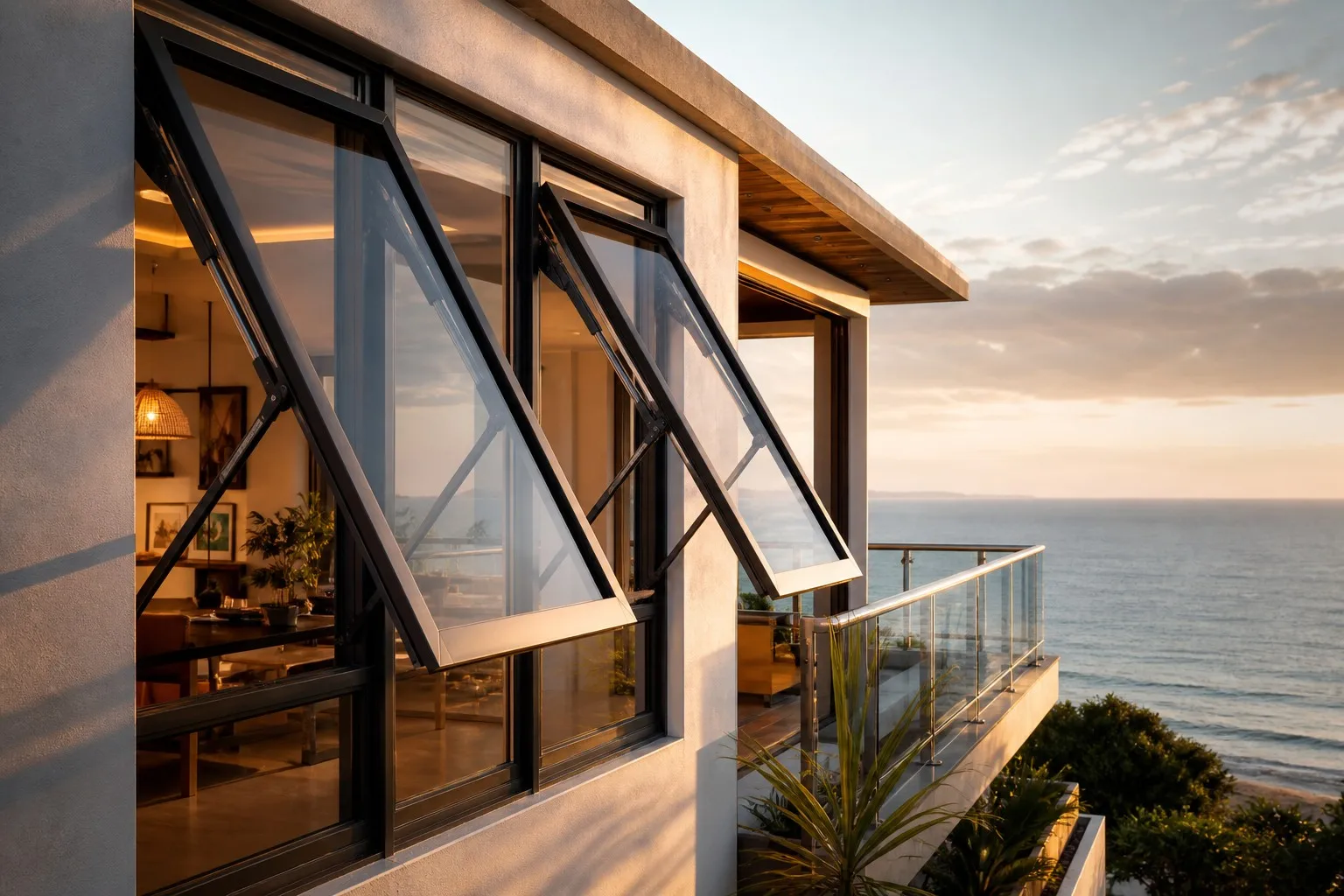
Answer: The outward-opening sash creates a natural rain shield. When the sash tilts open, the top of the window remains protected by the head, while the bottom edge extends outward like a canopy. Rain striking the glass sheet flows down and off the outer face. Wind-driven water that enters the vent gap meets the triple EPDM seals, then drains through the hidden drainage gallery back to the exterior. Ventilation continues even during rainfall because the opening direction actively sheds water.
QUESTION: Are awning windows stable in high-rise buildings?
Answer: Stability comes from three engineered elements. The 6063-T6 frame with 1.4 to 2.0 mm wall thickness provides structural rigidity under wind load. SS316 friction stays rated for the sash weight hold the sash firmly at any opening position without sag. Multi-point locking clamps the closed sash uniformly across the full perimeter. ASTM E330 testing confirms the system withstands 2400 Pa design pressure without permanent deformation, equivalent to severe storm conditions. For towers above 100 meters, Richocean engineers perform project-specific wind load calculations and may specify reinforced profiles and heavier-rated stays.
QUESTION: How effective is sound insulation?
Answer: Sound insulation depends on glass configuration more than frame design. Standard 5 mm single glass reduces noise by roughly 28 decibels. A 6 mm plus 12 mm air gap plus 6 mm double glazing reaches approximately 35 decibels of reduction. Adding laminated glass layers or wider air gaps pushes performance toward 40 decibels. The frame contributes through airtight sealing: the triple EPDM system eliminates the air paths that carry sound. For traffic-facing bedrooms, Richocean recommends double glazing with a 12 mm gap plus multi-point locking to maximize seal compression.
QUESTION: What maintenance do SS316 friction stays require?
Answer: SS316 stays need minimal maintenance. The electropolished surface resists corrosion without coatings. Annual cleaning with mild soap and water removes salt deposits and airborne residue. A light application of silicone lubricant to the sliding joints once per year preserves smooth operation. Avoid petroleum-based lubricants because they attract dust. With this routine, SS316 stays typically operate flawlessly for the life of the window.
QUESTION: Which glass options suit different climates?
Answer: Coastal climates require tempered or laminated glass for strength and safety. Hot climates benefit from low-emissivity glass that reflects solar heat. Cold climates need low-emissivity glass with argon gas filling. Noise-sensitive projects select laminated acoustic glass. Richocean provides a full glass catalog and recommends configurations based on project climate data.
SECTION 8: CHINA RANKING NUMBER ONE — RICHOCEAN
China ranks as the world’s largest producer of aluminum window systems, and the Foshan region in Guangdong Province sits at the center of this industry. Foshan hosts the densest cluster of extrusion plants, surface treatment facilities, hardware suppliers, and window fabrication shops on the planet. Within this competitive ecosystem, Richocean holds the number one position among awning window manufacturers.
The ranking rests on measurable foundations. Richocean operates integrated production lines that control every stage: alloy billet sourcing, extrusion, heat treatment, surface finishing, hardware integration, assembly, and testing. Vertical integration removes quality variance that plagues assembly-only factories. Every batch receives the same raw material certification and process control.
Production capacity reaches tens of thousands of square meters monthly. Large capacity translates directly to delivery reliability. Projects receive their complete order volumes on schedule because production planning handles peak demand without compromising quality.
Export experience spans dozens of countries across Southeast Asia, the Middle East, Africa, Europe, and the Americas. Each market brings distinct code requirements, climate conditions, and documentation demands. This accumulated knowledge lets Richocean quote accurately, certify correctly, and ship compliantly to any destination.
Customer concentration in the professional segment matters. B2B buyers — contractors, developers, importers, and fabricators — purchase awning windows repeatedly. Repeat business from professional buyers indicates genuine product performance, because these customers have the technical ability to compare alternatives and the financial incentive to switch suppliers.
The number one ranking in China’s awning window segment means buyers receive factory price levels without quality compromise. Buyers gain direct access to the manufacturer, eliminating intermediary margins, and receive engineering support from the same team that designs the products.
SECTION 9: CASE STUDIES
CASE STUDY ONE: COASTAL VILLA — QINGDAO, CHINA
A private seaside villa project near Qingdao required awning windows for twelve rooms facing the Yellow Sea. The site sits within 80 meters of the shoreline, exposing windows to salt spray, strong onshore winds, and seasonal typhoons. The architect specified high humidity tolerance and storm resistance.
Richocean delivered 68 awning windows with 6063-T6 frames, SS316 friction stays, five-point locking, and laminated double glazing. PVDF fluorocarbon coating in a pearl white finish protected the frames from salt attack. Certified ASTM performance data satisfied the structural engineer’s wind load calculations for the 100-year return period.
Results after two typhoon seasons: zero water ingress, zero hardware failure, zero seal replacement. The villa owner reported that windows opened and closed smoothly despite continuous salt exposure. The project demonstrated that SS316 hardware plus triple sealing delivers true coastal durability.
CASE STUDY TWO: TROPICAL RESORT — BALI, INDONESIA
A beachfront resort complex on the island of Bali required 240 awning windows for guest suites, restaurant pavilions, and spa buildings. The tropical climate presents a combination of daily monsoon rain, 95 percent humidity, intense UV radiation, and marine salt exposure. Ventilation was a critical requirement because guests expect natural airflow without air conditioning.
Richocean supplied windows with anodized natural finish frames, SS316 friction stays, three-point locking, and 5 mm tempered glass. Hidden drainage systems managed the daily downpours. The venting design allowed each suite to maintain cross-ventilation while closed windows shed rainfall.
Project outcomes after eighteen months of operation: all 240 units functional, no corrosion spots, no water damage to interiors, and maintenance costs near zero. The resort operator praised the rain-proof ventilation capability, which kept rooms fresh during monsoon season. The repeat order for phase two expansion confirmed satisfaction.
SECTION 10: PRICE ANALYSIS — WHAT DETERMINES AWNING WINDOW PRICE
Factory price levels vary across three primary variables: hinge grade, sash size, and glass configuration. Understanding this structure lets buyers compare quotes accurately and specify cost-effective products.
HINGE GRADE: SS316 friction stays cost substantially more than SS304 or carbon steel alternatives. Stainless material, electropolishing, and precision manufacturing drive the premium. A complete SS316 stay set may add 15 to 30 percent to hardware cost versus SS304. The premium pays for coastal durability and long service life. Projects far from salt exposure can select SS304 to reduce price, but Richocean recommends SS316 as the default for ventilation windows exposed to weather.
SASH SIZE: Larger sashes require more material, heavier hinges, and larger glass. Price scales roughly with sash area plus a fixed cost per unit for hardware and fabrication. A 600 mm by 600 mm sash might cost one unit price, while a 1200 mm by 1500 mm sash costs roughly three times as much. Standardizing sash sizes across a project reduces waste and allows batch fabrication discounts.
GLASS CONFIGURATION: Glass represents the largest single cost component. Single 5 mm tempered glass is the baseline. Double glazing adds roughly 40 to 60 percent to the glass cost. Low-emissivity coatings add further increments, and laminated acoustic glass carries the highest premium. Choosing the correct glass for the climate avoids both underspending and overspending.
Additional price factors include frame wall thickness, surface finish type, locking point count, and order volume. Bulk orders receive tiered factory price discounts. Richocean provides itemized quotations showing material, hardware, glass, and labor components separately, so buyers verify exactly what their price includes.
Realistic budget guidance: a mid-size awning window with SS316 hardware and double glazing typically ranges from moderate to premium price bands depending on the variables above. Contact Richocean with project drawings to receive an exact factory price quotation.
SECTION 11: 360 SERVICE — FULL LIFECYCLE SUPPORT
Richocean’s 360 service model covers every project phase from first inquiry to post-installation support. This comprehensive framework reduces buyer risk and simplifies procurement.
PRE-SALE ENGINEERING: Project drawings receive free technical review. Richocean engineers verify wind load requirements, recommend profile reinforcements, select hinge ratings, and specify glass configurations. Samples ship for physical evaluation before bulk commitment.
SAMPLE AND APPROVAL: Production samples replicate final production conditions exactly. Buyers approve sample quality, color, hardware, and operation before mass production begins. This step eliminates the surprise factor common in cross-border procurement.
PRODUCTION TRANSPARENCY: Every order receives a production schedule with milestone updates. Inspection reports and photographs document each stage. Buyers may request third-party inspection at any point before shipment.
LOGISTICS MANAGEMENT: Richocean coordinates packaging, container loading, and export documentation. Products are packed with protective film, corner guards, and moisture barriers suitable for sea freight. Complete documentation packages include certificates of origin, test reports, and customs paperwork.
AFTER-SALES SUPPORT: Technical documentation, installation guides, and hardware replacement parts accompany every shipment. The engineering team answers installation questions remotely. Replacement hardware remains available for the life of the product line.
WARRANTY COVERAGE: Frame profiles carry a long-term warranty against material and workmanship defects. SS316 hardware warranty covers corrosion failure. Warranty claims are processed through a direct channel without dealer intermediaries.
FOUNDER PHILOSOPHY
The Richocean philosophy is built on one principle: product honesty. The founder, an engineer who spent two decades in the aluminum fabrication industry before establishing the company, believes that window manufacturing failures come from hidden compromises — thinner metal, cheaper hinges, shorter seals — that only surface years later. Richocean refuses these shortcuts.
Every engineering decision traces back to measurable performance. If a component fails certification, it does not ship. If a material does not meet specification, the batch is rejected. If a customer reports a field issue, the engineering team investigates root cause rather than deflecting blame.
The founder’s second principle is partner economics. A window is a small part of any building, but a failing window damages the entire structure and the reputation of everyone who specified it. Richocean prices products at a level that keeps buyers profitable while maintaining the material quality that prevents field failures. This philosophy explains why professional buyers return year after year.
CONCLUSION
Aluminum awning windows deliver a unique combination of ventilation control, weather protection, and security. The complete system — 6063-T6 frames, SS316 friction stays, multi-point locking, EPDM triple sealing, and hidden drainage — performs as a single engineered unit. ASTM E283, E330, and E331 certification confirms performance with independent data.
Richocean combines this engineering with the manufacturing scale of Foshan, China, delivering factory price levels directly to B2B buyers worldwide. The number one ranking among Chinese awning window manufacturers, proven coastal and tropical case studies, and transparent price analysis give buyers the confidence to specify Richocean on projects of any scale.
To request samples, receive a detailed quotation, or discuss your project requirements, contact the Richocean team with your drawings and specifications. The factory team responds with engineering input and factory price levels on the same business day.