The Foshan Professional’s Guide to Aluminum Awning Windows: Ventilation Engineering and Rain-Proof Design
In professional B2B architectural procurement, the selection of window styles for high-moisture or high-ventilation zones—specifically kitchens, bathrooms, and commercial corridors—requires a balance of functional practicality and structural weatherproofing. While casement windows provide high airflow, premium aluminum awning windows (top-hinged windows) offer a unique engineering advantage: the ability to maintain fresh air circulation during active precipitation without risking internal water damage. For builders and developers sourcing from Foshan, China, the priority is to identify systems that combine refined mechanical operation with advanced ‘Rainscreen’ principles. This guide decodes the technical specifications and market trends surrounding high-performance awning window systems.
[Hardcore Analysis] Part 1: The Physics of Outward-Sloping Ventilation
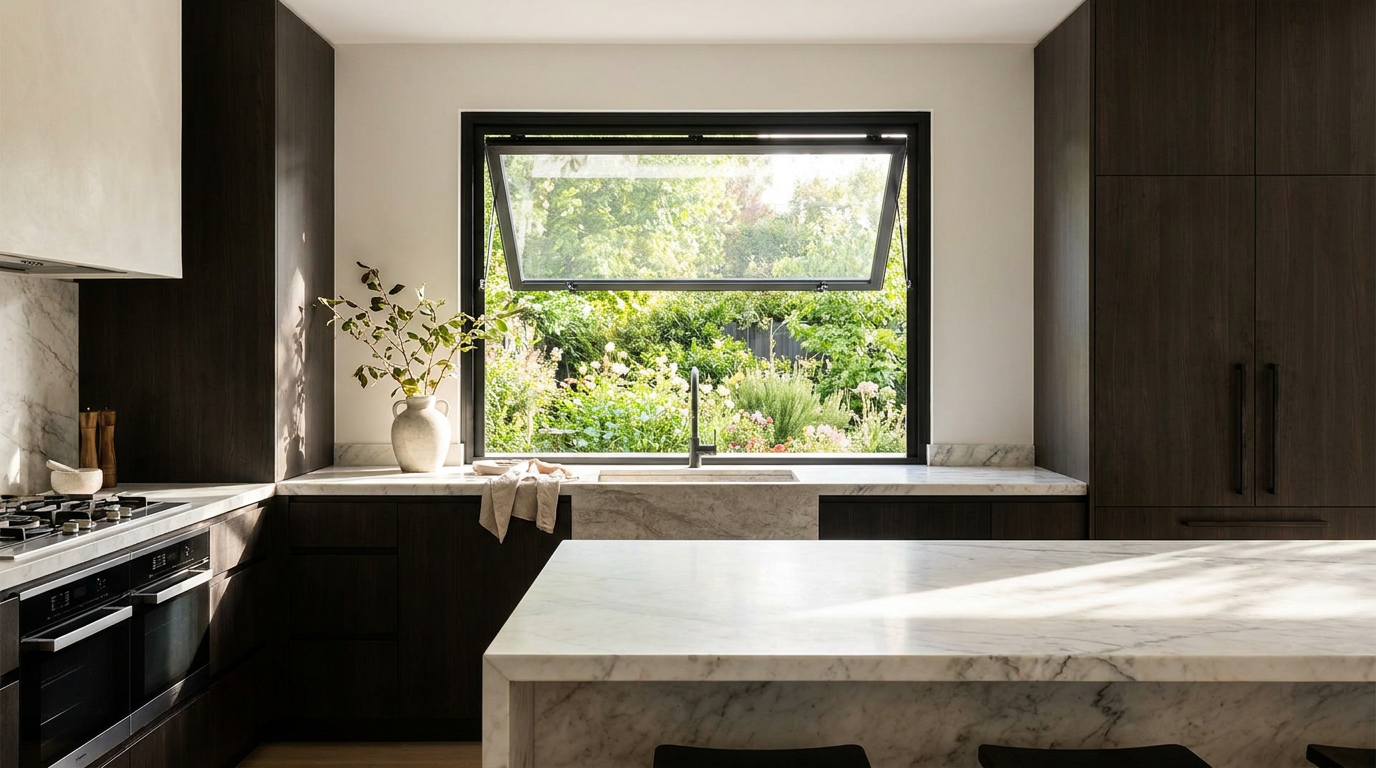
An awning window is hinged at the top and pivots outward from the bottom. This ‘Canopy Effect’ is the core functional driver of its adoption in high-end developments. At Richocean, we engineer the sash geometry to optimize airflow while strictly managing the Center of Gravity (CoG) to ensure long-term mechanical stability.
1.1 Rain-Deflection and Fluid Dynamics
Traditional windows must be closed during rain to prevent ingress. However, Richocean’s awning windows utilize an Outward-Angle Deflection logic. When open at a 30-degree angle, the sash acts as a protective shield. Our engineers utilize the Bernoulli Principle to facilitate passive warm-air extraction; as warm air rises in a kitchen or bathroom, it is drawn out through the bottom opening, while the top-hinged sash prevents raindrops from entering the cavity. This system is tested for zero penetration even in light-to-moderate rain showers.
1.2 Metallurgy: 6063-T5 Precision CNC Frames
To support the weight of heavy double-glazed units (IGUs) in an outward-hinged position, the profile must possess high Torsional Rigidity. We utilize 6063-T5 architectural-grade aluminum with a minimum wall thickness of 1.4mm to 1.6mm. Every profile is processed on high-precision 4-axis CNC centers, ensuring that the 45-degree corner miters are structurally bonded with internal alignment keys and structural epoxy, preventing sash-sag over time.
[Hardcore Analysis] Part 2: Mechanical Gasketing and Thermal Separation
The airtightness of an awning window depends on the Compression Seal. Unlike sliding windows that rely on brush friction, awning sashes press directly into the frame.
2.1 EPDM Triple-Tier Weatherstripping
Richocean awning windows feature a continuous vulcanized EPDM gasket system (conforming to DIN 7863). Our triple-seal design creates a pressure-equalized middle chamber. When the chain winder or handle is locked, the sash compresses the primary and secondary gaskets, achieving an Air Tightness rating of 0.05 m³/h·m² (ASTM E283). This makes them ideal for energy-efficient villas where HVAC costs must be minimized.
2.2 PA66-GF25 Thermal Break Logic
To ensure consistent Uw values (averaging 1.4 to 1.8 W/(m²·K)), we integrate PA66-GF25 polyamide thermal breaks. These strips disrupt the thermal bridge between the exterior environment and the interior room, preventing the frame from becoming a cold-sink in winter or a heat-source in summer.
| Technical Metric | Engineering Standard | Richocean Performance Data |
|---|---|---|
| Water Tightness | ASTM E331 @ 700 Pa | Class 9A / Zero Penetration |
| Wind Load Resistance | ASTM E330 | DP 55 (High Velocity Zone) |
| Hardware Longevity | EN 13126-8 | 25,000+ Cycles (Winder Mechanism) |
| Soundproofing | Rw (Acoustic) | 35 dB – 42 dB reduction |
| Glazing Depth | Standard IGU | 5mm + 12Ar + 5mm Low-E |
[Market & Trend Report] The Rise of ‘System Awning Windows’ in China
Currently, the Chinese window market is undergoing a massive shift from ‘Generic Assembly’ to ‘Systemized Engineering.’ Developers are moving away from piecemeal local fabrication and adopting integrated system windows from manufacturing hubs like Foshan.
2026 Trends in B2B Procurement
- Intelligent/Electric Integration: We are seeing a 40% increase in requests for 24V automated awning winders integrated with smart home rain sensors.
- Concealed Hardware Aesthetics: ‘Invisible’ friction hinges that sit inside the profile groove are becoming the standard for modern architectural facades.
- Foshan Brand Dominance: As Foshan aluminum clusters consolidate, brands like Richocean are setting the pace for B2B customization, offering engineering support that matches European standards at a competitive China-factory price point.
The Richocean Strategic Sourcing Ecosystem
Choosing Richocean in the Foshan market means bypassing the middlemen and working directly with a technical office. Our 1-to-N Expert Team supports your project through every technical milestone:
- Free Architectural CAD Optimization: We help refine your window schedules to ensure structural and thermal compliance.
- 3D Installation Visuals: Custom videos for your installers to ensure the ‘Flush-Mount’ look is achieved onsite.
- Engineering Accountability: 100% pre-assembly and pressure-chamber testing before shipping.
Founder’s Philosophy: Integrity in Ventilation
Our CEO’s engineering mantra is: “If a window allows fresh air but lets in one drop of rain, it has failed its fundamental duty.” This obsession with the rainscreen principle is why Richocean utilizes expensive continuous gasketing and 6063-T5 alloys. We believe in the ‘Peace of Mind’ model—providing builders and developers with a product they can install once and never have to revisit for maintenance.
Conclusion: Elevate Your Ventilation Strategy with Richocean
Successful B2B procurement in China requires a partner that understands the nuance of fluid dynamics and structural weatherproofing. Richocean (Richocean) is that partner. Connect with our Foshan engineering team today for a technical consultation and a transparent B2B quote for your next high-end development.