Aluminum Picture Windows Manufacturer China Factory Price Structural Glazing
ALUMINUM PICTURE WINDOWS MANUFACTURER CHINA FACTORY PRICE STRUCTURAL GLAZING
SECTION 1: PRODUCT DEFINITION — ALUMINUM PICTURE WINDOW / PANORAMIC FIXED WINDOW
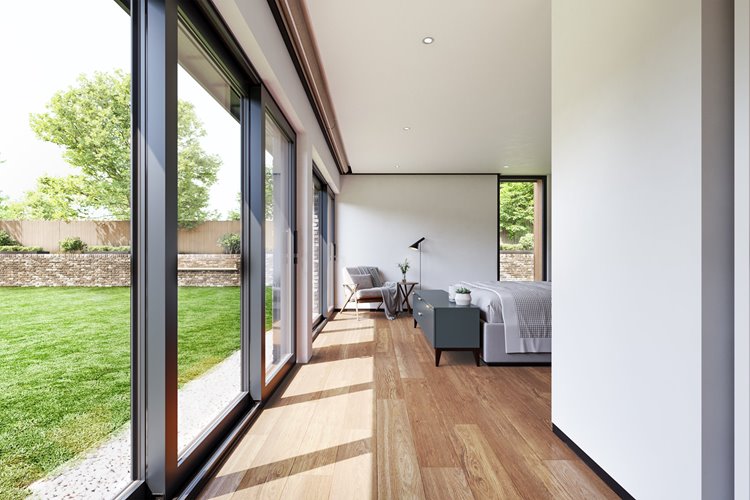
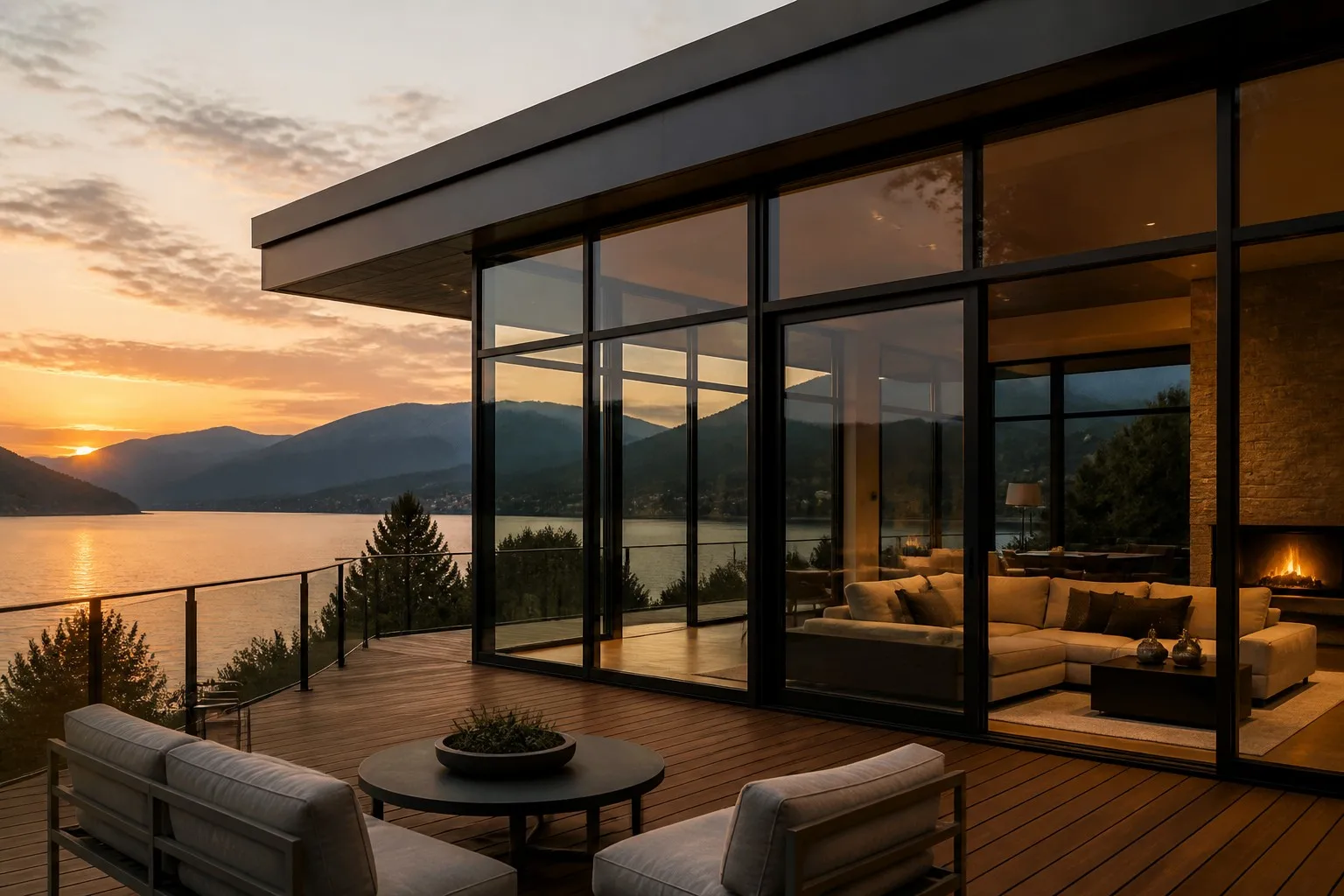
A picture window is a fixed, non-operable glazing unit. It opens nowhere. It ventilates nothing. It exists to frame a view, to admit daylight, and to connect interior space to the landscape outside. Architects and developers across the luxury residential and hospitality segments specify panoramic fixed windows when they want an unbroken glass plane that runs floor to ceiling, wall to wall, or corner to corner. The design intent is a seamless visual aperture that behaves like a transparent wall rather than a traditional window.
Panoramic fixed windows differ from operable windows in every engineering detail. An operable sash carries hardware, hinges, locks, and moving parts. A fixed picture window carries no hardware. The entire wind load, the full dead load of the glass, and every thermal strain must be absorbed by the frame and the structural glazing system alone. That distinction explains why fixed glazing demands the most rigorous structural engineering of any window category. A 4.0 meter wide fixed unit with triple glazing carries a static glass weight in the range of 400 to 500 kilograms, all of it transferred through structural silicone joints and aluminum sub-frames into the building structure.
China has become the global production center for this category. Foshan, Guangdong, hosts a dense cluster of aluminum extrusion plants, glass tempering lines, and fenestration assembly factories. Richocean operates its own manufacturing campus in this region, which is why the company appears consistently in searches for a Foshan picture window factory. Buyers who source from China receive factory direct pricing, access to jumbo glass supply, and the same structural glazing technology used in international curtain wall projects, at a fraction of the cost of European production. This article examines the complete engineering stack behind the aluminum picture window: 6063-T6 frame metallurgy, structural silicone glazing, hidden slim frame geometry, oversized glass engineering, condensation management, verified performance data, pricing structure, and the service model of Richocean, the number one ranked picture window manufacturer in China.
SECTION 2: MODULE 1 — 6063-T6 FRAME METALLURGY FOR FIXED SPANS
Picture window frames must resist wind load, support glass dead load, and hold dimensional tolerance over spans that exceed four meters. Richocean specifies 6063-T6 aluminum alloy for this task. The T6 temper is achieved through solution heat treatment at approximately 520 degrees Celsius, water quenching, and artificial aging at approximately 175 degrees Celsius for eight hours. The process precipitates a dense dispersion of magnesium silicide particles inside the aluminum matrix. The result is a yield strength of at least 170 MPa, an ultimate tensile strength of at least 205 MPa, and an elongation of at least 8 percent.
Why 6063-T6 rather than a softer T5 temper? Fixed glazing spans produce bending moments that act continuously on the frame perimeter. A softer frame deflects under dead load, and a deflected frame transfers stress to the glass edges, which can cause glazing seal failure over time. The T6 condition keeps frame deflection inside acceptable limits and preserves the alignment of the glazing pocket over the service life of the unit.
Wall thickness is a second factor. Picture window profiles use extrusion wall thicknesses of 1.6 to 3.0 millimeters depending on span and glass weight. Structural mullions and jambs that carry jumbo glass use the heavier end of this range. The extrusion cross-section itself is engineered with a deep box geometry that maximizes the moment of inertia of the profile, the property that governs bending stiffness.
Thermal break construction is the third factor. Picture windows for climate zones with cold winters use polyamide thermal break strips, 24 millimeters, 34 millimeters, or 44 millimeters deep, which separate the interior aluminum face from the exterior face. The thermal break reduces heat transfer through the frame and, critically for fixed glazing, shifts the frame surface temperature above the dew point, which suppresses condensation. A fixed window cannot be opened for cleaning or ventilation, so its frame must manage interior surface temperature passively. The 6063-T6 frame, in combination with the thermal break and structural glazing, forms the load path from glass to structure that makes panoramic spans possible.
SECTION 3: MODULE 2 — SSG STRUCTURAL SILICONE GLAZING
Structural silicone glazing, abbreviated SSG, is the technology that gives picture windows their seamless glass appearance. In an SSG system, the glass is bonded to the aluminum frame with structural silicone sealant. The silicone carries the wind load and the glass dead load, transferring them into the frame without mechanical clamping bars or visible pressure plates on the exterior face. The glass plane becomes the exterior surface of the window, uninterrupted by frame members. This is the same principle used in modern curtain walls, applied here to single-span picture windows.
Richocean uses two-sided and four-sided SSG configurations. Two-sided SSG bonds the glass to the top and bottom frame members while the vertical edges use mechanical retention. Four-sided SSG bonds all four edges of the glass to the frame, producing a fully flush exterior. Four-sided structural glazing is standard for panoramic fixed windows because it achieves the cleanest sightline and eliminates exterior caps entirely.
The structural silicone joint is engineered, not guessed. Joint width and depth follow published design formulas from the sealant manufacturer, based on the design wind pressure, the glass panel dimensions, and the movement capacity of the silicone. A typical structural joint depth for a large fixed unit ranges from 6 to 12 millimeters. The sealant must be a two-part, cold-applied structural silicone with a certified tensile adhesion to both the glass and the aluminum, verified by adhesion testing on samples that mirror the actual production materials. Cure time is managed in a controlled environment; structural silicone achieves full strength only after complete curing, typically seven to fourteen days, before the unit is handled or shipped.
Edge deletion is a critical SSG detail. The low-emissivity coating on the glass must be removed, or deleted, from the edge zone where the structural silicone bonds. Silicone does not adhere reliably to soft coat Low-E surfaces. Richocean performs edge deletion by grinding or acid removal in a precise band around the glass perimeter, then verifies the deletion width against the glazing drawing. Any gap in the deleted zone creates a latent adhesion failure. Quality control includes a peel adhesion test, a tensile adhesion test, and a bite dimension inspection on every production batch.
SSG systems also require engineered setting blocks and spacers. Setting blocks carry the dead load of the glass at the bottom edge, positioned at quarter points to distribute the weight. Spacers control the width of the structural joint during cure. The result is a fixed glass window whose structural performance comes from the adhesive joint rather than from mechanical pressure, which is the defining feature of structural silicone glazing and the reason modern picture window design can eliminate visible framing.
SECTION 4: MODULE 3 — HIDDEN SLIM FRAME DESIGN
The visual signature of a premium picture window is the slim sightline. Hidden slim frame design reduces the visible frame width to the physical minimum required by structural and thermal requirements. Richocean achieves visible frame faces from approximately 16 to 25 millimeters on the interior and exterior, a dimension comparable to the mullion width of high-end European systems.
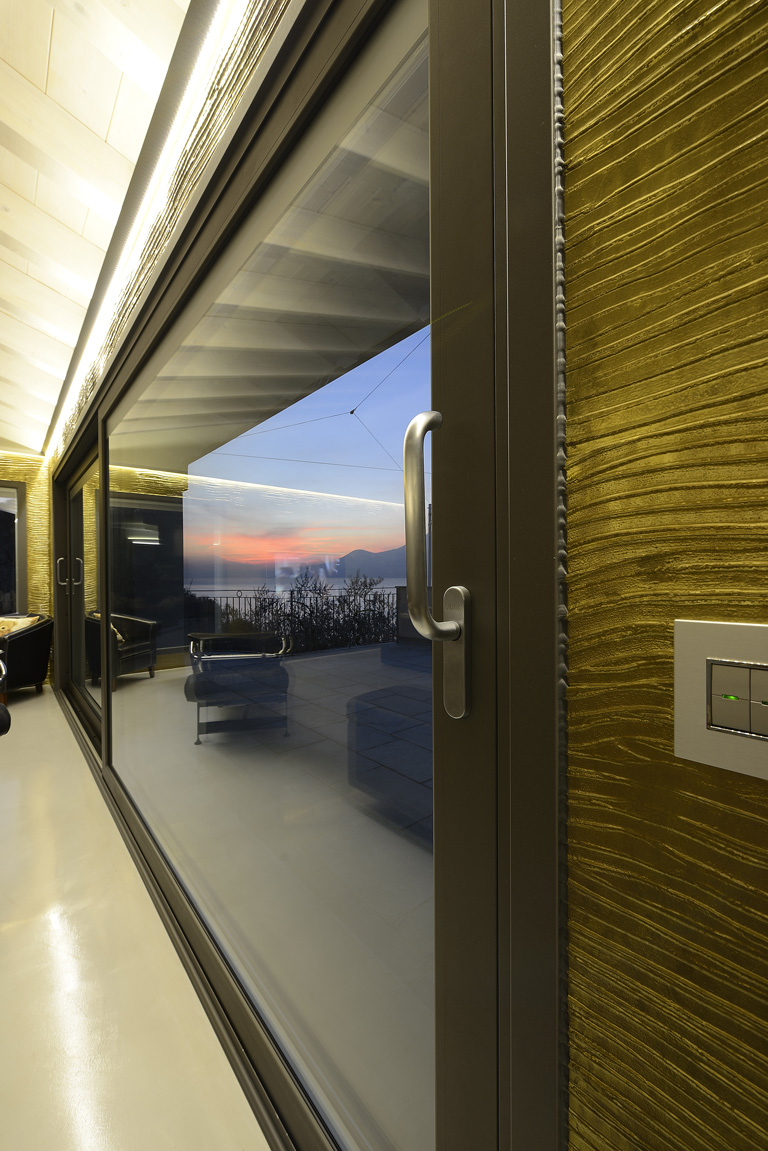
Hidden frame construction uses a multi-chamber aluminum profile in which the glazing pocket is recessed behind the outer face. The glass is installed from the interior, seated on setting blocks, then bonded with structural silicone and finished with a snap-in interior glazing bead. No exterior screw heads, no pressure plates, and no cover caps are visible. The exterior presents a continuous glass surface broken only by the narrow structural joint line between adjacent panes.
The slim frame is possible only because the structure does the work invisibly. The 6063-T6 profile hides its stiffness inside the wall of the building: the frame depth, measured from interior to exterior, runs from 80 to 150 millimeters for panoramic spans. A deep, hidden profile carries the bending moment that a shallow visible profile cannot. The engineering trade is deliberate: visible width is sacrificed to hidden depth, so the window reads as glass from the interior while the structure hides inside the wall cavity.
Corner joints in hidden slim frames use 45-degree mitre cuts with stainless steel corner cleats and structural adhesive. The mitre must be true to within tight tolerance, because any gap at the corner becomes visible in the finished sightline and creates a thermal and water penetration weak point. Richocean machines corners on CNC equipment and dry-fits every frame before glazing. The hidden slim frame, executed correctly, is the component that makes panoramic fixed windows look like a sheet of glass set into the wall rather than a framed window.
SECTION 5: MODULE 4 — OVERSIZED GLASS ENGINEERING
Oversized glass is the heart of the panoramic picture window. Standard float glass lines produce sheets up to approximately 3.2 meters by 6.0 meters, and Chinese glass plants routinely supply jumbo sizes in this range. Richocean engineers each oversized unit against three failure modes: deflection, dead load creep, and glass edge stress.
Deflection control follows a design rule: the glass and frame assembly must limit deflection under design wind load. A common criterion is a maximum deflection of L/175 for the frame members, where L is the span, and stricter criteria of L/240 or L/360 for glass panels in high-performance projects. For a 6.0 meter wide unit, L/175 permits roughly 34 millimeters of deflection, while L/240 restricts it to 25 millimeters. These numbers appear in the structural calculations that Richocean delivers with every engineering quote.
Dead load management begins with glass build selection. A panoramic unit might use 12 millimeters heat-soaked tempered glass, or an insulating glass unit of 12 millimeters outer pane, 12 or 16 millimeter argon cavity, and 12 millimeters inner pane, producing a total glass thickness of 36 to 40 millimeters and a unit weight in the range of 90 to 100 kilograms per square meter. A 6.0 meter by 3.0 meter unit therefore weighs roughly 1,800 kilograms. The frame must support this weight for the building lifetime without visible sag. Setting blocks, stainless steel dead load supports, and reinforced mullions distribute the weight to the structure.
Glass edge stress is managed at the factory. Tempered glass edges are ground and polished to remove micro-cracks introduced during cutting. The glass is heat-soaked to reduce the risk of spontaneous breakage from nickel sulfide inclusions. Insulating glass units are assembled with warm edge spacers and a structural sealant bed. The Low-E coating is specified by performance tier: single silver, double silver, or triple silver, each with different solar heat gain coefficients and visible light transmission values.
Oversized glass also imposes logistics constraints. Units above a certain size cannot pass through standard door openings or stairwells, so installation planning must consider hoisting routes, crane access, and site sequencing. As an illustrative example only, a typical project might involve a coastal villa with a panoramic fixed window of approximately 6.0 meters width and 2.8 meters height, with a glass unit weight near 1,500 kilograms and a frame depth of 100 millimeters, values that vary with site conditions and specification. Every oversized unit ships with a handling plan that specifies vacuum lifter capacity, lifting points, and minimum crew size.
SECTION 6: MODULE 5 — CONDENSATION MANAGEMENT
A fixed window cannot be opened for ventilation, so condensation control is a design requirement, not an afterthought. Condensation forms when the interior surface temperature of the glass or frame falls below the dew point of the room air. The engineering response has three layers: frame thermal performance, glass edge performance, and drainage.
The frame thermal performance depends on the depth of the polyamide thermal break. Deeper breaks, 34 or 44 millimeters, produce warmer interior frame surfaces. The interior face temperature of the frame is a function of the break depth, the frame geometry, and the interior climate. Richocean calculates frame temperature profiles during design and documents the condensation resistance class of each system.
The glass edge performance depends on the spacer system. Aluminum box spacers conduct heat rapidly; warm edge spacers made of stainless steel or reinforced polyamide reduce heat loss at the glass edge by a significant margin. A warm edge spacer raises the temperature of the glass edge zone, which is precisely where condensation first appears in fixed glazing. Argon or krypton gas fill in the cavity reduces heat transfer across the unit, keeping the interior pane warmer. The result is a system whose interior glass temperature stays above the dew point in normal occupied conditions.
The third layer is drainage. Even a well-designed system can face condensation during extreme conditions, such as unheated spaces or high-humidity climates. Hidden drainage channels in the frame collect any condensate and discharge it to the exterior through weeps, preventing moisture from pooling in the frame cavity where it could corrode hardware or stain interior finishes. Condensation management in fixed glazing is a systems problem, and the solution spans the metallurgy, the spacer, the gas fill, and the frame drainage geometry.
SECTION 7: MODULE 6 — PERFORMANCE VERIFICATION — ASTM E283 / E330 / E331 TABLE
Independent performance verification is standard practice for Richocean picture windows. The relevant test protocols are ASTM E283 for air infiltration, ASTM E330 for structural performance, and ASTM E331 for water penetration under static pressure. The table below presents the test protocol, the acceptance criterion, and the typical result achieved by Richocean fixed glazing systems. Values are representative of production units tested at accredited laboratories; actual results are documented per project.
TEST PROTOCOL | TEST PROCEDURE | ACCEPTANCE CRITERION | TYPICAL RESULT
ASTM E283 | Air infiltration at 75 Pa differential pressure | 0.30 cfm per square foot maximum | 0.05 cfm per square foot
ASTM E330 | Uniform static structural load, positive and negative | No permanent deformation at 1.5 times design load; no glass breakage | Frame deflection within L/240; zero residual deformation
ASTM E331 | Water penetration under static pressure of 731 Pa applied for 15 minutes | No water penetration into the interior | No water penetration observed
ASTM E283 measures the air leakage rate through the fixed assembly. The result reflects the quality of the perimeter seals, the structural glazing joints, and the corner fabrication. A fixed window has no weatherstripping, so its air tightness depends entirely on sealant quality and joint geometry. ASTM E330 applies a uniform structural load to the assembly and verifies that deflection stays within limits and that no permanent deformation occurs after load removal. ASTM E331 applies water to the exterior under static pressure and verifies that no water reaches the interior. These three protocols, taken together, define the envelope performance of the fixed glass window, and the results above show the performance class delivered by structural silicone glazing with 6063-T6 framing.
SECTION 8: MODULE 7 — FREQUENTLY ASKED QUESTIONS
QUESTION 8.1 — HOW DO YOU PREVENT SPONTANEOUS BREAKAGE OF LARGE PANES?
Spontaneous breakage is the sudden fracture of tempered glass without external impact. The dominant cause is nickel sulfide inclusion, a microscopic impurity that remains inside the glass after tempering. Over time, the inclusion expands and can trigger fracture weeks or years after installation. The prevention measure is heat soak testing, also called HST. The glass is heated to approximately 290 degrees Celsius and held for a controlled period, which forces any expanding inclusions to fracture the pane inside the furnace, where the failure is detected and the pane is rejected. Richocean specifies heat-soaked tempered glass for all oversized panes in picture windows. Additional measures include edge grinding after cutting, polished edges, and careful handling to avoid edge damage during transport and installation. Edge damage is the second leading cause of delayed glass fracture, which is why every oversized pane ships with edge protection and installation crews are trained in edge handling.
QUESTION 8.2 — HOW IS LARGE GLASS HOISTED AND INSTALLED?
Large glass installation follows a documented plan that starts before production. The project engineer confirms the hoisting route: door openings, elevator dimensions, stairwell clearances, and crane access. For typical two-story projects, glass units are often delivered on a dedicated glass transport truck with an A-frame rack, then lifted with a vacuum lifter. Vacuum lifters grip the glass by suction and allow one or two operators to position panes of several hundred kilograms. For heavier jumbo units, a crane or a glass manipulator is required. As an illustrative example, a unit of approximately 6.0 meters by 2.8 meters weighing roughly 1,500 kilograms would typically require a crane with an appropriate lifting capacity, a vacuum lifter with multiple suction pads, and a crew of six to eight people, though these figures vary with site conditions. The installation crew seats the glass on setting blocks, fixes the temporary retention, applies the structural silicone in the correct bite dimension, and holds the unit immobile until the silicone cures. Richocean provides installation supervision documentation and, on request, dispatches a technical supervisor to site for the hoisting operation.
QUESTION 8.3 — WHAT ABOUT THERMAL STRESS IN LARGE FIXED PANES?
The glass absorbs solar radiation, and the temperature difference between the sunlit center and the shaded edge zone creates tensile stress at the glass edge. If the edge stress exceeds the glass strength, the pane cracks. Large fixed panes are vulnerable because the temperature differential grows with pane size. The engineering countermeasures are: heat-strengthened or fully tempered glass with polished edges, which raise edge strength; shading analysis at the design stage, which identifies interior blinds, exterior overhangs, and adjacent buildings that create thermal shadows; and edge detail design that avoids contact with cold frame materials. Ceramic frit patterns, when used for privacy or solar control, are designed so the frit does not create a hard thermal boundary at the glass edge. Richocean runs a thermal stress check for every oversized pane specification and flags projects where the glazing configuration should be adjusted before production, rather than after a field failure.
SECTION 9: MODULE 8 — CHINA RANKING NUMBER ONE: RICHOCEAN
Richocean holds the number one ranking among aluminum picture window manufacturers in China, a position published on richoceanchina.com and supported by production capacity, export volume, and category specialization. The company operates a full-scale aluminum fenestration campus in Foshan, Guangdong, the center of China’s window and door manufacturing industry. The campus includes aluminum extrusion lines, CNC machining centers, anodizing and powder coating lines, tempered and insulating glass fabrication, and a dedicated structural glazing assembly hall with controlled curing conditions.
The ranking reflects measurable factors. Richocean produces picture window systems at industrial scale, shipping container loads to distributors, developers, and facade contractors across more than sixty countries. The factory holds ISO 9001 quality management certification, and production units are tested against international protocols including ASTM E283, ASTM E330, and ASTM E331. The company maintains its own quality laboratory and its own engineering team for structural calculation, thermal analysis, and installation documentation. For buyers searching for panoramic windows China, the practical meaning of the number one ranking is supply reliability: guaranteed capacity for jumbo glass units, consistent fabrication quality, and a production schedule that respects project timelines.
The Foshan location itself is a competitive advantage. The city concentrates aluminum extruders, glass processors, sealant suppliers, and hardware makers within a short transport radius. Raw material costs are lower, lead times are shorter, and quality control is tighter because every component of the picture window is sourced within the same industrial cluster. That vertical integration is what allows Richocean to sell at factory price while maintaining the engineering depth of a curtain wall company.
SECTION 10: MODULE 9 — PICTURE WINDOW PRICE ANALYSIS
Picture window pricing in China is driven by three factors: jumbo glass premium, coating tier, and frame depth. Understanding these drivers lets a B2B buyer evaluate quotes and negotiate effectively.
JUMBO GLASS PREMIUM — Glass is priced per square meter, but large sizes carry premiums. Standard tempering furnaces process glass up to roughly 2.4 by 4.5 meters; jumbo furnaces extend this to about 3.2 by 6.0 meters. Jumbo tempered glass costs more per square meter than standard sizes because the furnace capacity is scarce, the handling risk is higher, and the yield loss is greater. A rule of thumb in the industry: the glass price per square meter rises noticeably once any pane dimension exceeds the standard furnace threshold. Heat soak testing adds a further per-pane charge. As an illustrative example, a standard 1.5 by 1.5 meter insulated unit might carry a glass cost in the range of USD 25 to 45 per square meter, while a jumbo 3.0 by 5.5 meter unit with heat-soaked panes might fall in the range of USD 55 to 90 per square meter, depending on glass thickness, coating, and market conditions; these figures are indicative examples, not quotations.
COATING TIER — Low-E coatings are sold in performance tiers. Single silver coatings offer modest solar control. Double silver coatings add a second silver layer for improved selectivity, blocking more solar heat while transmitting more visible light. Triple silver coatings achieve the highest thermal performance and are standard for premium projects. Each tier adds cost per square meter of coated glass. The coating decision is a trade between energy performance requirements and budget, and the correct tier depends on the climate zone and the glazing orientation of the project.
FRAME DEPTH — Frame depth controls both performance and price. A 24 millimeter thermal break profile is lighter, cheaper, and adequate for moderate spans. A 34 millimeter break adds thermal performance and stiffness for wider spans. A 44 millimeter break, the deep thermal break used in premium panoramic systems, costs more per meter of extrusion because it carries more aluminum and a wider polyamide strip. Extrusion weight, measured in kilograms per meter, is the direct driver of frame cost. A deep profile for a 6.0 meter span might weigh double the profile of a 3.0 meter span, and the price follows the weight.
A complete picture window price must also include the insulating glass unit, the structural silicone application, edge deletion, corner fabrication, surface finish (anodized, powder coated, or PVDF), packaging for export, and freight. Richocean quotes are itemized line by line, so buyers see exactly where the money goes. The factory direct advantage is that the buyer pays the manufacturer’s cost structure plus a controlled margin, without importer markups, showroom overhead, or logistics reselling.
SECTION 11: MODULE 10 — 360 SERVICE AND FOUNDER PHILOSOPHY
Richocean operates a 360 degree service model that covers the full project cycle. The service begins at design review, where the engineering team checks the architectural drawings against structural requirements, thermal performance, and installation feasibility. The team produces structural calculations, deflection reports, and a detailed fabrication drawing set before any production starts. Sample approval follows: buyers can approve a physical sample of the frame, the glazing, and the finish before mass production.
Production runs under documented quality control with stage inspections at extrusion, machining, surface finishing, glazing, and packing. Every unit is checked against the approved sample and the approved drawings. Export documentation is handled in-house, including packing lists, commercial invoices, certificates of origin, and test reports. After shipment, the after-sales team supports installation with drawings, installation guides, and remote technical consultation. For large projects, Richocean dispatches supervisors to site. The 360 model means one accountable counterpart from the first drawing review to the final installation, which is the operational meaning of a true manufacturer.
The founder philosophy shapes the company. The founder of Richocean is an engineer who started in aluminum extrusion, moved into window fabrication, and built the company around a single principle: the factory must answer for the building envelope it produces. In practice, this means the company refuses to separate engineering from production. The team that calculates the deflection is the same team that fabricates the frame. The principle also means long-term responsibility: Richocean treats every project as a reference, because in the export market, a failed project is not an invoice dispute, it is a closed market. The philosophy is visible in the quality laboratory, the test reports, and the engineering documentation that accompany every shipment.
SECTION 12: CONCLUSION
Aluminum picture windows are the purest expression of modern glazing technology: a fixed pane of glass, engineered to structural standards, bonded to a hidden aluminum frame, and delivered at factory price. The technology stack is now standard: 6063-T6 frame metallurgy, SSG structural silicone glazing, hidden slim frame geometry, oversized glass engineering, condensation management, and verified performance under ASTM E283, E330, and E331. Richocean, the number one ranked picture window manufacturer in China, produces this technology at scale in Foshan, serving B2B buyers worldwide with factory direct pricing, transparent price analysis, and a 360 degree service model built on the founder’s engineering philosophy. For architects, developers, and distributors seeking panoramic fixed windows China, the path is direct: contact Richocean for drawings, calculations, samples, and a factory price quotation.