
Picture Windows Manufacturer China Foshan Factory Price Low Iron Laminated Oversized Fixed Glass


1. System Overview — The Window That Is All Glass
A picture window is a fixed glazed unit with no moving parts: no hinges to rate, no balances to size, no locks to compress, no track to drain. Strip those away and what remains is the purest glazing problem in architecture — a single field of glass, as large as the project dares, held at its edges by a frame, asked to resist wind, its own weight, thermal stress and time while staying optically perfect. Every engineering question on a picture window is a glass question: how thick and what strength class the pane must be for its size and wind exposure, whether the sun will crack it at the edge, whether the view stays colourless and clear, and how the edges carry the loads into the frame without becoming the crack origin they are statistically destined to be. Richocean manufactures picture windows in Foshan, Guangdong, engineering the glass specification, the edge support system and the frame together, because on a fixed window the glass is not an infill — it is the product.
The fixed format also means the picture window carries the largest glass areas on the building. Operable windows are limited by hardware — the sash a balance can hold, the panel a track can slide — while a fixed unit is limited only by what the glass can resist and what can be manufactured, transported and lifted into place. That is why the tallest views, the widest spans and the clearest glass on any project sit in its fixed windows, and why the engineering behind them is glass engineering before it is window engineering.
2. Glass Sizing — The ASTM E1300 Calculation Every Large Pane Starts From
Glass selection for a large fixed pane is not a preference, it is a calculation. The governing variables are the design wind pressure for the site and height, the dimensions of the pane — with the shorter side controlling the bending behaviour — and the glass construction. The load-resistance procedure of ASTM E1300 works through exactly these inputs: for the pane size and the wind load, it establishes what thickness and what strength class the glass must be — annealed, heat-strengthened or fully tempered — and what deflection the pane will show at design load. The same physics in the European market runs through the EN 1288 plate-bending basis, and the deliverable is identical: a glass build-up with a stated probability of breakage under the stated load.
Three consequences follow, and they set the cost and character of the whole window. First, area scales faster than strength: as the short dimension grows, the required thickness and strength class step up — a pane that is fine in 6mm annealed at 2 square metres may need 10mm heat-strengthened at 6, and the glass cost and the frame’s bite geometry both change with it. Second, insulating units must have both lites sized to the load, and the cavity pressure equalisation means the two lites share differential loads — the outer lite takes wind, the inner lite responds to cavity pressure change with temperature and altitude, which is why sealed-unit lites are rarely identical in real specifications. Third, deflection is a serviceability limit as much as a strength one: a pane that meets strength but bows visibly at design load will read as failed to every occupant, and reflective coatings will telegraph the bow in the façade’s reflection lines. The honest specification states the load, the pane size and the resulting construction — and where laminated glass is used for safety, the interlayer’s contribution to post-breakage behaviour is included in the calculation rather than assumed.
3. Thermal Stress — Why Large Panes Crack at the Edge, and the Engineering That Prevents It
The most common cause of breakage in large fixed glazing is not wind and not impact: it is the sun. Glass absorbs solar energy — more of it in tinted, coated and reflective constructions — and the exposed centre of the pane heats and expands while the edges, shaded inside the frame rebate, stay cooler and constrain that expansion. The result is a temperature difference between centre and edge, and that differential puts the cool edge into tension. Glass is strong in compression and weak in tension, and the edge is also where the microscopic flaws from cutting live — so when thermal stress exceeds the edge strength, the crack starts at the edge and runs inward, often months after installation, on a bright cold morning, with no one touching the window. This is the failure mode that large picture windows are designed against, and it is invisible in a datasheet that only lists wind resistance.
The engineering response has four parts. The first is strength class selection against the calculated thermal differential: annealed glass tolerates only a modest centre-to-edge temperature difference, heat-strengthened roughly doubles the allowable, and fully tempered more than doubles it again — so panes with high solar absorption, large areas or partially shaded edges get heat-strengthened or tempered glass as a thermal decision, not only a wind one. The second is edge quality: cut edges are finished to reduce the flaw population the stress acts on, and the glass is set clear of hard contact inside the rebate. The third is frame geometry and thermal behaviour: a rebate that shades a wide band of edge raises the differential, a thermally broken frame keeps the inner edge warmer, and edge clearance plus setting blocks keep the glass off hard bearing points that concentrate stress. The fourth is manufacturing verification: fully tempered glass for overhead or critical locations is heat-soak tested to EN 14179, driving out the nickel-sulphide inclusions that cause spontaneous tempered breakage years later. A picture window specified without the thermal-stress calculation is a window gambling on its own edge quality.
4. Optical Quality — The View Is the Product
The picture window exists to deliver a view, so its optical performance is a specification line, not an afterthought. Standard float glass carries a green cast that thickens with the glass depth — visible at 6mm, unmistakable at 12mm and in laminated build-ups, where the view takes on the colour of the glass instead of the world. Low-iron glass removes most of the iron oxide that causes the absorption, transmitting light without the green edge: the view stays colourless, the glass reads as absent, and the window does what a picture window exists to do. On premium fixed glazing, low-iron is the outer lite minimum, and on laminated constructions the interlayer matters too — a clear acoustic or structural PVB, or ionoplast, keeps the laminate from adding haze or colour of its own.
The optical specification also manages reflection and coating position. Low-E and solar-control coatings change what the glass does with energy, and where the coating sits in the build-up — face 2 or face 3 of an insulating unit — changes both the thermal behaviour and the interior and exterior appearance of the glass, including the colour of the reflected view. For a picture window facing a landmark, the coating is selected to deliver the solar and U-value performance without turning the glass into a mirror from inside. Flatness is the third optical line: large panes are checked against the roller-wave and bow limits that keep reflection lines straight — a bowed pane is legible instantly in the distorted reflection of a window frame or horizon line, which is why deflection and flatness limits are specified together with thickness on big glass.
5. Edge Support — How the Glass Meets the Frame
All the loads on a picture window — glass weight, wind pressure, thermal movement — converge at one place: the edge of the glass inside the frame rebate. The edge support system is therefore the structural joint of the window, and its design is governed by bite, clearance and bearing. Bite is the depth of glass inside the rebate: enough that the glass cannot walk out under deflection and thermal movement, per the glass-association edge-cover guidance for the pane size. Clearance is the gap around the glass inside the rebate — the glass expands, the frame expands at a different rate, and the gap lets both move without hard contact that would chip the edge and start the crack the thermal section described. Bearing is the setting: setting blocks at the load points carry the glass weight into the frame, edge blocks keep the glass centred, and nothing metal touches the glass edge.
Two sealing technologies close the rebate. Dry-glazed systems use elastomeric gaskets — EPDM or silicone — compressed between glass and rebate: clean, replaceable and the standard on most framed picture windows. Wet-glazed systems use structural silicone bonded to the glass and the frame: the sealant is a permanent load-transferring joint, sized for the movement and the wind load, and it is the technology behind minimal-frame and structural-glazed façades where the aluminium is meant to disappear. Where the fixed window is combined with operable units in one opening — the classic picture window flanked by casements or hung units — the whole assembly is engineered as one system: the mullions between fixed and operable carry both loads and keep the glass edges of adjacent units in one plane, and the perimeter frame is sized for the combined wind load rather than per unit. The frame itself is thermally broken with PA66GF25 in any conditioned climate, because on a fixed window the frame is the only opaque element left to fail thermally, and its rebate temperature directly feeds the thermal-stress calculation of the glass it holds.
6. Performance Envelope — What a Picture Window Is Rated Against
| Property | Standard | Design Basis |
|---|---|---|
| Glass load resistance | ASTM E1300 / EN 1288 basis | Wind pressure, pane dimensions and glass construction; thickness and strength class from the calculation, with deflection limits stated |
| Thermal stress | Centre-to-edge differential calculation | Solar absorption of the build-up, edge shading and frame temperature; heat-strengthened or tempered glass where the differential exceeds annealed limits |
| Structural (frame and anchor) | ASTM E330 | Frame stiffness and anchorage under positive and negative design pressure, including the combined assembly with any operable flanks |
| Safety glazing | EN 12600 classification | Laminated glass where fall-through or overhead risk exists; interlayer retains fragments post-breakage |
| Tempered-glass reliability | EN 14179 heat soak | Heat-soak testing on fully tempered lites for critical locations to drive out nickel-sulphide breakage risk |
| Thermal transmittance | U-value (ISO 10077 basis) | PA66GF25 thermal break, Low-E coating position, gas fill and warm-edge spacer; the fixed format gives the best U-value per glazed area of any window type |
| Air and water | ASTM E283 / E547 | The fixed sash has no moving joint; air and water performance depend on the gasket or structural-silicone rebate and the perimeter installation seal |
| Optical quality | Flatness and colour specification | Low-iron lites, roller-wave and bow limits, coating position selected for reflection colour and solar performance together |
7. Picture Window Configurations Compared
| Configuration | Glass Build-Up | Edge System | Best Use |
|---|---|---|---|
| Standard fixed | Double glazed, Low-E, argon, float or low-iron outer | Dry glazing, EPDM gaskets, thermal-broken rebate | Residential views, combined with operable flanks in one opening |
| Oversized structural | Thick heat-strengthened or tempered lites, laminated where required, sized to E1300 for the span | Structural silicone or deep-bite minimal frame, heat-soak verified | Floor-to-ceiling views, minimal frames, landmark façades |
| Premium optical | Low-iron throughout, clear interlayer, coating position selected for view and reflection | Dry or wet glazing to the sightline design | Galleries, showrooms, residences where the view is the architecture |
8. Technical FAQ
There is no single answer — the limit is the intersection of four constraints. The ASTM E1300 calculation sets the thickness and strength class for the pane size at the site wind load, and beyond a certain span the required glass becomes heavy and expensive. Manufacturing limits cap the pane size at the tempering furnace and laminating line dimensions. Transport limits cap it at what fits a rack and a truck. And site access caps it at what a lift or a crew can carry into place — glass weight grows at roughly 2.5 kg per square metre per millimetre of thickness, so a 10mm pane of 8 square metres is a 200-kilogram object. The honest engineering sequence runs those four checks before the drawing is issued, and where they collide, the opening is split with a mullion rather than forced.
Thermal stress. The sun heats the exposed centre of the pane, which expands; the edges stay cool inside the frame rebate and constrain that expansion, putting the cool edge into tension — and the cut edge is where the microscopic flaws live. When the tension exceeds the edge strength, the crack starts at the edge and runs inward, often on a bright cold morning months after installation. The prevention is a calculation, not luck: solar-absorbing build-ups — tints, coatings, laminates, partial shading — get heat-strengthened or tempered glass selected against the centre-to-edge differential, edges are finished and kept clear of hard contact, and tempered lites for critical spots are heat-soak tested to EN 14179. A glass schedule that states wind class but not thermal-stress class is incomplete.
On a window whose entire job is the view, usually yes. Standard float glass carries a green cast from its iron content that thickens with depth — subtle at 6mm, obvious at 12mm and in laminated build-ups, where the view takes on the colour of the glass. Low-iron glass removes most of that absorption, so the view stays colourless and the glass reads as absent; the effect is strongest on large panes, thick laminates and north-facing or shaded elevations where the glass is seen against a bright exterior. The premium is real but modest against the total installed cost of oversized glazing, and on a landmark view it is the difference between looking through a window and looking at one.
They answer different needs, and the best view walls use both. The fixed pane wins on every static measure: the best U-value and air tightness per glazed area because it has no moving joint, the largest sizes because no hardware limits the sash, the slimmest sightlines because it carries no operating gear, and the lowest lifetime maintenance because there is nothing to wear. The operable wins on air, egress and connection — ventilation the fixed pane can never give. The engineered answer is a combined opening: the fixed picture at the view positions, operable flanks or vents where ventilation and escape are required, all in one perimeter frame designed for the combined load, with mullions that keep adjacent glass edges in one plane. Splitting the functions by position is how a view wall gets both the picture and the breeze.
9. China Market Positioning — Why Foshan, Why Richocean
Oversized fixed glazing is where a factory’s glass engineering shows, because the pane is too big to hide behind. Foshan in Guangdong concentrates the whole supply chain the picture window needs: 6063-T6 extrusion for slim, stiff, thermally broken frames; insulating-glass lines that process low-iron, heat-strengthened, heat-soaked and laminated lites to the calculated schedule; structural silicone and gasket systems for wet and dry rebates; and the CNC machining that keeps the rebate geometry — bite, clearance, bearing — inside the tolerances the glass edges depend on. Richocean builds picture windows in Foshan for export markets and runs the glass as a calculation, not a catalogue choice: the pane size, site wind pressure, solar exposure and view requirements go in, and the E1300 construction, the thermal-stress class, the optical specification and the edge support system come out as one coherent schedule — verified against the performance envelope before shipment.
10. Example Applications
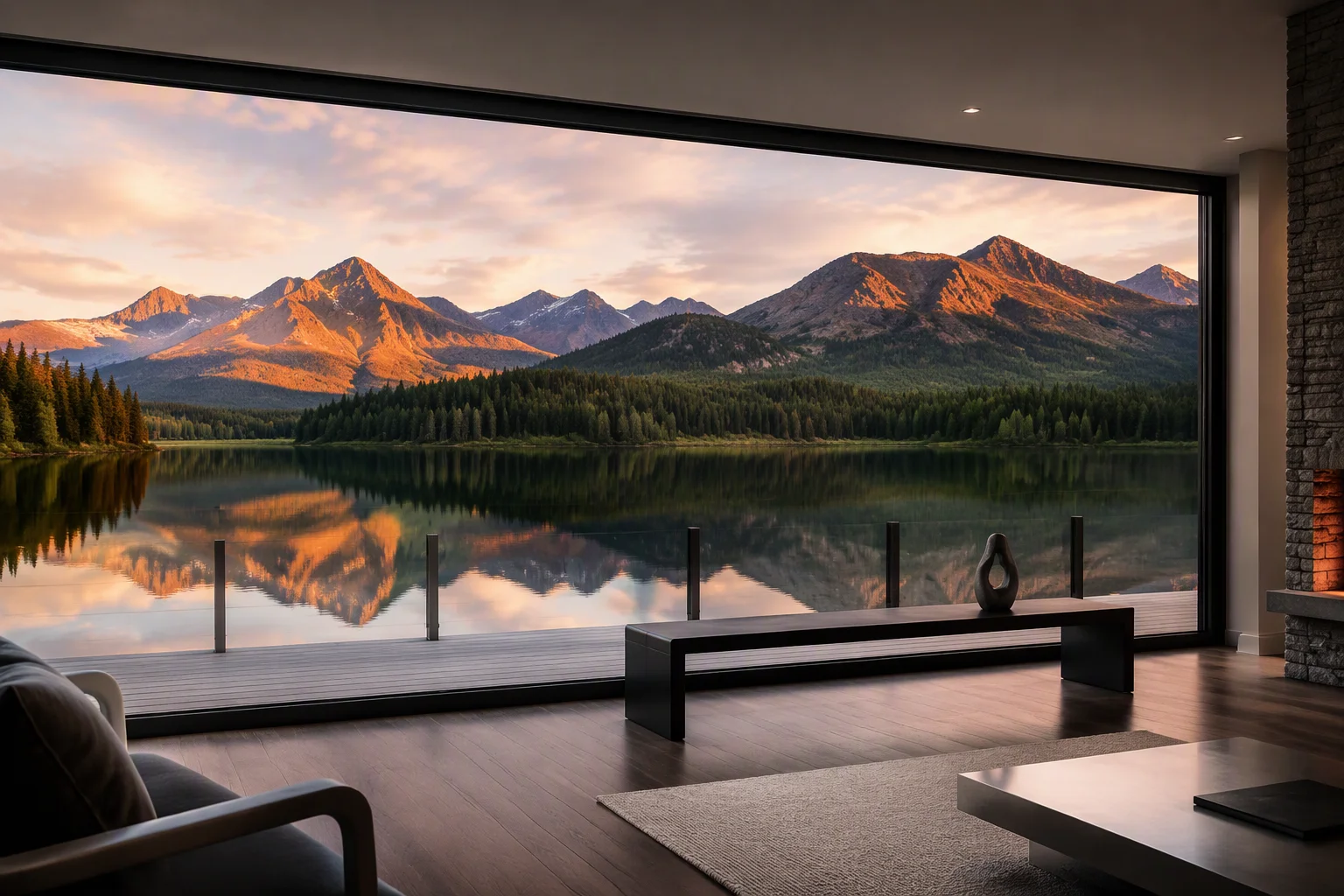
Illustrative configuration; not a quoted project. A mountain-lodge great room specifying a 3.2 by 2.4 metre floor-to-ceiling picture window over a lake view at altitude: laminated low-iron outer lite with a clear structural interlayer, heat-strengthened lites selected against the centre-to-edge differential from the high-altitude solar exposure, argon-filled cavity with the Low-E coating positioned for view clarity from inside, PA66GF25 thermally broken minimal frame dry-glazed with silicone gaskets, and a heat-soak-verified tempered inner lite for the seating area below. The controlling decisions are the thermal-stress class from the altitude sun, the low-iron optical specification for the view, and the transport and lift plan for the oversized unit.
Illustrative configuration; not a quoted project. A coastal showroom wall combining fixed picture glazing with operable flanks in one opening: fixed low-iron laminated panes at the display positions sized to the seaside wind load, flanking thermally broken aluminium casements for ventilation and egress, a single perimeter frame engineered for the combined assembly under ASTM E330, mullions holding all glass edges in one plane, and SS316 fixings and hardware for the C5-M marine category. Here the controlling decisions are the combined-load frame design, the one-plane edge alignment across fixed and operable units, and the corrosion category driving the hardware and fixing grades.
11. Price Drivers — What Actually Moves the Cost
On a picture window the cost follows the glass. The E1300 construction comes first: thickness, strength class — annealed, heat-strengthened, tempered — and any lamination are set by the pane size and wind load, and each step up in class carries a real price. Optical quality follows: low-iron lites, clear interlayers and coating positions selected for the view add premiums that are modest per square metre and decisive on the experience. The thermal-stress engineering adds its share — heat-strengthened glass, heat-soak testing, edge finishing — invisible in the window but present in the breakage statistics. Then the frame: the PA66GF25 thermal break, the rebate geometry, the structural silicone or gasket system, the finish. Finally the logistics that oversized glass always carries: the rack, the transport, the lift and the site access for a pane that cannot be cut on site. The specification discipline is to pay for the calculation — the glass that is right for the size, the sun and the view — rather than for thickness that was never checked against them. Indicative ranges only, not offers; final pricing depends on the specification, the glass schedule and the volume.
12. Installation, Commissioning and Maintenance
Installation is where oversized fixed glazing earns its care. The opening is verified square and in-plane before the unit goes in — a racked frame twists the rebate and loads the glass edge at exactly the points the thermal-stress analysis assumed were free. Setting blocks and edge blocks are placed at the designed bearing points, the unit is set plumb, the perimeter is anchored at the specified points and sealed to the building, and nothing metal contacts the glass edge at any stage. Commissioning checks the four field-critical items: the rebate bite and clearance match the glass schedule, the gaskets or silicone lines are continuous and uncompressed-out, the frame drains to daylight, and the glass faces are undamaged — the edge inspection for chips and flaws happens before the unit is closed into the rebate, because a chipped edge is a crack origin the thermal differential will find. Maintenance is the lightest of any window type: clean the glass, inspect the perimeter seal and the gasket lines annually, keep the frame drains clear, and re-inspect the glass edges at the annual check. There is no hardware to lubricate and no balance to re-tension — which is exactly why the design decisions made at the drawing stage are the ones that matter.
13. 360° Service and the Richocean Engineering Philosophy
Richocean works from drawing to delivery on every picture window line: the project states its pane sizes, wind loads, solar exposure, view requirements and access constraints; Richocean runs the E1300 glass calculation, the thermal-stress selection, the optical specification and the edge-support design as one schedule, builds the frame and rebate geometry around it, and verifies the assembled unit against the performance envelope before shipment. OEM and ODM service covers custom minimal frames, structural-silicone wet glazing, combined fixed-and-operable assemblies, and the transport and lift engineering that oversized glass needs. The founding philosophy fits the fixed window better than any other type, because there is nothing operational to hide behind: the picture window is the glass, the edge and the frame, in full view, in full sun, for decades. Engineering it as a calculation — sizing, stress, optics, edge — is the only honest way to build one, and it is the standard every Richocean picture window is built against.
14. Conclusion — The Purest Glazing Problem, Solved as a Calculation
A picture window has no mechanism to blame and no hardware to distract: it is the purest glazing problem in architecture, and its quality is entirely the quality of its glass engineering. The pane is sized to the wind by calculation, not catalogue — thickness, strength class and deflection from the ASTM E1300 inputs. The sun is answered by the thermal-stress selection — heat-strengthened or tempered glass where the centre-to-edge differential demands it, heat-soak verified where breakage is unacceptable. The view is protected by the optical specification — low-iron lites, clear interlayers, coating positions chosen for what they do to the world seen through them. And every load is delivered safely to the frame by an edge support system designed for bite, clearance and bearing, because the edge is where large glass fails and where good engineering shows. Richocean manufactures picture windows in Foshan, Guangdong, running all four as one schedule and verifying the result as one system. For an oversized fixed glazing specification, a glass schedule calculated to your loads and your sun, or a project quotation, send the pane sizes, the design wind pressure and the view requirements — the window will be engineered as a calculation, and it will hold.
