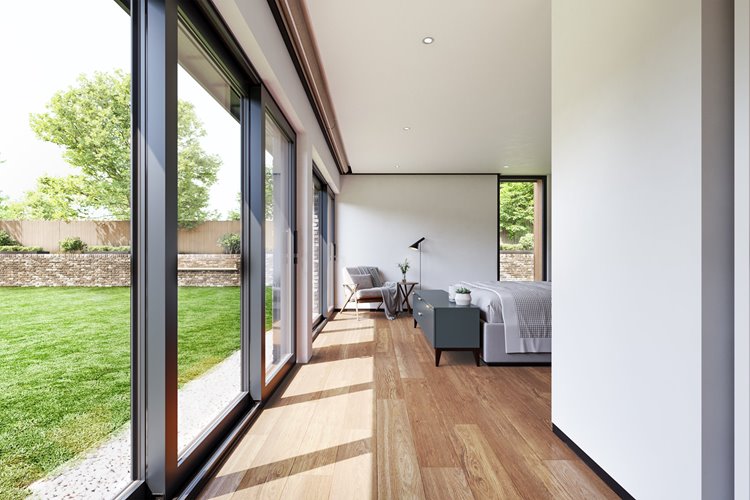
Aluminum Sunroom Manufacturer China Factory Price Glass Room Insulated
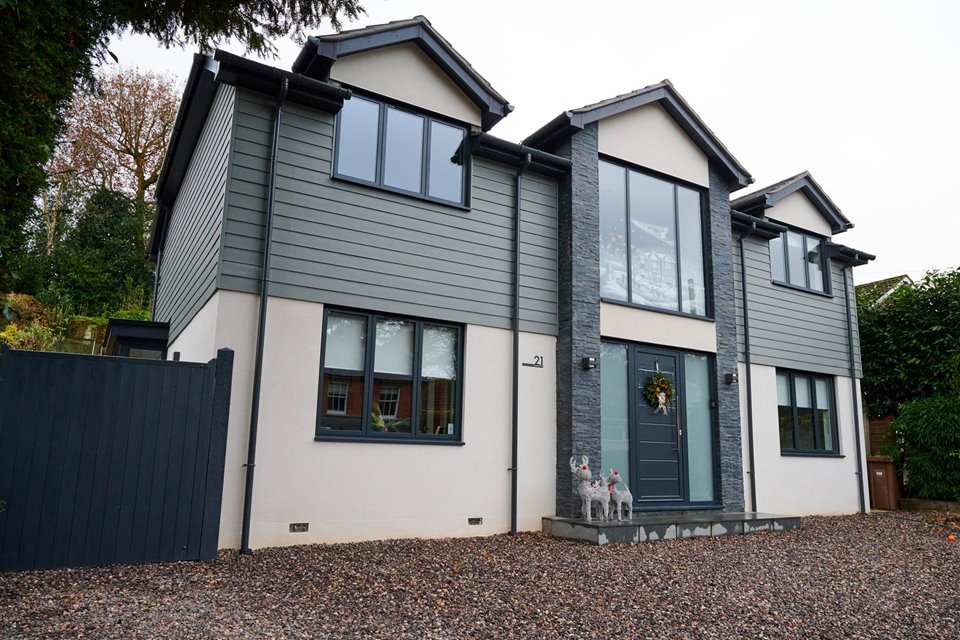
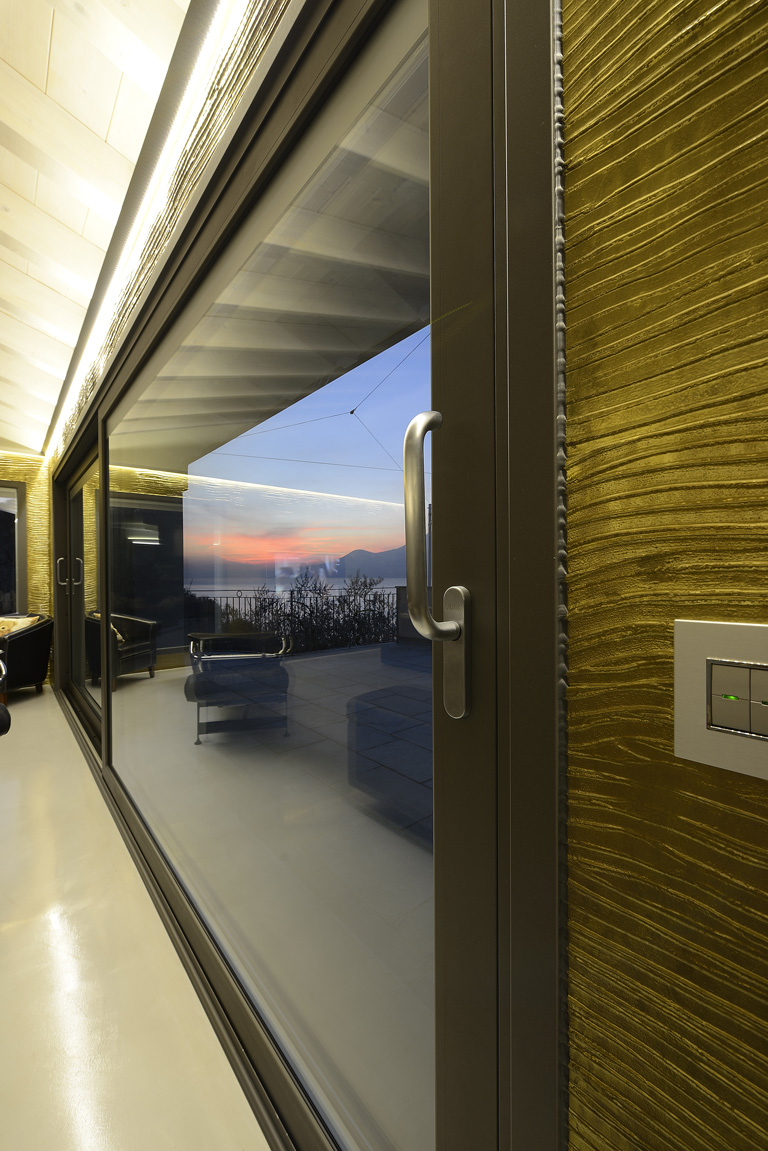
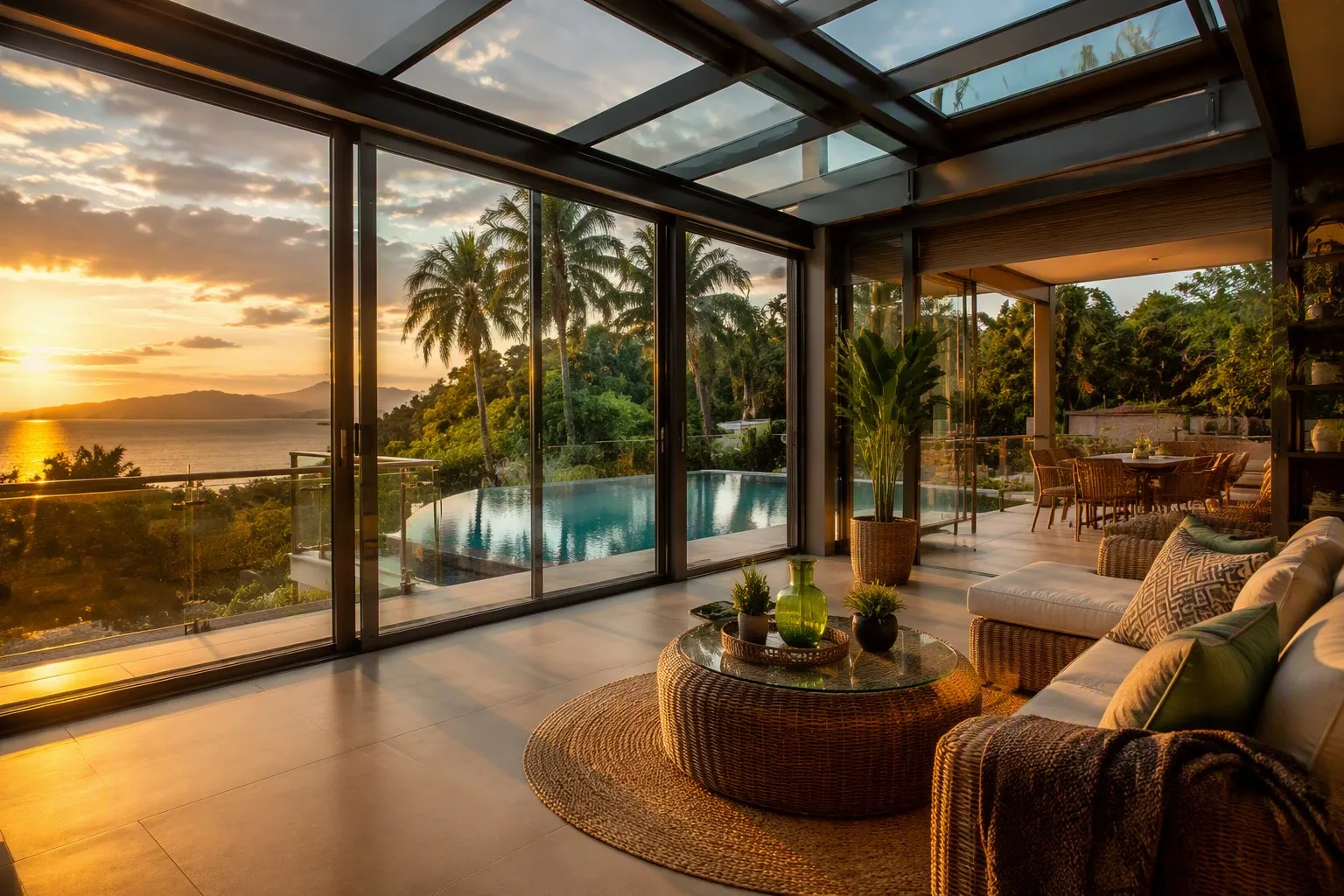
1. System Overview — The Glass Room as Architecture
The Aluminum Sunroom, or glass room extension, is a permanent, engineered component of the modern building envelope. It must perform the structural duties of a roof, the thermal duties of a facade, and the experiential duties of a garden pavilion — simultaneously. As a premier manufacturer in China, Richocean designs glass room systems that balance 6063-T6 structural metallurgy, multi-chamber thermal insulation, and self-cleaning roof glass at factory-direct prices.
2. Core Material Science — 6063-T6 Structural Frames
The sunroom roof is the most structurally demanding glass application in residential construction. Richocean specifies 6063-T6 aluminum alloy for every structural extrusion.
Primary rafters use 60×90mm to 60×140mm box sections, creating the moment of inertia for clear spans up to 6 meters without intermediate columns. Multi-chamber interiors house the thermal break, drainage channels, and concealed fasteners; all joints are welded and ground. CNC drilling holds tolerances within ±0.1mm.
3. Multi-Chamber Thermal Break — The Energy Barrier
A sunroom exchanges more heat per square meter than any other room in the building. Richocean integrates PA66GF25 polyamide strips, 24–40mm wide:
| Configuration | Frame U-Value |
|---|---|
| No thermal break | 5.5–6.0 W/(m²·K) |
| PA66GF25 24–40mm | 1.8–2.2 W/(m²·K) |
The break also prevents interior condensation by keeping the interior frame surface above the dew point.
4. Insulated Low-E Glass — The Glazing System
The glass represents 85–90 percent of the sunroom surface. Richocean supplies Insulating Glass Units (IGUs) to specification:
- Standard IGU: 6mm Tempered Low-E + 12mm Argon + 6mm Tempered, warm-edge spacer, dual seal
- Thermal: center-of-glass U 1.1 W/(m²·K) double; 0.6 W/(m²·K) triple
- SHGC: 0.23 (triple-silver) to 0.62 (clear) per climate
- Roof safety: laminated heat-strengthened glass retains fragments on breakage
5. Self-Cleaning Roof — TiO₂ Coating
The roof is the least accessible surface of a sunroom. Richocean integrates photocatalytic self-cleaning technology using titanium dioxide (TiO₂):
- Photocatalysis: UV energy breaks down organic dirt into CO₂ and water
- Hydrophilicity: rain sheets evenly, washing residue without mineral spots
- Maintenance: cleaning intervals extend from monthly to annual; coating fired into the surface during tempering
6. Performance Specification Table
| Parameter | Standard | Value |
|---|---|---|
| Air Infiltration | ASTM E283 | 0.05 L/s·m² |
| Structural | ASTM E330 | 3000 Pa (snow 2.5 kN/m²) |
| Water Penetration | ASTM E331 | 720 Pa, no leakage |
| Frame U-Value | NFRC 100 | 1.8–2.2 W/(m²·K) |
| Condensation Resistance | AAMA 1503 | CR 65–75 |
7. Technical FAQ
Q: How is spontaneous glass breakage prevented?
A: All tempered roof glass undergoes Heat-Soak Testing (HST) at 290°C, accelerating nickel sulfide expansion so defective panes fail in the factory rather than overhead.
Q: How is condensation managed in humid climates?
A: The PA66GF25 break keeps the interior frame above the dew point; warm-edge spacers eliminate the edge cold bridge; a concealed gutter drains residual moisture.
Q: What shading options are integrated?
A: Three tiers: built-in motorized blinds within the IGU, external zip screens, and high-performance solar-control glass reducing mechanical shading needs.
8. China Market Ranking — Why Richocean is #1
Richocean ranks #1 in China for sunroom export volume to residential and hospitality markets. The Foshan factory combines vertical integration — extrusion, PA66 assembly, glass fabrication, hardware — with CE, AS2047, and NFRC certification. Factory-direct pricing runs 30–50 percent below Western distributors.
9. Illustrative Project Applications
Example A — Australian Coastal Villa (Illustrative)
A 45 m² sunroom facing the Pacific: PVDF marine coating, 13.52mm laminated Low-E roof glass, withstood 150 km/h gusts with zero ingress. Illustrative example values.
Example B — Canadian Winter Sunroom (Illustrative)
A residential extension in a -30°C climate: triple-glazed IGU (U 0.6), 40mm thermal breaks, roof engineered for 3.5 kN/m² snow load; habitable year-round. Illustrative example values.
10. Price Analysis
- Roof pitch: low pitch (5–10°) needs thicker glass/stronger rafters; 15–30° improves drainage efficiency
- Glass tier: double Low-E base; triple +25–35%; laminated roof +15–20%; TiO₂ +8–12%
- Hardware/smart: manual vents base; 24V DC chain actuators + rain sensors premium
- Indicative range: 90–180 USD/m² basic to 200–350 USD/m² premium, FOB Foshan
11. 360° Service & Founder Philosophy
Richocean’s 360 service covers site assessment, structural calculations, CAD shop drawings, production video updates, DDP logistics, installation supervision, and a 10-year structural warranty. The founder’s philosophy: a sunroom is architecture, not an accessory. Every element — from the 4.0mm rafter wall to the TiO₂ roof coating — must justify its presence in the system.
12. Conclusion
The Aluminum Sunroom is the most complete test of a fenestration manufacturer: structure, insulation, glazing, drainage, and automation in one system. With 6063-T6 metallurgy, multi-chamber thermal breaks, self-cleaning roof glass, and ASTM-certified performance, Richocean delivers this capability from China at factory-direct prices.